
Nostalgia, Spirituality and Circe’s Final Triumph
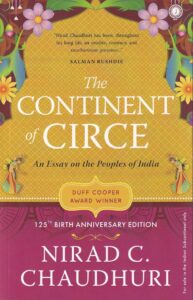
368 pages | English
Review & Analysis by Anil Saxena
Editorial Note
This is the third and concluding part of our analytical exploration of Nirad C. Chaudhuri’s The Continent of Circe. If Part I traced the historical foundations of his thesis and Part II examined what he believed to be the psychology of the Hindu mind, this final installment explores Chaudhuri’s most speculative and controversial ideas on nostalgia, Hindu philosophy, spirituality, sexuality, minorities and the legacy of India’s Anglicized elite.
As with the earlier parts, this essay is not an endorsement of Chaudhuri’s views. It is a chapter-by-chapter presentation and critical analysis of his arguments, with occasional editorial observations for context and balance. Many of his interpretations reflect the intellectual climate of the 1960s and remain subjects of vigorous debate among historians, archaeologists, anthropologists and scholars of religion.
Readers are encouraged to approach this concluding essay not as a statement of historical fact, but as an engagement with one of the most original, provocative and intellectually challenging books ever written on India. Whether one ultimately agrees with Nirad C. Chaudhuri or not, few readers can finish The Continent of Circe without questioning some of their own assumptions about Indian civilization.
– Rohit Tokhi
From Climate to Memory
In the previous part of this series, we arrived at what is perhaps the central pillar of Nirad C. Chaudhuri’s thesis. He argued that the defining force in the making of Hindu civilization was neither race, religion nor politics, but the tropical environment of the Indian subcontinent. According to him, successive waves of settlers—the Aryans first and, much later, the British – were gradually transformed by the land they inhabited. In Chaudhuri’s imagination, India itself became Circe, the enchantress who slowly altered the character of all who entered her realm.
The remaining chapters of The Continent of Circe take this argument into even more speculative territory. Having explained how Hindus became what they are, Chaudhuri now asks another intriguing question: what memories did they never lose? He believes that beneath the customs, rituals and beliefs of Hindu society lies an unconscious nostalgia for an earlier homeland—a world that the Aryans left behind but never entirely forgot.
This is also the most unconventional portion of the book. Chaudhuri leaves the relatively firmer ground of history and increasingly ventures into cultural psychology, symbolism and civilizational memory. Some of his observations are remarkably original; others appear highly conjectural. Yet throughout these chapters, one encounters the same restless and provocative intellect that refuses to be confined by academic orthodoxy.
As before, the purpose of this essay is not to defend every conclusion Chaudhuri reaches. Many of his arguments remain contested, and some are difficult to reconcile with modern historical or archaeological research. Nevertheless, his interpretations deserve to be understood on their own terms, for they reveal not only his understanding of India but also the extraordinary originality of his own mind.
Nostalgia for the Forgotten Home (Chapter 7)
One of the most fascinating ideas in The Continent of Circe is Chaudhuri’s belief that civilizations, like individuals, possess memories that outlive the events themselves. According to him, the Aryans who migrated into the Indian subcontinent did not merely bring their language, customs and religion. They also carried with them an emotional memory of the lands they had left behind. Although generations passed and those original landscapes faded from conscious recollection, fragments of that earlier world continued to survive in the collective imagination of Hindu civilization.
This nostalgia, Chaudhuri argues, explains much that later scholars have attributed to philosophy or religion. The melancholy that runs through many strands of Indian thought, the longing for liberation from worldly existence, and the repeated celebration of an idealized past are interpreted not as purely spiritual achievements but as psychological responses to displacement and environmental hardship. In his view, Hindu philosophy emerged less from serene contemplation than from the cumulative experience of living in a land whose climate gradually exhausted both body and spirit.
Here Chaudhuri parts company with many celebrated Orientalists. Western scholars often regarded the Upanishads, Vedanta and Buddhist philosophy as the highest expressions of humanity’s spiritual quest. Chaudhuri considers this interpretation profoundly mistaken. The philosophies did not create the Hindu temperament; rather, the Hindu temperament created those philosophies. Ideas, he insists, arise from lived experience, not the other way round.
His conclusion is deliberately unsettling. What later generations admired as sublime metaphysics was, according to him, often the intellectual expression of a civilization struggling against its physical environment. The longing for release from the cycle of existence, the emphasis on renunciation and the recurring sense that worldly life is inseparable from suffering are interpreted as reflections of a people gradually worn down by heat, disease, dust and the relentless pressures of tropical life.
Whether one accepts this explanation or not, it remains one of the boldest reversals in the entire book. Chaudhuri refuses to romanticize Indian philosophy. Instead of seeing it as evidence of extraordinary spiritual vitality, he often sees it as the consequence of diminished biological and psychological vitality. It is a conclusion that many readers, both Indian and Western, will undoubtedly reject. Yet it also demonstrates Chaudhuri’s determination to question even the most deeply entrenched assumptions about India.
The Gangetic Plain and the Burden of Climate
To support his thesis, Chaudhuri paints a vivid picture of the Indo-Gangetic plain. For him, this immense landscape is not merely a geographical feature but an active force in history. Endless heat, choking dust, torrential monsoons, humidity and recurring floods combined to create an environment that tested human endurance across generations. Even the first rains, so eagerly awaited after months of scorching heat, brought with them overflowing drains, disease and decay.
He observes that travellers from Babur to Kalidasa commented on the harshness of the Indian climate. Dust storms, blazing summers and oppressive humidity recur throughout classical literature. Modern Indians, he remarks with characteristic irony, continue to seek relief through coolers, ice and every possible escape from the heat, suggesting that even after millennia they have never truly become reconciled to their environment.
From this observation he constructs another imaginative parallel. Just as the British escaped to the hill stations during the summer months in search of familiar weather, the ancient Aryans too retained an emotional attachment to mountains and cooler landscapes. The Himalayas acquired an almost sacred significance in Hindu thought—not merely as the abode of Shiva but as symbols of an environment fundamentally different from the plains where most Hindus actually lived.
Chaudhuri notices that Kalidasa’s descriptions of the Himalayas overflow with joy and admiration, while the plains rarely inspire similar enthusiasm. To him, this preference reflects something deeper than literary taste. It represents an unconscious longing for landscapes resembling those once inhabited by the Aryans before their migration into India. The mountains become not only places of spiritual pilgrimage but also symbols of a forgotten home.
A Challenge to Hindu Spirituality
Perhaps nowhere does Chaudhuri provoke more controversy than in his assessment of Indian philosophy itself.
He dismisses the widespread belief that Hindu spirituality represents the highest achievement of human thought. The West, he argues, projected its own spiritual longings onto India and then mistook those projections for reality. Ordinary Hindus, in his opinion, were seldom preoccupied with abstract metaphysics. Their reverence was reserved not for philosophers but for miracle-working sadhus, occult practitioners and holy men believed capable of providing practical benefits in everyday life.
He is particularly dismissive of attempts to discover profound metaphysical meanings where simpler explanations would suffice. Gautama Buddha’s renunciation, which millions regard as one of history’s greatest acts of spiritual courage, is interpreted by Chaudhuri as an expression of biological exhaustion rather than transcendence. The Sankhya system’s preoccupation with suffering appears to him as further evidence of a civilization overwhelmed by its environment. Even Shankaracharya, whose philosophy he considers more affirmative than many others, ultimately arrives at definitions of ultimate reality through negation – neti, neti (“not this, not this”) – which Chaudhuri sees as another form of withdrawal from the material world.
These judgments are among the most controversial in the entire book, and many readers will find them impossible to accept. Indeed, one may reasonably disagree with Chaudhuri without diminishing the significance of the philosophical traditions he criticises. Countless thinkers across cultures have found genuine intellectual and spiritual depth in Vedanta, Buddhism and other Indian systems of thought.
Yet Chaudhuri’s target is not merely Indian philosophy itself. He is equally critical of Western admirers who transformed India into a mystical paradise while overlooking the lived reality of its people. His quarrel is as much with romantic Orientalism as it is with Hindu self-perception.
By the close of this chapter, one begins to appreciate the consistency of Chaudhuri’s method. Every institution, every belief and every philosophical system is ultimately brought back to the same question: what kind of environment produced this way of thinking? Whether discussing politics, religion or culture, he continually searches for material and historical causes beneath metaphysical explanations.
The next chapter develops this argument in a fascinating new direction. Chaudhuri identifies four enduring cultural obsessions – the Vedas, fair complexion, rivers and cattle – and argues that each of them represents an unconscious memory carried across centuries from a world that the Aryans had long since left behind.
Auld Lang Syne: The Four Great Obsessions (Chapter 8)
If the previous chapter attempted to explain the psychological origins of Hindu civilization, Chapter Eight explores what Chaudhuri considers its deepest cultural memories. The title, Auld Lang Syne, literally means “times gone by” or “days long past.” Chaudhuri borrows it deliberately, for he believes that Hindu civilization has never completely forgotten its distant past. Long after the Aryans settled in India, they continued to preserve fragments of an earlier world, often without consciously realizing why those memories endured.
According to Chaudhuri, four enduring features of Hindu civilization reveal this unconscious nostalgia more clearly than anything else. These are the reverence for the Vedas, the preference for fair complexion, the sacredness of rivers, and the emotional attachment to cattle. To him, these are not isolated cultural practices. They are echoes of a forgotten homeland, preserved across centuries even after their original context had disappeared.
Whether one accepts this thesis or not, it is one of the most imaginative sections of The Continent of Circe. Here Chaudhuri moves beyond conventional history and enters the realm of cultural memory, attempting to explain not simply what Hindus believe, but why certain beliefs acquired such enduring emotional power.
The Vedas: Memory Rather Than Living Tradition
Chaudhuri begins with the Vedas, which occupy an unparalleled position in Hindu civilization. Yet his interpretation is anything but conventional.
He argues that the Vedas survive today less as living religious texts and more as objects of civilizational reverence. Most Hindus, he points out, do not study them as devotional literature. Their hymns are rarely read by ordinary believers in the way sacred texts are read in many other religions. Instead, portions of the Vedas continue to be recited during rituals, marriages and other ceremonies, often without any detailed understanding of their original context.
For Chaudhuri, this reverence resembles the preservation of an ancient inheritance rather than the continuation of an active intellectual tradition. He goes so far as to describe the Vedas as museum pieces, treasured because of their antiquity rather than because they shape the daily religious life of most Hindus.
He is equally sceptical of modern attempts to discover every conceivable scientific achievement within Vedic literature. The tendency to claim that all modern inventions were already anticipated in the Vedas appears to him less as scholarship than as a manifestation of cultural insecurity. Respect for the Vedas, he argues, should not depend upon exaggerated claims about their scientific content.
One of his most controversial assertions follows naturally from this line of reasoning. Chaudhuri suggests that significant portions of the Rigveda took shape before the Aryans entered India, locating their origins in the wider cultural world of Upper Mesopotamia. Whether modern scholarship supports this conclusion is another matter, but within his own framework it reinforces the central idea that the Vedas represent memories carried into India rather than creations that originated entirely within it.
Fair Complexion and the Memory of Race
The second obsession concerns complexion.
Chaudhuri argues that although the Aryans gradually became darker through centuries of settlement and intermixture, their preference for fair skin never disappeared. What survived was not racial purity but cultural memory. Beauty continued to be associated with fairness long after the physical distinctions between conquerors and conquered had become blurred.
He notes that the Sanskrit word varna also denotes colour, and he links this linguistic association with the historical importance attached to lineage and endogamy. In his view, strict rules governing marriage within caste were originally intended to preserve distinctions that the Aryans considered important. Over time these distinctions hardened into social conventions whose original purpose was forgotten.
Chaudhuri does not spare modern India from criticism either. He points to the irony of Indians protesting racial discrimination abroad while simultaneously maintaining deep prejudices regarding complexion at home. Fair skin, he observes, continues to enjoy a privileged place in conventional standards of beauty, despite centuries of racial and cultural mixing.
Modern readers may find parts of this discussion dated, especially in light of contemporary genetics and anthropology, which reject the old racial categories employed by Chaudhuri and many earlier scholars. Nevertheless, his observations on colour consciousness remain thought-provoking because they draw attention to a social preference that continues, in varying degrees, to exist across large sections of the subcontinent.
Rivers: Geography Turned Sacred
The third object of nostalgia is the river.
For Chaudhuri, the reverence shown to rivers in Hindu civilization cannot be explained solely by religion. He believes it reflects a much older attachment carried by migrating peoples from the river systems of their earlier homeland. The Danube, Volga, Don, Dnieper, Tigris and Euphrates formed part of the geographical memory of the Aryans long before they encountered the Indus, the Ganga and the Yamuna.
As they moved eastward, rivers retained their emotional significance even though the names and landscapes changed. Eventually the great rivers of India became sacred, not merely because they sustained life but because they resonated with an inherited cultural memory of flowing water as the centre of civilization.
Chaudhuri sees the Kumbh Mela as one of the most striking expressions of this attachment. Millions gather to bathe in sacred rivers believing that immersion washes away sin. Whatever one’s theological understanding of the ritual, Chaudhuri interprets it as evidence that rivers occupy a place in the Hindu imagination far beyond their practical importance.
He also suggests that, as in many other aspects of Hindu civilization, an original emotional response gradually hardened into ritual. What may once have been an expression of genuine wonder before nature eventually became formalized into religious custom.
The Sacred Cow and the Burden of Contradiction
The fourth obsession is the cow, and here Chaudhuri’s pen becomes particularly sharp.
He fully acknowledges the immense importance of cattle in early Vedic society. For pastoral communities, wealth was measured in livestock. The gift of cattle was among the highest forms of generosity, and the prosperity of families depended directly upon their herds.
What puzzles him is the later transformation of this practical importance into an intensely emotional and religious attachment.
Chaudhuri does not hesitate to point out what he regards as one of the great contradictions of modern Hindu society. The cow is revered as sacred, yet abandoned cattle wander through streets eating refuse and plastic. Their protection often becomes a matter of passionate public debate, while their actual welfare is frequently neglected. Worship and indifference, he argues, exist side by side without apparent discomfort.
He also reminds readers that ancient Indian texts contain evidence both for the protection of cattle and for the ritual slaughter of cows on particular occasions. The Mahabharata, for instance, refers to royal feasts involving large numbers of cattle. Such passages are often dismissed by modern interpreters or explained away, but Chaudhuri believes they reveal a far more complex historical reality than later orthodoxy is willing to acknowledge.
His conclusion is characteristically provocative. In his view, Hindus eventually transformed a sensible economic sentiment into a sacred religious principle because they possessed a remarkable tendency to sacralize everyday life. Whether discussing rivers, cattle or ancient customs, ordinary practices gradually acquired religious significance until questioning them became almost impossible.
By the end of this chapter, Chaudhuri has identified four enduring symbols that, in his opinion, connect modern Hindu civilization with a forgotten past. The next chapter shifts from memory to behaviour, exploring what he calls the spirit of defiance that expresses itself through asceticism, self-mortification and the extraordinary reverence shown to holy men who reject the ordinary comforts of life.
The Defiance: Asceticism and the Hindu Temperament (Chapter 9)
Having explored the memories that, according to him, continued to shape Hindu civilization, Chaudhuri now turns to one of its most striking behavioural traits. Why does a civilization that prizes cleanliness also revere ash-smeared ascetics? Why do people living amid intense heat willingly embrace even greater physical hardship? Why are self-denial and self-mortification so often regarded as signs of spiritual greatness?
His answer is both original and controversial.
According to Chaudhuri, life in a tropical environment inevitably confronted people with dust, dirt, heat and discomfort. Since many of these hardships could never be completely overcome, two parallel responses emerged. One was to fight them through elaborate rules of ritual purity and cleanliness. The other was to defy them altogether.
This spirit of defiance, he argues, gradually became one of the defining characteristics of Hindu asceticism.
If dust cannot be avoided, then smear it over the body. If unbearable heat is unavoidable, then sit amid blazing fires. If discomfort is inevitable, embrace it willingly. What begins as necessity eventually becomes virtue. The act of enduring suffering acquires moral prestige.
For Chaudhuri, this explains the extraordinary respect traditionally accorded to ascetics who reject ordinary comforts. The naked sadhu, the yogi lying on a bed of spikes, the hermit who lives in extreme austerity, all represent not merely religious devotion but a conscious challenge to the world around them. Their suffering is transformed into a public declaration of mastery over circumstance.
The Cult of the Holy Man
One of Chaudhuri’s recurring observations is that ordinary Hindus have historically shown greater fascination with miracle-working holy men than with philosophers.
The West often celebrates India as the land of profound metaphysics, but Chaudhuri believes this image is largely a romantic construction. In everyday life, he argues, people are drawn less to abstract speculation than to visible demonstrations of supernatural power.
Ascetics who undertake extraordinary penances, saints reputed to perform miracles and wandering holy men believed to possess occult abilities often command immense reverence. Their authority rests not upon philosophical argument but upon the belief that they have acquired powers unavailable to ordinary mortals.
Chaudhuri sees this as another consequence of a civilization shaped by uncertainty and hardship. Where rational means appear insufficient to overcome life’s difficulties, supernatural intervention naturally becomes attractive. Doctors, priests, astrologers and miracle-workers frequently coexist without contradiction because each addresses a different aspect of human anxiety.
He is particularly sceptical of attempts to cloak such practices in sophisticated philosophical language. In his opinion, much of what later commentators describe as profound spirituality is, at a more practical level, an appeal for relief from suffering, illness, misfortune or insecurity.
Penance as Public Virtue
The tradition of penance receives similar treatment.
Throughout Indian history, fasting, austerity and self-denial have been associated with moral authority. Kings performed penance before major undertakings. Women observed fasts for the welfare of husbands and families. Ascetics subjected themselves to prolonged physical hardship in pursuit of spiritual merit.
Chaudhuri does not deny the sincerity of these practices. What he questions is their origin.
He suggests that prolonged exposure to an unforgiving environment gradually produced a culture that elevated endurance itself into an ideal. Suffering ceased to be merely an unavoidable condition of life and became something worthy of admiration.
Even in modern India, he observes, political leaders frequently organize public rituals, yajnas and religious ceremonies during times of national crisis. Rational administration and ritual observance often proceed side by side without either being seen as incompatible.
For Chaudhuri, this coexistence illustrates yet another contradiction within the Hindu mind. Practical action and supernatural expectation do not compete. They reinforce one another.
Contradictions Without Embarrassment
Perhaps the most striking feature of Chaudhuri’s analysis is his insistence that Hindus rarely feel compelled to resolve contradictions.
A society may simultaneously value ritual cleanliness and celebrate ash-covered ascetics. It may respect scientific education while consulting astrologers. It may seek medical treatment while performing religious ceremonies for recovery. To many Western observers, these combinations appear inconsistent.
Chaudhuri argues that the Hindu mind experiences no such discomfort. Contradictory attitudes coexist naturally because they serve different emotional and cultural needs.
Whether this diagnosis is convincing is open to debate. Yet it remains consistent with the larger argument he has been developing throughout the book. Again and again, he returns to the same conclusion: Hindu civilization cannot be understood solely through theology, philosophy or politics. One must also account for geography, climate, historical experience and the peculiar ways in which societies adapt to prolonged adversity.
The next chapter takes this argument into territory that is perhaps the most controversial in the entire book. Chaudhuri examines Hindu attitudes towards sexuality, arguing that eroticism, asceticism and spirituality are not opposing forces but interconnected responses within the same civilization. His observations on the Kamasutra, temple sculpture and Sanskrit literature remain among the boldest and most debated sections of The Continent of Circe.
The Anodyne: Sex, Spirituality and the Tropical Mind (Chapter 10)
This is undoubtedly one of the longest, boldest and most provocative chapters in The Continent of Circe. It is also the chapter where Nirad C. Chaudhuri writes with the greatest freedom, combining literary criticism, history, psychology and social observation in equal measure. Whether one agrees with him or not, it is impossible to accuse him of timidity.
Chaudhuri begins with what appears to be a paradox. Hindu philosophy, he argues, repeatedly urges man to transcend the world, deny desire and seek liberation from worldly existence. Yet Hindu society itself has always displayed an extraordinary openness towards sexuality. Instead of treating these two tendencies as contradictory, he believes they developed together.
According to him, the very philosophies that denied the material world left ordinary people searching for relief within it. If the highest metaphysical ideals culminated in renunciation or even the negation of worldly life, then the pleasures of the body naturally became one of the principal consolations available to human beings. Sexuality, therefore, was not merely instinct. It became what Chaudhuri calls an anodyne, something that eased the burdens imposed by climate, suffering and the frustrations of everyday existence.
He introduces the chapter with a striking Sanskrit maxim: “Verily, man is a creature devoted to penis and belly.” Characteristically, he refuses to veil biological realities behind spiritual language. Hunger and sex, he reminds us, are among the most basic human impulses, and civilizations build their moral systems around them rather than escape them.
The Erotic World of Ancient India
Chaudhuri rejects the popular belief that ancient India was prudish or sexually repressed.
On the contrary, he argues that Vedic literature, the epics and classical Sanskrit poetry reveal a society that accepted sexuality as a natural part of life. The gods themselves were hardly ascetics. Indra appears repeatedly as a seducer. Many sages, despite their reputation for spiritual discipline, are portrayed as vulnerable to desire at the mere sight of beautiful women.
For Chaudhuri, these stories reveal a civilization that neither denied nor demonized sexuality. Conjugal love, fertility and physical attraction were acknowledged openly. Later Sanskrit literature, especially the works of Kalidasa and Bhavabhuti, refined these themes into some of the most sophisticated erotic poetry ever produced.
He makes an important distinction here.
While classical Sanskrit literature was deeply sensual, it was rarely pornographic. Its descriptions of love were governed by literary restraint and aesthetic taste. Explicit anatomical detail was generally avoided, and emotional nuance often took precedence over physical description. Chaudhuri considers this refinement one of the great achievements of classical Indian literature.
In fact, he boldly claims that Sanskrit erotic poetry surpasses much of the erotic writing produced in other civilizations because it combines sensuality with artistic discipline.
Temple Sculpture Without Mystification
Perhaps nowhere is Chaudhuri more uncompromising than in his discussion of the famous erotic sculptures adorning many medieval temples.
Over the years, numerous scholars have attempted to explain these carvings as symbolic representations of cosmic energy, Tantric philosophy or spiritual union. Chaudhuri finds many of these interpretations unnecessarily elaborate.
His preferred explanation is disarmingly simple.
The sculptures depict human sexuality because sexuality formed an accepted and visible part of life. Temples, he reminds us, were not merely places of worship. They were centres of social, cultural and even commercial activity. Music, dance, festivals and entertainment often surrounded them. Erotic sculpture therefore requires no hidden metaphysical code to justify its existence.
He also points out that the Sanskrit word mandira simply means “house,” and deva mandira means “the house of God.” The deities inhabiting these temples were imagined not as abstract theological entities but as divine kings, surrounded by every aspect of royal life. If kings lived amid music, dancers, festivals and sensual pleasures, their divine counterparts naturally did the same.
Attempts to discover profound religious symbolism in every erotic carving, Chaudhuri believes, often reveal more about modern embarrassment than medieval intention.
This is one of those moments where his literary instinct is particularly persuasive. Instead of multiplying explanations, he prefers the most direct one unless compelling evidence suggests otherwise.
The Decline of Vitality
Yet beneath his admiration for classical Sanskrit literature lies another of his characteristic theories.
He believes that sexual vitality itself declined over the centuries.
The Vedic age, in his description, burned with vigorous energy. The classical age retained elegance and refinement, though the fire had moderated. By the medieval period, the flame had become little more than glowing embers. Works such as the Kamasutra, he argues, were attempts not to celebrate a flourishing sexuality but to revive one that had already begun to weaken.
Here again, Chaudhuri attributes long-term decline to the same force that dominates the entire book: climate.
Generation after generation, the tropical environment gradually diminished physical vitality. The civilization responded by codifying erotic practices, refining techniques and elevating the aesthetics of love, but these were ultimately compensatory measures rather than signs of increasing vigour.
Whether this sweeping conclusion convinces the reader is another matter. Modern scholarship would certainly question such deterministic explanations. Nevertheless, within Chaudhuri’s broader framework, the argument remains internally consistent.
A Critique of Both East and West
As throughout the book, Chaudhuri criticizes both Indians and Western admirers with equal enthusiasm.
He ridicules Western readers who discover mystical secrets in every aspect of Indian erotic art. Equally, he mocks Indians who retrospectively invent spiritual explanations simply to avoid acknowledging the obvious presence of sexuality in their own cultural history.
To him, neither extreme is satisfactory.
Sexuality need not be disguised as metaphysics, nor should spirituality be reduced entirely to sexuality. Ancient Indian civilization possessed room for both without feeling obliged to merge them artificially.
His impatience with intellectual fashion is also evident in his dismissal of D. H. Lawrence’s Lady Chatterley’s Lover. Far from considering it a masterpiece of erotic literature, Chaudhuri treats it as an overpraised expression of lower middle-class prejudice against aristocratic morality. Such comparisons reveal both his confidence and his willingness to challenge accepted literary reputations.
By the end of this remarkable chapter, one recognizes once again Chaudhuri’s refusal to romanticize India. Whether discussing philosophy, religion or sex, he consistently seeks explanations rooted in history, biology and lived experience rather than comforting myths.
The next chapter turns from the body to the mind. It introduces one of Chaudhuri’s most memorable concepts, Hindu Acedia, a condition of mental and physical inertia which, in his view, explains many of the habits, frustrations and contradictions of everyday Indian life.
The Hindu Acedia: Weariness as a Way of Life (Chapter 11)
Among all the ideas presented in The Continent of Circe, few are as memorable as Chaudhuri’s concept of Hindu Acedia. Borrowing the medieval Christian term acedia, meaning spiritual and mental listlessness, he uses it to describe what he believes is a deeply rooted condition of physical fatigue, emotional exhaustion and paralysis of will that has gradually become embedded in the life of Hindu society.
For Chaudhuri, this is not simply laziness. It is something far more pervasive.
Generation after generation, he argues, the oppressive climate of the Indo-Gangetic plain gradually corroded both body and mind. The result was a civilization in which energy steadily gave way to inertia, initiative yielded to resignation and enthusiasm slowly dissolved into habit. Once again, he traces a large cultural phenomenon back to the same central cause that runs throughout the book: the triumph of Circe.
Whether one accepts this diagnosis or not, the chapter is full of observations that are instantly recognizable because they arise not from abstract theory but from ordinary life.
The Everyday Face of Acedia
Chaudhuri has an extraordinary eye for small details.
He asks the reader to observe the neighbourhood shopkeeper, the railway booking clerk or the bank teller. Long queues gather before them, yet there is seldom any sense of urgency. Work proceeds at its own leisurely rhythm, almost untouched by the impatience of those waiting.
He notices the man descending from a crowded bus one step at a time while gripping both handrails, completely indifferent to the passengers waiting behind him. He recalls how, because he himself walked briskly through the streets, children mockingly called him “Johnny Walker.” To move quickly, to appear energetic or unusually purposeful, often invited ridicule rather than admiration.
These are small incidents, but Chaudhuri treats them as symptoms of a larger cultural condition. A society accustomed to inertia eventually begins to normalize it. What should appear exceptional gradually becomes ordinary.
Readers may smile at these examples, but many will also recognize the sharp observational skill behind them. Chaudhuri possessed an uncanny ability to elevate everyday habits into subjects worthy of cultural analysis.
The Culture of Complaint
Another feature of Hindu acedia, according to Chaudhuri, is a curious attachment to suffering.
He believes that people often exaggerate their difficulties, not merely to seek sympathy but because sorrow itself acquires social value. If a listener fails to respond with sufficient concern and instead remarks that things appear to be improving, disappointment may even turn into irritation.
This tendency, he suggests, creates a society that constantly dwells upon grievances while rarely examining its own contribution to them.
Scapegoats are always available. Husbands blame wives, wives blame husbands, neighbours blame one another, employees blame employers, politicians blame predecessors and citizens blame governments. Rarely does self-examination receive the same enthusiasm.
Here Chaudhuri’s prose becomes particularly sharp. He does not deny that genuine hardships exist. Rather, he criticizes what he sees as the habit of converting every disappointment into proof that someone else must bear responsibility.
The Hindu Family
Some of Chaudhuri’s most colourful observations concern family life.
He portrays the traditional Hindu household as a place where affection and hostility coexist with remarkable ease. Arguments over money, authority and inheritance may become fierce. Harsh words are exchanged. Old grievances are revived with astonishing precision. Every forgotten mistake is carefully retrieved whenever a quarrel erupts.
Yet, remarkably, life continues.
The same family members who spend an evening exchanging bitter accusations often resume their ordinary routines the next morning as though nothing significant had occurred.
Chaudhuri interprets this as another contradiction within the Hindu temperament. Alongside anger exists an equally strong instinct for accommodation. Resentment accumulates quickly, but so does forgiveness. Relationships survive not because conflicts are resolved, but because people develop an extraordinary capacity to live with unresolved tensions.
It is a perceptive observation, even if one feels that he occasionally paints with too broad a brush.
Happiness Viewed with Suspicion
One of the more unusual themes in this chapter is Chaudhuri’s suggestion that visible happiness itself sometimes attracts suspicion.
To appear unusually cheerful, energetic or well-groomed may invite teasing or criticism. Looking prosperous or healthy can provoke envy rather than admiration. Public displays of optimism are often treated as signs of superficiality, while visible suffering attracts sympathy and social legitimacy.
Chaudhuri extends this idea further.
He remarks that people frequently neglect their health until illness becomes serious. Wives, he suggests rather provocatively, sometimes ignore their own well-being until their condition becomes grave enough to make husbands feel guilty. Whether this reflects a broader social pattern or merely Chaudhuri’s personal observations is difficult to determine. Even sympathetic readers may find such generalizations overly sweeping.
Indeed, this chapter contains several moments where Chaudhuri’s confidence in his own conclusions exceeds the evidence he presents. Yet even here, his observations remain engaging because they arise from careful attention to human behaviour rather than ideological argument.
The Acid That Corrodes
The metaphor of acid gives the chapter its title and its emotional force.
According to Chaudhuri, acedia slowly corrodes the personality. It weakens initiative, dulls ambition and encourages resignation. Unlike sudden catastrophe, it works quietly over generations until an entire civilization begins to mistake weariness for normality.
It is one of the bleakest chapters in the book.
Yet there is also an unintended optimism hidden within it. By diagnosing what he believes to be the illness, Chaudhuri implicitly invites readers to resist it. His relentless criticism is never entirely destructive. Beneath the harshness lies an enduring conviction that societies improve only when they possess the courage to examine themselves honestly.
The remaining chapters shift away from the Hindu majority to examine India’s minorities, particularly Muslims, Anglo-Indians, Eurasians and the Anglicized Hindu elite. These chapters are among the most politically charged in The Continent of Circe and reveal Chaudhuri’s equally uncompromising views on nationalism, identity and the direction of post-Independence India.
Minorities, the Anglicized Elite and Circe’s Triumph (Chapters 12–14 & Epilogue)
In the closing chapters of The Continent of Circe, Chaudhuri shifts his attention from the Hindu majority to the various minorities and elite groups that emerged under successive political orders. These chapters are less concerned with climate or philosophy than with identity, power and the future of independent India. Yet the central argument remains unchanged. Every community, he insists, has been shaped by the peculiar forces of the Indian subcontinent, though each has responded differently.
The tone also becomes more political. Chaudhuri writes not merely as a historian or cultural critic but as an observer of post-Independence India, deeply dissatisfied with the intellectual and political direction the country had taken after 1947.
The Muslim Question
Chaudhuri approaches the Hindu-Muslim relationship with the same bluntness that characterizes the rest of the book.
He traces Muslim history in India from rulers to rebels during the Revolt of 1857, and later to political negotiation under British rule and the eventual demand for Pakistan. He argues that, despite centuries of coexistence, Hindus and Muslims retained distinct historical memories, social customs and political aspirations.
For Chaudhuri, the violence of Partition was not an accidental eruption but the culmination of tensions that had existed for generations. He remains unconvinced by romantic descriptions of perfect communal harmony and believes that successive governments often preferred comforting slogans to confronting difficult realities.
His observations closely resemble arguments later advanced by several writers across the ideological spectrum. At the same time, his analysis remains largely confined to the politics of the Muslim League and the Ashraf leadership. He pays comparatively little attention to the enormous diversity within Indian Muslim society, particularly the experiences of Pasmanda Muslims and other marginalized communities whose voices seldom shaped national politics.
This limitation does not necessarily invalidate his broader observations, but it does narrow the scope of his conclusions.
Anglo-Indians and Indian Christians
Chaudhuri next turns to communities that occupied uncertain positions within colonial society.
Anglo-Indians, he observes, were never accepted as equals by the British despite their cultural proximity. Many found employment in the railways, education and nursing, yet remained suspended between two worlds. After Independence, they faced the difficult task of adjusting to a nation in which the political and cultural order had fundamentally changed.
His discussion of Indian Christians is equally unsentimental.
He notes that many converts, especially from historically disadvantaged communities, embraced Christianity in search of equality and dignity. Yet conversion did not always erase social prejudice. Their former caste identities often continued to influence their social position, revealing the remarkable persistence of older hierarchies even after religious change.
As elsewhere in the book, Chaudhuri resists simple explanations. Political independence, religious conversion and constitutional equality, he argues, cannot by themselves erase historical habits that have developed over centuries.
The Dominant Minority
The sharpest criticism in these closing chapters is reserved not for any religious community but for what Chaudhuri calls the dominant minority.
These are the English-educated, urban, Anglicized Indians who inherited influence after Independence. Though small in number, they occupied positions of power in politics, administration, education and public discourse. In Chaudhuri’s view, they became the new ruling class of India.
He regarded Jawaharlal Nehru as both the finest representative and the principal patron of this elite.
To Chaudhuri, these men and women were culturally Western in manners, education and outlook, yet insufficiently rooted either in Indian traditions or in the lived realities of ordinary Indians. They spoke fluently about socialism, secularism, planning and internationalism, while remaining detached from the everyday concerns of the people they governed.
His criticism is not directed at English education itself. Few Indian writers possessed greater command over the English language than Chaudhuri. What he opposed was imitation without independence, admiration without discrimination and borrowed intellectual fashions replacing original thought.
He repeatedly returns to an accusation made earlier in the book. Modern Indian writing in English, he believes, too often looked towards London, New York or Paris for approval instead of speaking confidently in its own voice.
Circe’s Triumph
The epilogue brings Chaudhuri’s extraordinary argument to its logical conclusion.
If India is indeed the Continent of Circe, then the enchantress has triumphed.
The Aryans entered the subcontinent carrying memories of Europe and Western Asia. Over centuries they were transformed by climate, geography and historical experience until they became something entirely different from their ancestors. The British, despite all their confidence in racial and cultural superiority, underwent a similar transformation while ruling India. Even they, Chaudhuri argues, became impatient, authoritarian and psychologically altered by the environment they inhabited.
Circe spared no one.
In one of the book’s most controversial conclusions, Chaudhuri presents himself as someone who consciously escaped that enchantment. By settling permanently in England, he believed he had returned, intellectually if not biologically, to the civilizational home from which the Aryans had once departed. It is a conclusion that many readers find unconvincing, even contradictory. Yet it is perfectly consistent with the larger framework he had constructed throughout the book.
Whether this represents remarkable intellectual honesty or an extraordinary act of self-identification with Europe is for the reader to decide.
A Final Assessment
Few books on India provoke as many conflicting reactions as The Continent of Circe.
There are moments when Chaudhuri appears astonishingly perceptive. His observations on everyday behaviour, social contradictions and the complexity of Indian civilization often display remarkable originality. His prose is elegant, his scholarship formidable and his willingness to challenge accepted opinion almost unmatched.
There are also moments when he overstates his case. His tendency to explain vast historical developments through the single lens of climate often borders on determinism. His racial vocabulary reflects the scholarship of an earlier age and cannot be accepted uncritically today. Some of his sweeping generalizations about Hindus, Muslims and Indian society inevitably invite disagreement.
Yet to dismiss Chaudhuri would be a mistake.
He belongs to that rare class of writers who compel readers to think, argue and re-examine their assumptions. His purpose was never to flatter India. It was to provoke it into self-examination. Sometimes he succeeds brilliantly. Sometimes he goes too far. But he is almost never dull.
Perhaps that is why The Continent of Circe remains relevant more than six decades after its publication. It is not a book that demands agreement. It demands engagement.
As Shakespeare wrote, “The fault, dear Brutus, is not in our stars, but in ourselves.” Chaudhuri turns that famous line on its head. For him, the fault lies not merely within ourselves but also in the land that shaped us, the climate that moulded us and the enchantment of Circe from which, he believed, few civilizations ever truly escaped.
Whether one accepts that extraordinary thesis or rejects it entirely, one cannot deny its audacity.
And perhaps the best way to read Nirad C. Chaudhuri is exactly as Kabir advised centuries ago:
“Keep your critic close to you. Build him a hut in your courtyard. Without soap or water, he cleanses your nature.”
“निंदक नियरे राखिए, आँगन कुटी छवाय।
बिन साबुन पानी बिना, निर्मल करे सुभाय।”
Read him with patience. Argue with him where necessary. Reject him where you must. But above all, read him. Few writers challenge the Indian mind with the same relentless intensity as Nirad C. Chaudhuri.
This article is Part III of a three-part series.
Part I: History, Aryans and the Making of Hindu Civilization
Part II: Understanding the Hindu Mind: Contradictions, Climate and Character
Part III: Nostalgia, Spirituality and Circe’s Final Triumph (Current Article)
Author Bio: Anil Saxena
 Anil Saxena is a retired Principal Chief Conservator of Forests and Head of Forest Force (HoFF), Maharashtra.
A lifelong nature lover and prolific reader, he brings depth, clarity, and insight to every book he reviews. As a Core Committee member of the Nagpur Book Club, he is known for his comprehensive reviews that make even complex subjects accessible and engaging.
Anil Saxena divides his time between Nagpur, Mumbai, and New York, enjoying the company of his children and grandchildren while continuing to explore the world of literature.