
Aryans, History, and the Making of Hindu Civilization
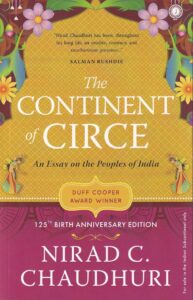
368 pages | English
Review & Analysis by Anil Saxena
PART I | PART II | PART III
A journey through Nirad C. Chaudhuri’s audacious reconstruction of Indian history and his controversial thesis on the origins of Hindu civilization
Editorial Note
This essay examines the arguments advanced by Nirad C. Chaudhuri in The Continent of Circe. The views discussed are primarily those of Chaudhuri himself and are presented for literary and intellectual discussion. At places, the author agrees, disagrees, or qualifies Chaudhuri’s arguments, but the purpose throughout is not to enter into a polemic with him. It is to understand one of the most original, provocative, and controversial minds that modern India has produced.
– Rohit Tokhi
Introduction: Entering the Continent of Circe
Nirad C. Chaudhuri drew the title of his seminal work The Continent of Circe from Homer’s Odyssey. In Greek mythology, Circe was an enchantress who lived in a dense forest and transformed men into beasts after making them forget their homeland.
Chaudhuri applies this metaphor to the Indian subcontinent itself.
According to him, India is a civilizational Circe. The original Aryans who came to this land, carrying memories of distant landscapes, rivers, climates, and ways of life, were gradually transformed by the subcontinent. Climate, geography, and the peculiar conditions of life in India altered them physically, psychologically, and spiritually, producing what we today call the Hindu.
This essay is not a review of The Continent of Circe in the conventional sense. Rather, it is an attempt to summarize, chapter by chapter, Chaudhuri’s extraordinary and often infuriating thesis on Hindus and Hindu civilization, while occasionally offering my own reflections wherever I believe he goes too far.
One may love him or hate him, but one cannot ignore him.
Nirad C. Chaudhuri belongs to that rare category of Indian-born writers who attempted not merely to describe India but to anatomize it. His scholarship is formidable, his prose dazzling, his memory astonishing, and his intellectual courage almost reckless.
His pen is lethal when wielded against Hindu weaknesses and cultural complacency.
Many readers have dismissed him as a British lackey, an inveterate contrarian, or simply a malicious critic of Hindu civilization. Yet his works remain impossible to put down. One may disagree vehemently with his theories and conjectures, but neglecting him altogether would be an intellectual mistake.
Read him, if only to sharpen your own analytical faculties.
The Man Behind the Thesis
Like many Bengali intellectual giants of his generation, Nirad Babu possessed dual loyalties. He was Bengali in appearance, habits, language, and sensibility, but British in outlook, method, and intellectual discipline.
Erudite, witty, occasionally mischievous, and equipped with an astonishing command over Sanskrit, Latin, and French, he not only called a spade a spade but a bloody shovel. Yet he was no blind admirer of the West. He could be as severe on modern Europe as on Hindus. He spared no one. If he castigated Hindu degeneration, he could also gush over Sanskrit poetry and whatever was noble and vigorous in the old Aryans.
He was essentially an uncompromising critic who believed that civilizations survive only through relentless self-examination. He was not a writer for the faint-hearted.
“He not only called a spade a spade but a bloody shovel.”
The Three Indians of Nirad Babu
Chaudhuri broadly identifies three categories of Indians.
First were the original Aryans who migrated into India carrying memories, customs, and traditions of an earlier homeland.
Second came the later Hindus, gradually worn down by what he repeatedly describes as the treacherous tropical environment of the subcontinent.
Third were the modern Anglicized Nehruvian Indians who, according to him, inhabited a make-believe world of secularism, industrialization, and internationalism while remaining detached from ordinary Indians.
Written in 1963, the book is particularly harsh on the English-speaking elite. Chaudhuri regarded them as culturally uprooted, derivative, and eager to imitate Western fashions without understanding either the West or India. He was enamoured neither of Gandhi nor of Nehru. Indeed, he looked with suspicion upon almost every political orthodoxy of his age.
Contemporary Indian writing in English did not impress him either. Without mincing words, he asserted that there was no original English writing in India, that Indian writers merely took their cues from foreign fashions while remaining cut off from the life of the common people. One may find such judgments unfair or exaggerated, but exaggeration was often part of Nirad Babu’s method. Provocation was one of his preferred instruments.
Aryan Origins and the Forgotten Homeland
The early chapters of The Continent of Circe seek to reconstruct the origins of Hindu civilization. The word “Hindu”, Chaudhuri reminds us, is fundamentally geographical. He considered “Sanatana Dharma” a more appropriate designation for the civilization.
From there he embarks upon a sweeping reconstruction of Indian history. Much of this discussion employs racial classifications and historical assumptions common in the first half of the twentieth century. Modern genetics and anthropology have challenged or discarded many of these formulations. Nevertheless, understanding Chaudhuri’s argument remains important because it reveals the intellectual assumptions within which he worked.
According to him, the Aryans originated outside India and entered the subcontinent in successive waves. They carried with them memories of cooler climates, broad rivers, grand landscapes, and a pastoral way of life.
The West, in Chaudhuri’s imagination, always remained a source of inspiration for these early settlers. He further speculates about connections among Aryans, Hurrians, Mittanians, Persians, and other ancient peoples of West Asia. In his reading, the conflict between Devas and Asuras was essentially a family quarrel among peoples sharing common origins.
One group remained behind; another moved eastwards. Paradise lost and the longing to regain it, he argues, remained embedded in Hindu consciousness. Whether one accepts these conjectures or not, they form the backbone of Chaudhuri’s civilizational psychology. For him, Hindu civilization is, at least in part, a civilization shaped by nostalgia.
Ramayana, Mahabharata, and Early Hindu Society
Chaudhuri’s interpretation of the great epics is as unconventional as everything else he wrote. He sees the Ramayana not merely as a sacred narrative but as a composite work reflecting both memories of distant conflicts and the gradual colonization of southern India by Aryan pioneers.
Similarly, he regards the Mahabharata as the memory of tribal conflicts among early Aryan groups.
South India, according to him, was gradually incorporated into the expanding Aryan world. Indigenous populations were absorbed into the social order, and in this process, the caste system acquired its immense complexity. There are moments when Chaudhuri’s language about indigenous peoples appears jarring to modern readers. His descriptions often reflect the racial assumptions of an earlier era.
Yet he also acknowledges that the encounter between Aryans and aboriginal communities was not merely one of hostility. It involved adaptation, assimilation, admiration, and cultural borrowing on both sides. The result was the emergence of a civilization of astonishing diversity.
Foreign Invasions and the Hindu Retreat into Itself
One of Chaudhuri’s most compelling arguments concerns the effect of repeated foreign invasions on Hindu society. According to him, the incessant waves of invasions beginning in antiquity gradually transformed Hindus into a more inward-looking and defensive people. Unable to withstand repeated assaults, they became increasingly self-conscious and insular.
Foreigners were designated as mleccha — outsiders regarded as unclean or uncivilized. The myth of Kalki, the final avatar destined to destroy evil and restore order, acquired renewed significance during periods of political humiliation. At the same time, Chaudhuri points out that Hindus had not always been xenophobic. Earlier contacts with Persians, Greeks, and Romans had often been cordial and intellectually fruitful.
Foreign rulers such as Kanishka could even be assimilated into the Hindu cultural universe. But the cumulative effect of centuries of invasions, in his view, was the growth of insecurity and cultural defensiveness. In support of this argument, Chaudhuri frequently invokes Al-Biruni, whose observations on Hindu conceit and insularity remain among the most discussed passages in medieval travel literature.
Caste as Civilization’s Shock Absorber
Perhaps no aspect of The Continent of Circe is more controversial than Chaudhuri’s treatment of caste. He refuses to see caste merely as an oppressive social hierarchy. Instead, he presents it as a gigantic civilizational mechanism designed to absorb diversity.
India, he argues, experienced repeated migrations, invasions, and cultural encounters. In such circumstances, the caste system functioned as a vast federation of communities, assigning each group its own place, duties, and social niche. According to Chaudhuri, caste reduced competition, facilitated coexistence, and preserved social cohesion.
Far from being completely rigid, he believed the system possessed a considerable degree of elasticity. Brahmins could become rulers, traders, or peasants. Foreigners could be assimilated. Influential outsiders could even be incorporated into the upper orders of society. For Chaudhuri, caste was the great shock absorber of Hindu civilization. He went so far as to warn reformers against dismantling it altogether, arguing that without caste Hindu society might have disintegrated under the pressure of diversity.
Modern readers will understandably challenge many of these conclusions. The historical experience of caste also includes exclusion, discrimination, and immense human suffering. Yet one cannot deny the originality or boldness of Chaudhuri’s argument.
Aryans and the Aboriginal Peoples
Chaudhuri devotes considerable attention to the relationship between Aryans and the indigenous peoples of India. He portrays this relationship as one of simultaneous attraction and antipathy. The Aryans regarded themselves as racially and culturally superior. They looked down upon hunting and gathering communities and considered many of their practices primitive. At the same time, they admired the courage, hunting skills, and physical vigour of tribal populations. This ambivalence persisted throughout Indian history.
Chaudhuri interprets the acceptance of Shabari and Guha in the Ramayana as symbolic gestures of reconciliation, while the treatment of Eklavya in the Mahabharata illustrates continuing social exclusion. Yet what impressed him most was the resilience of tribal communities. Despite centuries of pressure, many retained distinctive cultural identities while simultaneously borrowing elements from the surrounding Hindu civilization.
Chaudhuri is sharply critical of modern industrial civilization, which, in its hunger for minerals and resources, increasingly encroaches upon tribal lands. He accuses modern Indians of pursuing wealth with little regard for the destruction inflicted upon indigenous communities. Missionaries, colonial entrepreneurs, industrialists, and postcolonial elites all come under his scrutiny. No one escapes.
Conclusion: A Colossus We Cannot Ignore
This first part of The Continent of Circe reveals Nirad C. Chaudhuri at his most ambitious. He attempts nothing less than an explanation of Hindu civilization from its beginnings to modern times.
His arguments are frequently speculative, occasionally exasperating, and often deeply controversial. Modern scholarship has revised or rejected several of his assumptions. Yet the scale of his intellectual ambition remains breathtaking.
Whether one agrees with him or not, one thing is undeniable: Nirad Babu compels us to look at Indian civilization from angles we would otherwise avoid. That alone makes him worth reading.
In the next Part II of this series, we shall move from history to psychology and examine Chaudhuri’s fascinating, contradictory, and often unsettling attempt to understand the Hindu mind itself. Stay tuned!
Author Bio: Anil Saxena
 Anil Saxena is a retired Principal Chief Conservator of Forests and Head of Forest Force (HoFF), Maharashtra.
A lifelong nature lover and prolific reader, he brings depth, clarity, and insight to every book he reviews. As a Core Committee member of the Nagpur Book Club, he is known for his comprehensive reviews that make even complex subjects accessible and engaging.
Anil Saxena divides his time between Nagpur, Mumbai, and New York, enjoying the company of his children and grandchildren while continuing to explore the world of literature.