
How the Greatest Scientific Mistakes Changed Our Understanding of the Universe
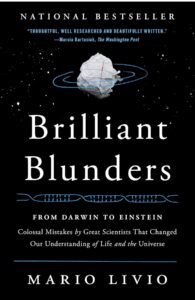
352 pages | English
Review by Anil Saxena
“Science advances by learning from its mistakes.”
This idea lies at the heart of Mario Livio’s fascinating book.
The common belief is that blunders, mistakes, and failures are the fate of ordinary men and women alone, while great scientists are somehow immune to such lapses. Brilliant Blunders tells us an altogether different story. According to the author, some of the greatest scientific minds of history also had chinks in their armour. It is reassuring to be reminded of the old adage, “To err is human,” for even the grandest specimens of humanity were not spared from error.
Livio examines the remarkable stories of six celebrated scientists; Charles Darwin, Lord Kelvin, Linus Pauling, Fred Hoyle, and Albert Einstein (along with one additional case in the book), showing not merely how they were wrong, but how their mistakes ultimately propelled science forward.
Darwin’s Blind Spot: Evolution Without Genetics
Charles Darwin revolutionized biology with his theory of evolution through natural selection, shattering long-held religious beliefs in divine creation and “evolution by design.” His theory was the product of an exceptionally clear scientific mind and initially met fierce resistance before eventually transforming our understanding of life.
Darwin’s conclusions did not emerge overnight. They were built upon years of meticulous observation and supported by the pioneering work of geologists who, through fossils and rock formations, demonstrated that the Earth was vastly older than previously imagined.
Yet Darwin had one important blind spot. He knew little about heredity or how characteristics were transmitted from parents to offspring. Mendel’s discoveries still lay in the future, and the prevailing theory in Darwin’s time was blending inheritance; the belief that parental traits blended together in successive generations.
A useful analogy is that of mixing gin with tonic. If every generation simply blended inherited traits, distinctive characteristics would gradually become diluted and eventually disappear. How then could favourable new traits survive natural selection?
Darwin himself had no convincing answer. As he admitted, his mathematical abilities were limited, and genetics had not yet arrived to rescue his theory.
Mendel Saves Darwin
Who was Gregor Mendel, and what exactly did he discover?
Through his famous experiments on pea plants, Mendel demonstrated that hereditary traits are governed by dominant and recessive factors.
When yellow and green peas were cross-fertilized, their offspring appeared in predictable ratios, revealing that hereditary factors remain discrete rather than blending together. A dominant yellow trait and a recessive green trait produced offspring in a characteristic 3:1 ratio in later generations.
The revolutionary insight was that genes are not blended like gin and tonic; rather, they are passed on intact; more like shuffling a deck of cards. This discovery preserved Darwin’s theory by explaining how advantageous traits could persist through generations.
How Old Is the Earth?
One of the most fascinating episodes in the book recounts the nineteenth-century conflict between geologists and physicists over the age of the Earth.
Geologists, studying sedimentary rock layers, fossils, and erosion, argued that the Earth had to be immensely old – perhaps billions of years. Darwin’s theory also required such enormous timescales for evolution to operate.
Physicists, however, disagreed.
Lord Kelvin, the greatest physicist of his age, used thermodynamics to estimate the Earth’s age by calculating how long it would take a molten Earth to cool. He arrived at an age ranging from about 20 million to a few hundred million years. Similarly, he believed the Sun derived its energy solely from gravitational contraction and estimated its age within the same range.
(Today we know the Earth is about 4.5 billion years old.)
Kelvin’s own student, John Perry, challenged his assumptions, arguing that heat transfer within the Earth’s interior was far more complex than Kelvin had assumed. Perry’s calculations brought the Earth’s age much closer to the estimates proposed by geologists.
A younger Earth also posed a serious challenge to Darwin. If the planet were only a few million years old, there simply would not have been enough time for evolution through natural selection.
Livio argues that Kelvin became a victim of cognitive dissonance, stubbornly refusing to consider alternatives beyond his elegant calculations.
The situation changed dramatically when Ernest Rutherford discovered radioactivity. Radioactive decay provided a completely new internal heat source unknown to Kelvin and simultaneously supplied an accurate method for dating rocks through radioactive half-lives.
Radioactivity rescued Kelvin’s reputation to some extent, since neither radioactivity nor nuclear fusion was known during his lifetime. Nevertheless, Perry had already shown that Kelvin’s calculations contained flaws even within the framework of classical physics.
Likewise, the Sun’s energy was eventually explained through thermonuclear fusion, where hydrogen nuclei fuse into helium and release enormous amounts of energy.
Linus Pauling and the Race to Decode Life
Linus Pauling was one of the greatest structural chemists of the twentieth century. His pioneering work on protein structures earned him worldwide acclaim. Early in his career, however, he believed proteins – not DNA – were the principal hereditary molecules.
His celebrated alpha-helix model of proteins was brilliantly confirmed through X-ray diffraction studies.
Meanwhile, two relatively young scientists – James Watson (23), a biologist, and Francis Crick (35), a physicist – were attempting to decipher the structure of DNA, the true hereditary material of life. X-ray diffraction images consistently suggested an “X”-shaped pattern.
Initially, Pauling showed little interest in DNA. Only after learning of Watson and Crick’s progress did he enter the race. Unfortunately, he proposed a triple-helix model of DNA.
When Watson and Crick examined Pauling’s paper, they immediately recognized its flaws. Soon afterward, they unveiled the correct double-helical structure of DNA – one of the greatest discoveries in modern biology.
DNA functions like the zipper of a jacket. The two strands can separate, allowing complementary base pairs to replicate accurately, thereby transmitting hereditary information from parents to offspring.
Pauling’s Mistakes
Pauling’s errors were surprisingly fundamental.
- He proposed a triple helix instead of a double helix.
- He overlooked crucial X-ray diffraction evidence.
- He misunderstood DNA’s acidic chemical nature.
- He failed to recognize complementary base pairing.
Thus, perhaps the world’s greatest structural chemist lost the greatest biological race of the century to two comparatively young scientists. One cannot help wondering how history might have changed had Pauling solved DNA first.
Fred Hoyle and the Big Bang Debate
Fred Hoyle was a brilliant astrophysicist whose contributions to stellar nucleosynthesis permanently transformed astronomy, although he never received the Nobel Prize.
Scientists already understood that helium forms through nuclear fusion of hydrogen. The mystery was the origin of heavier elements such as carbon, nitrogen, oxygen, and iron.
Many physicists believed these elements were synthesized during the Big Bang. Hoyle disagreed.
He demonstrated that heavier elements are forged inside dying stars under precisely the right temperatures and pressures. As massive stars exhaust their fuel, they explode as supernovae, scattering newly formed elements throughout the universe.
Initially ridiculed, Hoyle’s theory was later accepted. Today we know that the Big Bang produced the lighter elements, while stars manufacture the heavier ones.
Ironically, Hoyle’s collaborator received the Nobel Prize while Hoyle himself did not. Hoyle believed his criticism of the Nobel Committee and his opposition to the Big Bang theory contributed to this omission.
Steady State Universe vs. Big Bang
Following Edwin Hubble’s discovery that galaxies are moving away from one another, evidence increasingly favoured an expanding universe.
Yet Hoyle remained unconvinced.
Early estimates placed the universe’s age at only about 1.2 billion years – far too young for life to evolve on Earth. This encouraged Hoyle, Hermann Bondi, Jayant Vishnu Narlikar, and others to propose the Steady State Theory, arguing that the universe has always existed in essentially the same form.
As observations improved, however, the estimated age of the universe increased dramatically. Even more decisive was the discovery of the cosmic microwave background radiation – the fossil afterglow of the Big Bang.
Many of Hoyle’s own collaborators eventually accepted the expanding universe. Hoyle and Narlikar, however, continued to defend the Steady State model.
Livio characterizes Hoyle’s unwavering commitment as a form of scientific stubbornness. Nevertheless, the author also shows that even Hoyle’s mistaken ideas stimulated important research and sharpened competing theories.
Einstein’s “Biggest Blunder”
Following his General Theory of Relativity, Albert Einstein introduced the cosmological constant to maintain a static universe. This mysterious repulsive force would prevent gravity from causing the universe to collapse upon itself.
When Hubble’s observations demonstrated that the universe was expanding, Einstein abandoned the cosmological constant.
Physicist George Gamow later wrote that Einstein called this his “biggest blunder.”
Livio carefully investigates this famous quotation and concludes that there is no convincing evidence Einstein ever actually used those exact words. He certainly acknowledged his mistake, but the phrase itself appears to be apocryphal.
Ironically, history was not finished with the cosmological constant.
Out of Empty Space
In 1998, Einstein’s discarded cosmological constant experienced an astonishing revival.
Astronomers expected the expansion of the universe to slow down under gravity. Instead, observations revealed that the universe is expanding at an accelerating rate.
To explain this acceleration, cosmologists proposed the existence of dark energy, now believed to constitute nearly 73% of the universe, with ordinary matter accounting for only about 27%.
The vacuum, once thought empty, now appeared to possess enormous hidden energy.
This also led to anthropic reasoning. For life to exist, the cosmological constant cannot be either too large or too small. A stronger repulsive force would tear galaxies apart before stars could form; a weaker one would cause the universe to collapse too quickly.
These ideas naturally evolved into discussions of biophilic universes, the multiverse, and string theory, where different universes may possess different physical constants.
Thus, Einstein may have abandoned the cosmological constant too hastily in pursuit of mathematical elegance.
Livio beautifully summarizes Einstein’s approach by suggesting that he trusted intuition more than formalism, and that it is better to be wrong while pursuing profound truths than to be right about trivialities.
Ultimately, Einstein’s two great “blunders” deepened our understanding of the universe.
An exceptional book
This beautiful book, beginning with Darwin and moving through Lord Kelvin, Linus Pauling, Fred Hoyle, and finally Albert Einstein, is exceptional in every respect.
Its greatest lesson is one of humility. Even the finest scientific minds occasionally stumble, and their failures become stepping stones for future generations.
Science, unlike religion or spirituality, never claims finality. Every theory remains provisional until replaced by a better explanation. As Livio reminds us,
“Science is a self-correcting enterprise.”
Even in failure, these giants continued to illuminate new paths of inquiry. Their mistakes opened fresh avenues of research and enriched science itself.
The book is highly recommended not only for readers interested in the history of science but also for lay readers. Livio writes without burdening the reader with mathematics, equations, or complex graphs, making this an engaging and accessible account of how science truly progresses – not through perfection, but through the courage to be wrong.
Author Bio: Anil Saxena
 Anil Saxena is a retired Principal Chief Conservator of Forests and Head of Forest Force (HoFF), Maharashtra.
A lifelong nature lover and prolific reader, he brings depth, clarity, and insight to every book he reviews. As a Core Committee member of the Nagpur Book Club, he is known for his comprehensive reviews that make even complex subjects accessible and engaging.
Anil Saxena divides his time between Nagpur, Mumbai, and New York, enjoying the company of his children and grandchildren while continuing to explore the world of literature.




It was, of course, interesting to know about these blunders by some of the biggest minds but what was even more interesting was how they reacted to it. Some were graciously accepting of their mistakes, others stubbornly refusing to admit that they were wrong.