
Understanding the Hindu Mind: Contradictions, Colonial Perceptions and the Making of a Civilization
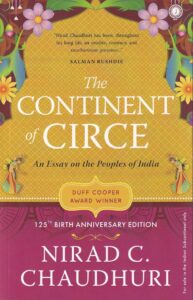
368 pages | English
Review & Analysis by Anil Saxena
Editorial Note
This is Part II of Anil Saxena’s three-part analytical exploration of Nirad C. Chaudhuri’s The Continent of Circe, and forms the intellectual heart of the series. Here, Chaudhuri moves beyond history and begins examining what he believed to be the psychology of the Hindu mind, its contradictions, its encounter with the West, and his controversial theory that India’s climate profoundly shaped the character of its people and even its rulers.
This essay is not a book review in the conventional sense, nor is it an endorsement of Chaudhuri’s arguments. It is a chapter-by-chapter presentation and analysis of his ideas, accompanied by occasional editorial observations where they are necessary for context or balance. Many of Chaudhuri’s views reflect the intellectual climate of the 1960s and include sweeping generalizations that remain vigorously debated by historians, anthropologists and scholars today.
Readers are encouraged to approach this essay in the same spirit in which Chaudhuri wrote his book; with curiosity, patience and a willingness to engage critically with ideas, whether they ultimately agree with them or not.
– Rohit Tokhi
From History to Psychology
In the first part of this series, we followed Nirad C. Chaudhuri as he reconstructed the historical evolution of Hindu civilization—from the arrival of the Aryans and their encounter with the indigenous inhabitants of the subcontinent to the emergence of caste, the impact of repeated foreign invasions, and the gradual inward turn of Hindu society. Whether one accepted or rejected his conclusions, it became clear that Chaudhuri was never interested in writing a conventional history. He was searching for something much deeper: an explanation of why Hindus became what they are.
With Chapter Four, The Continent of Circe enters an altogether different territory. History now gives way to psychology. Chaudhuri leaves behind kings, dynasties and migrations, and begins examining the inner world of the Hindu mind. In many ways, this is the real heart of the book. The preceding chapters merely prepare the ground for what follows.
These chapters are also among the most provocative that Chaudhuri ever wrote. They are not organised as a systematic philosophical argument; rather, they resemble the observations of a brilliant, impatient and occasionally mischievous mind that refuses to accept easy explanations. He moves effortlessly between history, anthropology, literature, psychology and personal experience, quoting everyone from Al-Biruni and Bankim Chandra to British administrators and Sanskrit texts, before arriving at conclusions that may strike the reader as either remarkably perceptive or deliberately outrageous.
For that reason, these chapters demand a certain temperament from the reader. Chaudhuri was never interested in winning universal agreement. On the contrary, he seemed to enjoy provoking disagreement. Hyperbole was one of his favourite literary devices, and many of his sharpest observations are intentionally exaggerated to force the reader into questioning accepted assumptions. The purpose of this essay, therefore, is not to defend or demolish his arguments but to understand them on their own terms. Where I feel he carries a point too far, I shall say so. Where I find his insight unusually penetrating, I shall acknowledge that as well. The objective remains the same as in Part I—to understand not merely India, but the extraordinarily original and often unsettling mind of Nirad C. Chaudhuri.
Can the Hindu Mind Be Understood?
Chaudhuri begins this section with what is almost an admission of defeat. After tracing nearly a thousand years of Indian history, he confesses that the Hindu mind cannot be adequately explained through the fashionable intellectual frameworks of the modern West. Neither Freudian psychology nor Marxist interpretations, he argues, can fully account for the peculiar habits of thought that have shaped Hindu society. The Hindu mind belongs to a world of its own, governed by assumptions, instincts and historical experiences that are unlike those of Europe.
This observation forms the foundation of everything that follows. Chaudhuri believes that most attempts to understand India have failed because they have relied either on abstract theories or on idealised images. The Hindu mind, in his view, cannot be captured through ready-made philosophical systems. It must be approached through its history, customs, contradictions, prejudices and everyday conduct.
It is here that he launches one of his sharpest criticisms of traditional Indology. Early European Orientalists, he acknowledges, possessed formidable scholarship. They mastered Sanskrit, translated ancient texts and produced works of enduring academic value. Yet, according to Chaudhuri, many of them understood classical India far better than they understood living Hindus. Their India was largely the India of manuscripts and metaphysical speculation rather than of bazaars, villages, railway stations and family life.
For Chaudhuri, this distinction is crucial. A civilisation cannot be understood solely through its greatest books. The Upanishads, the Mahabharata or Kalidasa reveal only one aspect of India. Equally important is the behaviour of ordinary people—their habits, prejudices, superstitions, quarrels, aspirations and contradictions. It is in everyday life, rather than in philosophical abstractions, that the true character of a civilisation becomes visible.
This insistence on observing lived reality instead of merely celebrating inherited ideals gives The Continent of Circe much of its enduring freshness. Chaudhuri is rarely content with what Indians say about themselves, nor is he satisfied with what foreigners imagine India to be. He is constantly trying to strip away comforting myths—whether they are created by Indian nationalists, European Orientalists or colonial administrators—and examine the society beneath.
India Through Western Eyes
One of the recurring themes in these chapters is Chaudhuri’s criticism of the romantic image of India that took hold of the Western imagination during the nineteenth century. According to him, Europe often discovered not the India that existed but the India it wished to find. Tired of industrialisation, materialism and the spiritual uncertainties of modern life, many Western thinkers projected onto India an image of timeless wisdom, profound spirituality and philosophical serenity.
Chaudhuri has little patience for this romanticism. He argues that the celebrated spirituality of India often reflected a Western need more than an Indian reality. Visitors arrived expecting sages and mystics and consequently interpreted everything they encountered through that expectation. In doing so, they overlooked the ordinary Hindu, whose concerns were often no different from those of people elsewhere—earning a livelihood, raising a family, securing social status and navigating the practical difficulties of daily life.
From this observation, Chaudhuri makes another characteristically provocative leap. He suggests that the Western hunger for mystical India eventually encouraged the rise of numerous self-appointed Indian spiritual teachers who found an eager audience abroad. The demand for exotic wisdom, in a sense, created its own supply. Whether one accepts this rather sweeping judgment or not, it reveals Chaudhuri’s lifelong suspicion of romanticised narratives. He distrusted idealisation in all its forms, whether directed towards India or towards Europe.
At the same time, he is equally critical of those Indians who derive their self-esteem entirely from Western praise. He repeatedly warns against confusing admiration with understanding. The fact that Europe praised the Upanishads or celebrated yoga did not necessarily mean that it understood Hindu civilisation. Nor, for that matter, did Indians understand the West simply because they borrowed its political vocabulary or institutions. Mutual fascination, he suggests, is often accompanied by mutual misunderstanding.
The Hindu Mind: A Civilization of Contradictions
If there is one idea that forms the intellectual centre of The Continent of Circe, it is Chaudhuri’s insistence that the Hindu mind is a paradox. According to him, no attempt to understand Hindu civilization can succeed unless one first accepts that it comfortably accommodates opposites which, to the Western mind, appear mutually exclusive. This, he believes, is the principal reason why generations of European observers found India bewildering. They expected consistency where the Hindu mind accepted contradiction as a natural condition of life.
To illustrate this, Chaudhuri turns first to earlier observers of India. He cites the celebrated Persian scholar Al-Biruni, who spent years studying Indian society in the eleventh century. Al-Biruni admired the learning of the Hindus, yet confessed how difficult it was to penetrate their essential nature. According to Chaudhuri, this inability was not due to any lack of intelligence on Al-Biruni’s part but because Hindu civilization operated according to assumptions entirely different from those of the Islamic and Greco-Persian worlds. The same difficulty, he argues, confronted British administrators centuries later. They mastered Indian geography, surveyed its rivers and mountains, documented its flora, fauna and monuments with admirable diligence, yet remained baffled by the people themselves.
Among Indian thinkers, Chaudhuri reserves particular admiration for Bankim Chandra Chattopadhyay, whom he regarded as perhaps the first modern Indian to understand the limits of British comprehension. Bankim believed that the British ruled India efficiently but never truly understood the civilization they governed. Chaudhuri beautifully paraphrases this sentiment by comparing them to the owner of a magnificent orchard who had never tasted its fruit. They possessed India, administered it and catalogued it, but they never grasped the emotional and psychological world of the Hindus.
The misunderstanding, however, was not one-sided. Chaudhuri repeatedly reminds us that Hindus too viewed the British through their own inherited prejudices. Colonial memoirs are full of harsh epithets directed at Indians – “duplicitous,” “perverse,” “grotesque,” “untruthful” and “dishonest.” Indian newspapers, meanwhile, returned the favour with equal enthusiasm. Each civilization interpreted the other through its own moral vocabulary. Neither made a sustained effort to understand the assumptions that lay beneath the other’s conduct. The result was not merely political domination but a profound failure of communication.
One of the more surprising observations Chaudhuri borrows from Bankim concerns the value of criticism itself. Bankim believed that an able adversary could become a powerful instrument of progress. British contempt, unpleasant though it was, compelled educated Indians to master English, compete intellectually and prove themselves on equal terms. Chaudhuri candidly admits that his own remarkable command of English owed something to precisely this challenge. Praise, in his opinion, often breeds complacency; criticism demands excellence. Whether one agrees with this austere philosophy or not, it reveals an important aspect of Chaudhuri’s own temperament. He welcomed rigorous criticism, even when it was uncomfortable, because he believed that civilizations, like individuals, grow only when they are challenged.
The Great Contradiction
Having established that outsiders repeatedly failed to understand Hindu civilization, Chaudhuri proceeds to explain why. His answer is strikingly simple. The Hindu mind, he argues, is not governed by logical consistency but by an extraordinary ability to reconcile opposing tendencies. What appears contradictory to an outsider is, for the Hindu, perfectly natural.
He offers a long catalogue of these opposites. Hindus display remarkable solidarity in moments of crisis, yet remain deeply divided among themselves. They oscillate between collective pride and collective self-abasement. They are intensely xenophobic, regarding outsiders as impure or alien, yet simultaneously display an almost uncritical admiration for foreign cultures. They are capable of authoritarian discipline while also exhibiting an astonishing tolerance for disorder and anarchy. Courage and cowardice, violence and non-violence, militarism and pacifism, possessiveness and renunciation, cleverness and gullibility—all coexist within the same civilization without creating any apparent intellectual discomfort.
To Chaudhuri, these are not isolated inconsistencies but defining characteristics of Hindu civilization. The Western mind, trained to seek coherence and logical resolution, naturally finds them bewildering. Hindu civilization, on the other hand, has seldom regarded contradiction as something that must necessarily be eliminated. Opposing impulses are allowed to exist side by side, each neutralising the other without destroying it.
This argument, provocative as it is, also explains why Chaudhuri finds conventional Western theories inadequate for interpreting India. Neither Freudian psychology nor Marxist sociology, he believes, can adequately explain a civilization that refuses to fit into neat ideological frameworks. Hindu society repeatedly frustrates attempts to classify it because it contains within itself multiple and often opposing tendencies, each asserting itself at different moments in history.
Reason, Measure and the Western Critique
Chaudhuri then examines how these contradictions appeared to Western observers. European civilization, shaped by Greece, Rome, Christianity and the Enlightenment, placed a high value on reason, proportion and intellectual consistency. The Hindu mind appeared to violate all three.
Western critics frequently described Indians as irrational, extravagant, inconsistent and hypocritical. Chaudhuri does not dismiss these criticisms outright, nor does he accept them uncritically. Instead, he asks why such impressions arose so consistently across different centuries and among observers of widely differing backgrounds.
One reason, he suggests, lies in the extraordinary coexistence of lofty metaphysical ideals with everyday superstition. The same civilization that produced the Upanishads also accepted astrology, miracle workers and magical remedies without embarrassment. A professor of modern physics might wear several protective amulets around his neck. A politician professing secular ideals might simultaneously sponsor elaborate yajnas to secure electoral success or national victory in wartime. Educated families consulted doctors and astrologers with equal seriousness, seeing no contradiction between science and ritual.
To Chaudhuri, this was not merely an occasional inconsistency but a deeply rooted habit of mind. The Hindu intellect, he argues, possesses an exceptional capacity to hold opposing ideas simultaneously without feeling compelled to choose between them. Western observers interpreted this as confusion. Chaudhuri interprets it as a distinctive civilizational trait, though one whose consequences were not always beneficial.
The Curious World of Hindu Texts
His argument becomes sharper when he turns to classical Sanskrit literature itself. Here Chaudhuri delights in pointing out examples that would have amused as much as puzzled European scholars.
He cites Kautilya’s Arthashastra as perhaps the finest ancient manual on statecraft ever produced in India. It is practical, secular and astonishingly modern in its understanding of administration, espionage and governance. Yet, towards its conclusion, the text unexpectedly ventures into recipes for invisibility and magical substances capable of producing supernatural effects. To Chaudhuri, the transition is so abrupt that it perfectly illustrates the Hindu tendency to combine rigorous realism with occult speculation.
He finds similar examples elsewhere. The Manusmriti, after laying down elaborate social and legal principles, calmly informs the reader that stealing silk will result in rebirth as a partridge, stealing cotton as a crane, and stealing linen as a frog. Such passages, he suggests with characteristic irony, coexist happily alongside otherwise serious discussions of ethics and jurisprudence.
Al-Biruni had noticed something similar centuries earlier. Comparing Indian scientific works with those of the Greeks, he observed that valuable insights were often mixed indiscriminately with fantasy, mythology and speculation. He famously likened them to a collection containing pearls alongside sour dates and dung, lamenting that Hindu scholars seemed unwilling to distinguish one from the other. Chaudhuri repeats the analogy not to dismiss Indian learning but to underline what he considers a persistent inability to separate empirical reasoning from inherited belief.
Whether one accepts this criticism or not, it reveals Chaudhuri’s impatience with attempts to portray Indian civilization as uniformly rational or uniformly mystical. He insists that it is both—and neither. It is precisely this refusal to remain within neat intellectual categories that fascinates him throughout The Continent of Circe.
By the end of this discussion, the reader begins to understand why Chaudhuri considered the Hindu mind one of the most difficult subjects in the world to analyse. It is not because Hindus lack intelligence or historical depth, but because they have developed a civilization that instinctively reconciles contradictions which other cultures strive to resolve. Whether this quality represents strength or weakness is a question Chaudhuri continues to explore in the chapters that follow.
The next chapter takes this argument to its logical – and highly controversial – conclusion, as Chaudhuri examines violence, non-violence and the paradoxical relationship between Hindu compassion and Hindu militancy.
Violence, Non-Violence and the Hindu Paradox (Chapter 5: Janus and Its Two Faces)
If the previous chapter attempts to explain why the Hindu mind appears contradictory, Chapter Five seeks to demonstrate those contradictions in action. Here Chaudhuri turns to one of the most cherished assumptions about Hindu civilization—that it is fundamentally a civilization of non-violence—and proceeds to dismantle it with characteristic boldness.
For Chaudhuri, ahimsa is not the defining instinct of Hindu civilization but one pole of a much older and deeper duality. He argues that non-violence is meaningful only because violence already exists. Even linguistically, he points out, the word ahimsa derives from himsa; the negative exists only in relation to the positive. From this observation he arrives at one of his most provocative conclusions: Hindu civilization has always oscillated between violence and non-violence rather than consistently embracing either.
This is typical Chaudhuri. He delights in overturning accepted narratives. The popular image of India as an eternally peaceful civilization, shaped by the legacies of Emperor Ashoka and Mahatma Gandhi, appears to him historically incomplete. If India had truly been governed by an instinctive abhorrence of violence, he asks, how does one explain the almost continuous record of warfare that fills its political history? Dynasties rose and fell through conquest, kingdoms expanded through military campaigns, and succession disputes were often settled on the battlefield. Even the Mahabharata, the greatest epic of Hindu civilization, culminates in one of the bloodiest wars imagined in world literature. War, when fought for what was considered a righteous cause, acquired the noble designation of dharma yuddha.
Chaudhuri therefore rejects the comforting belief that Hindus have always been natural pacifists. Violence, he argues, has never been alien to Hindu civilization. It has merely existed alongside an equally powerful impulse towards renunciation, forgiveness and compassion. Rather than resolving these opposing tendencies, Hindu society has historically accommodated both.
He reinforces his argument by referring to events that were painfully recent when The Continent of Circe appeared in 1963. The horrors of Partition remained fresh in public memory. The massacres, forced migrations, rapes and communal killings that accompanied the division of India had shattered any romantic notion that either Hindus or Muslims possessed a monopoly over virtue or brutality. Chaudhuri bluntly reminds his readers that blood flowed on both sides of the newly created border. If Muslims committed atrocities against Hindus in one region, Hindus retaliated with equal ferocity elsewhere. To him, these events demonstrated that beneath the veneer of civilizational restraint lay immense reservoirs of suppressed violence.
Yet Chaudhuri is careful not to reduce Hindu civilization to mere aggression. What fascinates him is precisely the coexistence of these contradictory impulses. The same society that reveres the Buddha, Ashoka and Gandhi also celebrates Rama, Arjuna, Shivaji and countless warrior heroes. Temples echo with prayers for peace, while epics and folklore glorify martial courage. Compassion and militancy are not successive phases in Hindu history; they exist simultaneously, each waiting for circumstances to call it forth.
The Nehru Years Through Chaudhuri’s Eyes
It is against this background that Chaudhuri turns his attention to contemporary India. Readers must constantly remind themselves that these observations belong to the early 1960s, a period dominated by Jawaharlal Nehru’s vision of non-alignment, secularism and peaceful coexistence. Chaudhuri was deeply sceptical of what he considered the moral idealism of the Nehruvian state.
He argues that independent India outwardly proclaimed universal peace while inwardly nurturing a strong sense of grievance and latent militancy. Public discourse celebrated international harmony, yet political rhetoric frequently invoked threats from Pakistan, memories of colonial humiliation and the need to assert national honour. To Chaudhuri, these were not isolated inconsistencies but further evidence of the dual nature of the Hindu mind.
His interpretation of the 1962 Sino-Indian conflict is particularly controversial. Chaudhuri believed that the border dispute with China could have been resolved through negotiation rather than war. He regarded the conflict as a tragic consequence of nationalist sentiment, emotional rhetoric and inherited colonial boundaries rather than an unavoidable civilizational clash. In his opinion, Nehru himself initially preferred compromise but eventually yielded to political pressures and public opinion, abandoning his own instincts in favour of a more militant posture.
Many readers will disagree strongly with this assessment, especially in light of subsequent historical developments and later scholarship on Sino-Indian relations. Even so, Chaudhuri’s argument is significant because it reveals how consistently he applied his central thesis. He interpreted Nehru’s apparent shift from idealistic pacifism to military mobilisation not simply as a political decision but as another manifestation of the enduring contradictions embedded within Hindu civilization itself.
His comments occasionally drift into speculation, and here one may legitimately part company with him. Yet even where his conclusions appear exaggerated, they illuminate the remarkable consistency with which he interpreted history. Everything, in Chaudhuri’s universe, ultimately returns to the same psychological pattern: opposing instincts existing within the same civilization, each alternately gaining the upper hand.
Madness Within Limits
Among the most memorable passages in this chapter is Chaudhuri’s curious comparison between Hindu civilization and the composition of the atmosphere itself.
He argues that every civilization possesses a certain degree of collective irrationality. The question is not whether madness exists, but how it expresses itself. Hindu civilization, he believes, contains its passions within certain limits. Its irrational impulses resemble oxygen diluted by a much larger quantity of nitrogen. Oxygen alone would produce uncontrollable combustion; mixed with nitrogen, it sustains life without setting the world ablaze. Likewise, Hindu passions remain largely contained, rarely exploding into the systematic destructiveness witnessed elsewhere.
To strengthen this analogy, Chaudhuri contrasts Hindus with twentieth-century examples such as Nazi Germany and militarist Japan. Those societies, in his opinion, allowed collective irrationality to overwhelm restraint, producing catastrophic consequences for humanity. Hindu civilization, by contrast, tends to direct its excesses inward. Its contradictions often wound itself more than they threaten the outside world.
This observation leads him to one of the book’s most striking metaphors. Why, he asks, has Hindu civilization survived when so many brilliant ancient civilizations have vanished? His answer is deliberately unsettling.
A mammoth, magnificent though it may be, eventually becomes extinct. A cockroach survives.
The comparison is intentionally irreverent. Chaudhuri does not mean that Hindu civilization lacks greatness. Rather, he suggests that its extraordinary capacity for adaptation, compromise and resilience has ensured its survival where more rigid civilizations have perished. Grandeur alone does not guarantee permanence. Flexibility does.
Whether one finds this metaphor insightful or offensive is almost beside the point. It perfectly captures Chaudhuri’s literary method. He preferred vivid, memorable images over cautious academic prose, often risking outrage in order to force readers into confronting uncomfortable questions.
A Chapter That Demands Argument
Few chapters in The Continent of Circe provoke as much disagreement as this one. Chaudhuri challenges some of the most cherished assumptions of modern India and does so without the slightest attempt to soften his language. At times he undoubtedly overstates his case. His reading of contemporary politics can appear selective, and several of his conclusions invite serious historical debate.
Yet beneath the provocations lies a genuine intellectual challenge. Chaudhuri asks whether civilizations can be understood through comforting myths or whether they must also be judged by their contradictions. He refuses to accept simplified portraits of India as either a land of saints or a land of warriors. To him, it is both, and that very duality explains much of its historical experience.
Whether the reader ultimately agrees or disagrees, one cannot deny the force of the argument. Chaudhuri compels us to examine familiar ideas from unfamiliar angles, and that, perhaps more than any individual conclusion, is the enduring value of reading him.
In the next section, Chaudhuri introduces what is arguably the most controversial thesis of the entire book: that it was not British rule, nor religion, nor politics, but the climate of the Indian subcontinent itself that gradually transformed both the Aryans and later the British into victims of what he calls Circe’s enchantment.
The Victims of Circe: Climate as Destiny (Chapter 6)
If Chapter Five unsettles the reader by questioning the popular image of Hindu non-violence, Chapter Six goes much further. Here Chaudhuri unveils what is perhaps the central pillar of The Continent of Circe—the astonishing proposition that the greatest architect of Indian history is neither religion nor politics, neither race nor economics, but climate itself. It is this harsh, tropical environment, he argues, that gradually transformed successive waves of settlers into what they eventually became. In one sweeping stroke, Chaudhuri shifts the burden of explanation away from men and institutions and places it upon geography and weather. It is a theory at once original, audacious and deeply controversial.
This is also the point where many readers are likely to part company with him. Throughout the book he has criticised Hindu society with relentless severity, but here he unexpectedly extends a measure of sympathy towards both the ancient Aryans and even the British rulers of India. Neither, in his opinion, escaped the enchantment of Circe. Both arrived with vitality, confidence and discipline, and both were gradually altered by the unforgiving conditions of the Indian subcontinent.
Chaudhuri begins with a striking observation about the British in India. The Englishmen who reached India were products of a temperate climate, trained in habits of restraint, order and empirical thinking. Yet many of them, once settled in India, appeared to become different people. They drank more heavily than they would have at home, lost patience more easily, became arrogant in their dealings with Indians and frequently displayed behaviour that would have shocked respectable society in England. Indian servants, he remarks with dry humour, had countless stories to tell about the moral lapses of sahibs and memsahibs who, in the unfamiliar surroundings of India, seemed to abandon many of the conventions they otherwise professed.
Chaudhuri does not cite these examples merely to expose British hypocrisy. On the contrary, he employs them to support a much larger argument. The British, he suggests, were not inherently cruel or unjust by nature. They too became victims of an alien climate that steadily eroded their temperament. Even the most balanced and civilized among them could, under the pressures of heat, disease, isolation and insecurity, become impatient, overbearing and occasionally brutal. Whether one accepts this explanation or not, it demonstrates how consistently Chaudhuri applies his thesis. The climate spares no one—not the conquered, not the conquerors.
The Fear of Being Outnumbered
Climate alone, however, was not the only burden borne by the British. Chaudhuri argues that they also lived under a perpetual psychological strain. They governed a vast country while remaining an exceedingly small minority. The fear of being overwhelmed by the very people they ruled never entirely disappeared, and after the Revolt of 1857 that fear became almost instinctive.
According to Chaudhuri, this constant anxiety shaped the entire structure of the Raj. Social distance, racial exclusiveness and the elaborate etiquette of authority were not merely expressions of imperial arrogance; they were also mechanisms of self-preservation. The traditions of Hakim and Hukum – the ruler who commands and the subject who obeys—became indispensable for maintaining confidence among a tiny ruling elite surrounded by millions of subjects.
He illustrates this atmosphere with several revealing anecdotes. British officials were often warned not to assault Indian servants too severely lest they accidentally kill them and invite public scandal. Motorists received instructions to avoid striking Indian pedestrians, though the advice itself betrayed an unmistakable sense of racial hierarchy. Some administrators, he notes with characteristic irony, believed that Bengalis were so politically troublesome that they rarely met them without armed Gurkha guards nearby. During the Second World War, Britain stationed an astonishing proportion of its available battalions in India, partly because of the persistent fear of internal unrest.
Chaudhuri interprets these incidents not simply as evidence of colonial oppression but as symptoms of a deeper psychological insecurity. The British ruled India confidently, yet they never truly felt at home in it. Their authority rested upon power, but beneath that confidence lingered an abiding fear of submergence.
Aryans and the British: Parallel Histories
Perhaps the boldest comparison in the entire book is Chaudhuri’s attempt to draw a parallel between the early Aryans and the British Empire. At first glance the analogy appears improbable, yet it forms a crucial part of his overall thesis.
Like the British, the Aryans entered a land whose climate, geography and inhabitants differed profoundly from their own. They possessed a strong consciousness of racial and cultural superiority, maintained social distance from the indigenous population, and initially hesitated to share either their customs or their institutions. They viewed themselves as bearers of a higher civilization while simultaneously fearing that prolonged contact with the native population would erode their own identity.
Over the centuries, Chaudhuri argues, precisely that erosion occurred. The Aryans gradually lost the vigour that had enabled them to conquer and settle the subcontinent. Their descendants adapted to the land but also paid a heavy psychological price for doing so. The British, though separated from them by millennia, underwent a comparable process. Both peoples arrived energetic and self-confident; both eventually found themselves altered by the same tropical environment.
This comparison naturally raises uncomfortable questions. Can climate alone account for such sweeping historical transformations? Does it explain political decline, social stagnation and cultural change more convincingly than economics, institutions or historical circumstance? Many historians would answer in the negative, and with good reason. Chaudhuri’s argument often appears to grant climate an almost mystical agency that overshadows every other factor.
Yet dismissing the theory outright would be equally unwise. Climate has undoubtedly influenced patterns of settlement, agriculture, disease, architecture and even political organisation throughout history. Chaudhuri’s originality lies not in recognising that influence, but in elevating it to the central explanatory principle of Indian civilization. Whether one ultimately accepts or rejects the thesis, it remains one of the most imaginative attempts ever made to interpret India’s long historical experience.
Circe’s Triumph
By the close of this chapter, the metaphor of Circe acquires its fullest meaning. In Homer’s Odyssey, Circe transforms wandering men into beasts, causing them to forget their homeland and lose something essential about themselves. Chaudhuri adapts this legend to India with extraordinary audacity. The enchantress is no longer a mythical woman but the subcontinent itself—its oppressive heat, relentless monsoons, dust, disease and exhausting physical environment. Those who enter this land, whether Aryan or British, gradually surrender part of their original character.
It is a bleak conclusion, for it leaves little room for individual agency. History, in Chaudhuri’s telling, is shaped less by human choice than by an irresistible geographical destiny. One may find this deterministic vision excessive, and I certainly do at points, yet there is no denying its intellectual power. Few writers have attempted to explain India through so unexpected a lens or pursued their argument with such relentless consistency.
With this chapter, Chaudhuri completes the first half of his grand thesis. Having explained how the inhabitants of India were transformed, he now turns to an equally intriguing question: what memories did they preserve from the world they left behind? The remaining chapters explore this theme of nostalgia, tracing the enduring Hindu attachment to the Vedas, rivers, fair complexion, cattle and other cultural symbols that, according to Chaudhuri, represent echoes of a forgotten homeland rather than merely features of Indian civilization itself.
Conclusion
By the end of these chapters, it becomes clear that The Continent of Circe is far more than a historical study. It is Nirad C. Chaudhuri’s bold attempt to explain the Hindu mind through history, psychology and, above all, the overwhelming influence of geography and climate. Whether one agrees with his conclusions or finds them excessively deterministic, one cannot deny the originality or intellectual courage of his thesis.
Chaudhuri is at his best when he unsettles comfortable assumptions. He provokes, exaggerates and occasionally overreaches, but he never allows the reader to remain intellectually complacent. That, perhaps, is the enduring value of reading him.
In the concluding Part III of this series, we shall explore his equally controversial ideas on nostalgia, the Vedas, rivers, cattle, Hindu spirituality, sexuality, minorities and, finally, his extraordinary vision of Circe’s triumph.
Author Bio: Anil Saxena
 Anil Saxena is a retired Principal Chief Conservator of Forests and Head of Forest Force (HoFF), Maharashtra.
A lifelong nature lover and prolific reader, he brings depth, clarity, and insight to every book he reviews. As a Core Committee member of the Nagpur Book Club, he is known for his comprehensive reviews that make even complex subjects accessible and engaging.
Anil Saxena divides his time between Nagpur, Mumbai, and New York, enjoying the company of his children and grandchildren while continuing to explore the world of literature.