
His Lives and the Legacy of a Rational Universe
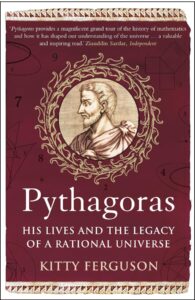 368 pages | English
Review by Dinesh Dhawane
When Numbers Become Music
“All things known have number.”
For most readers, Pythagoras begins and ends with a theorem learnt in school. Kitty Ferguson’s The Music of Pythagoras reminds us that this famous equation is only a tiny part of a much larger story. Behind the mathematics stood a remarkable thinker whose ideas shaped philosophy, science, music, and the way later generations came to understand the universe.
This is not a conventional biography. Ferguson is less interested in assembling dates than in recreating the world in which Pythagoras lived and the ideas that survived him. Reading the book, I was reminded of Albert Einstein’s belief that the universe is mysterious but ultimately understandable. Ferguson suggests that Pythagoras saw the world in much the same way more than twenty-five centuries earlier.
The book moves comfortably between history, philosophy, mathematics, and music without becoming heavy. It separates the historical Pythagoras from the legends that gathered around his name, while showing why those legends arose in the first place. By the end, the famous theorem almost feels like a footnote to a much richer intellectual legacy.
The Life of a Seeker
Ferguson presents Pythagoras not simply as a mathematician but as someone who devoted his life to the search for truth. He believed that wisdom required discipline, self-control, and a life lived in harmony with nature. Ideas, for him, were meant to be lived rather than merely discussed.
Leaving the island of Samos during a period of political uncertainty, he eventually settled in Croton in southern Italy, where he founded the Pythagorean brotherhood. It was a community unlike any other, bringing together mathematics, music, ethics, philosophy, and spiritual practice.
“There is geometry in the humming of the strings; there is music in the spacing of the spheres.”
Whether these words are authentically his hardly matters. They capture the spirit of his philosophy perfectly. Ferguson explains how simple observations about musical harmony led Pythagoras to believe that numbers reveal the hidden order of the universe. Harmony was not limited to music. It existed in the heavens, in nature, and within the human soul.
One aspect I particularly appreciated was Ferguson’s restraint. She does not pretend to know more than history allows. Wherever evidence is uncertain, she says so. That honesty makes the portrait of Pythagoras far more convincing.
A World Learning to Ask Questions
The sixth century BCE was a fascinating period. Ancient traditions still shaped everyday life, yet people had begun asking questions that demanded reason instead of inherited belief. Ferguson brings this world alive with remarkable clarity.
Pythagoras arrived in Croton at a time when Greek society was changing rapidly. His followers believed that mathematics, philosophy, religion, ethics, and music were different paths leading towards the same truth.
“No man is free who cannot control himself.”
For the Pythagoreans, philosophy was never just an intellectual exercise. It demanded discipline. Learning and character belonged together.
The brotherhood remained secretive and highly organised, which eventually attracted suspicion. Political unrest finally led to its destruction, forcing Pythagoras to spend his last years in Metapontum.
“The wise man should be prepared for everything that does not lie within his control.”
This historical background gives the book depth. Ferguson reminds us that ideas do not exist in isolation. They are shaped by the societies that nurture them and sometimes threatened by the societies that fear them.
The Language of Numbers
No writings by Pythagoras himself have survived. His ideas lived on because his followers preserved them. Ferguson makes an interesting point here. A thinker’s greatest work is not always a book. Sometimes it is the tradition that continues long after the person is gone.
The central idea of Pythagorean philosophy is surprisingly simple. The universe is ordered, and mathematics offers the clearest path towards understanding that order.
Experiments with the lyre showed that harmonious sounds arise from simple numerical ratios. From that observation grew an extraordinary vision of reality. Nature itself, the Pythagoreans believed, is built upon mathematical relationships.
“Geometry is knowledge of the eternally existent.”
Ferguson follows these ideas through later thinkers such as Plato, Aristotle, Euclid, Johannes Kepler, and Isaac Newton. Reading these chapters, one begins to see how deeply the Pythagorean way of thinking entered the foundations of Western civilisation.
“The universe is rational.”
Another strength of the book is its refusal to blur history and mythology. Ferguson carefully distinguishes early evidence from later legends, including works such as The Golden Verses. Instead of dismissing those stories, she asks why people felt compelled to create them. That question turns out to be just as interesting as the stories themselves.
More Than a Biography
What stayed with me long after I finished the book was its atmosphere. Ferguson writes with quiet confidence. She never lectures the reader, nor does she oversimplify difficult ideas. She trusts the reader to think.
The result is something richer than biography. It is really the story of an idea and its remarkable journey across more than two thousand years.
The book also reminds us that philosophy was once understood as a way of living. Pythagoras reportedly called himself a philosopher, a lover of wisdom, rather than a wise man. That distinction still feels meaningful today.
His belief that mathematics, music, ethics, astronomy, and spirituality belong to the same search for truth gives the book its central theme. Whether one agrees with every conclusion is almost beside the point. The ideas themselves are endlessly fascinating.
Why It Still Matters
It is remarkable how modern many of these ideas still feel.
Pythagoras believed that the universe follows patterns that human beings can discover. Modern science continues that search. His work on musical harmony still influences music theory. His emphasis on discipline and self-mastery remains relevant in an age that often values speed over reflection.
The book also reminds us that knowledge is not simply about collecting information. It is about learning to see order where others see confusion.
That may be Pythagoras’ greatest lesson.
Thoughtful and Engaging
Kitty Ferguson has written a thoughtful, engaging, and deeply readable introduction to one of history’s most influential thinkers. She succeeds in making philosophy accessible without making it simplistic, and history enjoyable without sacrificing scholarship.
This book will appeal to readers interested in philosophy, mathematics, ancient history, music, or the history of science. It offers enough depth for serious readers while remaining approachable for newcomers.
More than anything else, it encourages curiosity. It reminds us that the biggest questions about truth, beauty, order, and the universe are still worth asking.
In a noisy world, The Music of Pythagoras offers something quieter. It invites us to slow down, think carefully, and look again at a world that may be far more harmonious than it first appears.
About the author: Dinesh Dhawane
 Dinesh Dhawane is a passionate bibliophile, rare and vintage book collector, and reviewer, with one of the largest personal libraries in the country. Deeply drawn to Marathi, Hindi, and Urdu literature, he brings sensitivity and insight to his reviews.
He has also authored several academic works and, as a Core Committee Member of the Nagpur Book Club and Nagpur Film Society, actively promotes literary and cinematic culture.




पायथागोरसची ही बाजू बिलकुल माहित नव्हती..
आईन्स्टाईन, होमी भाभा, सत्येंद्रनाथ बोस, रिचर्ड फाइनमन यांसारख्या जगप्रसिद्ध भौतिक शास्त्रज्ञांचा संगीताशी असलेला समांतर प्रवास माहीत होता. आज एका गणितीच्या अपरिचित पैलूचा परिचय झाला
thanks ❤️❤️🙏