
Book Review of ‘The Goldfinch’ by Donna Tartt – A story of Loss, Obsession, and Survival
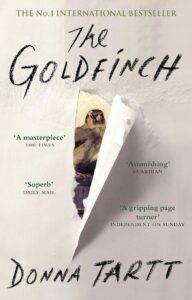
962 pages | English
Review by Pushpa Rathi
Note: I have just finished this 962-page novel. It took me about a month and a half to read, and by the end I felt as if I had lived inside the world of the book rather than merely read it.
Before speaking about the novel, a few words about the author. Donna Tartt is one of the most respected contemporary American writers, known for her deeply psychological and richly layered fiction.
The Goldfinch was awarded the Pulitzer Prize for Fiction in 2014, one of the highest honours in literature. The novel was widely praised for its emotional depth, its unforgettable characters, and its meditation on art, grief, fate, and the strange ways in which life shapes us.
Origin of the Title
The title ‘The Goldfinch’ comes from a famous painting by the Dutch master Carel Fabritius, painted in 1654, the same year the artist died in a tragic explosion, though the painting itself survived.
The image is simple: a small bird, chained to its perch. Yet this small painting becomes the emotional and symbolic heart of the entire novel.
And I add my own love to the history of people who have loved beautiful things.
The whole story revolves around this painting and the strange, almost fateful way it comes into the life of a young boy named Theo.
The Beginning : Tragedy in the Museum
The novel begins with a shocking and unforgettable incident.
Twelve-year-old Theo visits a museum with his mother when a sudden bomb blast destroys the building. His mother dies in the explosion, and in the confusion that follows, Theo finds himself wandering among the ruins.
A dying visitor in the museum tells him to take a small painting; the painting of the chained bird, and carry it away. That visitor dies, but his granddaughter survives.
In that moment of fear and shock, Theo takes the painting without fully understanding what he is doing. That single act shapes the rest of his life.
Things would have turned out better if she had lived. But that is the thing about the world: it goes on.
After the tragedy, Theo goes to live with the Barbour family, whose son studies with him. Yet he secretly keeps the painting hidden, always living with the fear that someone will discover it.
Life with his Father : Loneliness, Fear, and Self-destruction
After a few months, his long-absent father suddenly appears and takes Theo away.
Now the boy becomes even more anxious about the stolen artwork. He carefully wraps the painting, carries it in his suitcase, and hides it behind his bed, knowing that the whole world must be searching for it.
During this period, his life becomes unstable and directionless.
He meets Boris, a Russian immigrant boy with an abusive father. The two boys form a strange but powerful friendship, and together they fall into drugs, alcohol, and reckless living.
We are damaged and broken and it’s not our fault, but it’s our responsibility.
This part of the novel shows with great honesty how grief, loneliness, and lack of love can slowly destroy a young mind.
Return to New York : Antiques, Deception, and the World of Appearances
After Theo’s father dies, he returns to New York.
At first he stays again with the Barbour family, but tragedy has struck them as well, and eventually he goes to live with an antique dealer.
Here the novel opens into a fascinating world of old furniture, rare objects, collectors, and wealthy clients.
Theo grows into a skilled salesman of antique furniture, moving among rich people and art lovers, yet always carrying his secret inside him.
What we’re drawn to may not be what’s good for us.
The painting becomes less an object and more like a burden, something he cannot throw away and cannot return.
The Revelation : Boris and the Missing Painting
Years later, Theo meets Boris again, and one of the most surprising revelations of the novel comes at this point.
Boris tells him that he had stolen the painting long ago and replaced it with an old textbook, a book Theo never opened, because he was too afraid of being discovered.
This moment changes the meaning of everything that came before.
Boris also tells him about the international world of stolen art, and takes him to Amsterdam to recover the painting.
What follows is one of the most dramatic parts of the novel, filled with danger, crime, and even murder.
In the end, Boris secretly informs the authorities about the stolen paintings and receives reward money for giving information.
Because of this, Theo is finally freed from the fear of being punished for the theft.
Pippa : Love, Memory, and Shared Trauma
Running parallel to the story of the painting is Theo’s quiet and painful love for Pippa, the girl who also survived the museum explosion.
Both of them carry the same trauma, and both understand that some wounds never completely heal.
Their relationship remains incomplete, almost like a memory that never becomes real.
That life – whatever else it is – is short.
Pippa realises that the past has shaped them too deeply, and that their pain may destroy them if they try to live together.
The Ending : Philosophy, Art, and the Meaning of Suffering
The novel ends on a deeply philosophical note.
Theo reflects on guilt, beauty, love, loss, and the strange way in which art survives even when human lives are broken.
Only after losing everything can we understand the value of what we had.
The book becomes not just a story about a stolen painting, but about survival; how people continue living after tragedy, how obsession can both destroy and save, and how beauty sometimes gives meaning to suffering.
It is a story of loss, mental trauma, greed, obsession, and the instinct to survive.
My Final Thoughts
Overall, it is a true page-turner and a deeply interesting story to read.
Donna Tartt’s ending of the book I could not fully fathom, yet the novel remains powerful, haunting, and unforgettable.
About the Author: Pushpa Rathi
 Mrs. Pushpa Rathi is an avid reader, world traveler, and Core Committee member of the Nagpur Book Club. A postgraduate in Botany, she discovered her love for literature early in life, encouraged by her parents and teachers in Bramhapuri. Growing up in the Bhaiya family, founders of the Nevjabai Hitkarini educational institutions, she was shaped by an environment rich in learning and books.
She reads widely in Marathi, Hindi, and English, with a special fondness for history, culture, and fiction. Her reviews are known for their insight, clarity, and genuine love for the written word. Passionate about nurturing young minds, she actively works to encourage children to develop a lifelong reading habit. When not reading or mentoring young readers, she enjoys music and meaningful conversations.