
A review and summary of the book, Nehru and Bose, Parallel Lives by Rudrangshu Mukherjee
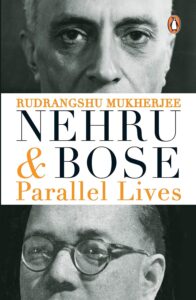
Pages 265 | English
Review & Summary by Anil Saxena
Subhash Chandra Bose and Jawaharlal Nehru are the two brightest stars of our independence struggle against the British in the first half of the twentieth century. There are several biographies of Nehru available, some of them full of deep scholarship. There are also a few biographies of Subhash Chandra Bose, but the book which I picked up was unique in the sense that it describes the parallel growth of these two politicians in the political ferment of India, and it also throws a very focused beam on their personal relations, their similarities, bonhomie, rivalry, and differences in their outlook towards the struggle for freedom.
Today’s generation, and sometimes people with motives in their heads, want them to be seen as rivals and combatants of each other. But the reality lies somewhere else, and this short but penetrative book explores their relationship with sincerity and objectivity. In an age of WhatsApp history, where every piece of history and every character is brutally trivialized and cut to fit the size of cloth of a particular colour and shape, this book becomes still more valuable to readers who want to have a just and reasonably fair assessment of both leaders and their interpersonal relations.
Early Years
Subhash Chandra Bose was eight years younger than Jawaharlal Nehru. A brilliant student, he was drawn to spiritualism from an early age, attracted towards Swami Vivekananda, Ramakrishna Paramahamsa, and later Sri Aurobindo. He was a rebel throughout his youth. Once he thrashed his British teacher for insulting a student, refused to divulge the names of the other boys involved, and got rusticated. He participated in the Territorial Army, enjoying military authority and discipline. Later he tried to enter the Bengal Army, but his poor eyesight prevented him. After 1921 he came under the influence of Chittaranjan Das and Gandhi.
Subhash was born into a middle class family with nine siblings. His father was a successful lawyer of Cuttack. He wrote the civil service examination in England, secured fourth position, but quit because he did not want to serve the British against his own countrymen, and he wanted a life full of action and purpose.
Jawaharlal Nehru was born with a silver spoon, being the son of one of the highest paid lawyers of Allahabad, Motilal Nehru, whose practice was flourishing. He was raised in riches and was given the best education in English, Sanskrit, and theosophy. Since the beginning he was fond of reading, Walter Scott, Three Men in a Boat, poetry, and gems of English literature, tales of Shakespeare remained his favourites in childhood.
He was moderate in studies, passed out from Harrow without much distinction, and later at Cambridge too he cleared all examinations rather indistinguishably. When he came to India he was, in his own words, an aesthete, a dilettante, and a prig, a sucker for the good life.
Entry Into Politics
With the advent of Gandhi, Nehru changed for good. The peasant uprising in Awadh opened his eyes to the plight of peasants, and the atrocities committed in the form of levies, tithes, and fines made him revolt internally. The British tried to crush the movement, but for the first time he realized the power of the crowd and their acceptance of non-violence as a creed. From then on he was a follower of Gandhi and stood by him at all times, despite misgivings on many occasions.
Subhash too, at the first opportunity, met Gandhi, but he found Gandhi’s ideas cloudy on many issues. Still, on the advice of Gandhi he joined C. R. Das to conduct the affairs of the Congress in Bengal. He became enamoured of Das and remained his acolyte for a long time.
Visit of Prince of Wales, Early Cutting of Teeth in Politics
Gandhi launched the civil disobedience movement and boycott of the visit of the Prince of Wales. Subhash was successful in conducting the boycott in Calcutta, and Nehru in Allahabad. Das agreed to the offer of the government after the Montagu Chelmsford reform to participate in the government. Gandhi rejected it, and Motilal Nehru and Das formed the Swaraj Party to work with the administration. Nehru too disliked this arrangement.
Later C. R. Das and Subhash were made Mayor and Chief Executive Officer of Calcutta. Subhash plunged into the job and forgot politics for a while, but their tenure was marred with corruption allegations and other charges. Later Subhash was sent to Mandalay jail on a flimsy charge of fomenting revolution against the government with the help of Bolsheviks.
Mayoralship, Nehru & Other Congress Stalwarts
Both Nehru and Subhash were aghast when Gandhi withdrew the civil disobedience movement after the Chauri Chaura killings. Later Nehru too went to prison with his father, and still further he became Mayor of Allahabad. During that era Vallabhbhai Patel was made Mayor of Ahmedabad, and Vitthalbhai Patel of Bombay. Nehru cut slackness, sloth, and indiscipline, controlled corruption, and was quite upright in keeping the administration clean. He even asked the committee to feel free to reprimand him if he breached protocol. But unlike Subhash, he remained a quintessential Congress man.
Nehru went to Europe for his wife’s treatment, and when he returned he had become a socialist to the core. It had very clearly dawned on him that mere independence without an overall change in the social and economic superstructure along socialist lines would not be of much worth.
First Disillusionment with Gandhi
Nehru asked for complete independence and not Dominion Status, which most of Congress and Gandhi were demanding at that time. Subhash stood by Nehru on this issue. Nehru got the resolution on independence passed, but Gandhi criticised it in his paper. A major difference emerged between the two, though Nehru later succumbed to Gandhi’s wishes.
Subhash and Nehru were now two emerging stars. Nehru formed an Independence League and Subhash supported it, but some politicians from Bengal did not like Nehru getting prominence and floated a parallel outfit, much to the irritation of Nehru.
Simon Commission
Both opposed the Simon Commission. Nehru received more than a dozen lathi blows while protesting in Lucknow, but came out stronger physically and more resolute in his idea of complete independence.
Nehru questioned
Who is the British Parliament to take a decision about the affairs of India?
Nehru now made fiery arguments against capitalism along with imperialism, his belief in socialism growing stronger. The British were ruling India through baton and bayonet, and both Nehru and Subhash echoed each other. Subhash too successfully organised protests against the Simon Commission.
By now both tiger cubs had attained adulthood, Subhash undertaking a fifteen day hunger strike, and Nehru taking blows of lathis on his body during the Simon agitation.
Subhash’s Love for Military Pomp
In 1928, in response to a British challenge, Congress constituted a committee headed by Motilal Nehru to propose a constitutional framework for India. The Motilal Nehru Report asked only for Dominion Status, and Jawaharlal signed it quite unwillingly. Motilal wanted to see his son as the next Congress President after his term, and when he reached Calcutta for the Congress session, Subhash organised a full military style parade and a twenty one gun salute befitting a king or a viceroy. He paraded himself and volunteers in military uniforms stitched by English tailors. Subhash forgot that only a few days earlier he had boycotted and burnt foreign goods and clothes. Gandhi did not like it and called it a Bertram Mills circus.
Nehru and Subhash made it clear to Gandhi that Dominion Status was not acceptable to them, only complete independence. Gandhi in the session pressed for Nehru to be made President, though Nehru had only three votes against Gandhi’s ten and Patel’s five. Nehru hated to hold the presidency in such a manner and felt humiliated, refusing strongly at first. Subhash too took it as a shrewd move to put a wedge between him and Nehru, but he was disappointed to find Nehru finally accepting Gandhi’s offer. Gandhi tried to mend fences by declaring that if Dominion Status was not given in one year then Congress would force complete independence. Everyone considered it a far fetched possibility.
Round Table Conference, The Game Plan of the Viceroy
Lord Irwin deliberately floated a dubious proposal of a Round Table Conference, knowing that it would lead to nothing, but it would keep Congress in good humour. Bose and Nehru both showed no inclination towards the offer and reiterated their stance of complete independence. Gandhi got the Delhi Manifesto written, diluting many demands, and asked Nehru to sign it, but he refused. Subhash too put forward an alternative proposal, but Gandhi forced Nehru to sign. Nehru did sign but wept and resigned from the General Secretaryship. Bose had already resigned from the Working Committee.
Ultimately Gandhi too realised that the proposal was a deception, withdrew from the Round Table Conference, and Subhash and Nehru both took their resignations back.
In Bengal meanwhile, Bose was thrust into factional fights, as some not so popular Jyoti Sen from Chittagong was made Mayor and leader of the legislative assembly, a man considered close to Gandhi. Subhash resigned but immediately took back his resignation. The factional fights however remained bitter.
The Congress committee run by Bose supporters was later marred by financial mismanagement, irregularities, and charges of misuse of funds.
Lahore Session And Declaration of Independence
During the Lahore session, Nehru arrived in a charger and declared complete independence as the goal, and announced that 26 January would be celebrated as Independence Day. Subhash introduced two amendments, complete boycott of the British, and formation of a parallel government. Nehru understood that the time was not ripe for such drastic action, and both amendments failed. Adding insult to injury, Bose found his name cut from the Working Committee. While he had earlier been in disagreement with Gandhi, he now felt disappointed with Nehru also. Gandhi again succeeded in putting a wedge between him and Nehru.
Civil Disobedience Movement, The Mesmerizing Power of Gandhi
Gandhi jolted everyone by his master stroke of launching the Civil Disobedience Movement through the Salt Satyagraha, and he received applause from both Nehru and Subhash. Soon both were arrested. Motilal died while in jail.
Nehru felt bereft and needed a father figure for emotional stability, and he found that in Gandhi. Their bond became stronger as years passed. On the other hand Subhash was slowly drifting apart from Gandhi.
While Gandhi, Nehru, and Bose were in jail, Sapru and Jaikar tried to reconcile Congress with the British but failed. Gandhi unilaterally signed the Gandhi Irwin Pact. Nehru and Bose both felt uneasy about it, Nehru silently but with great anguish, and Subhash openly.
After release, Subhash again became Mayor of Calcutta, and he openly proclaimed his choice to combine the equity of socialism, the freedom of democracy, and the discipline and efficiency of fascism.
Subhash and Nehru both missed the presence of Motilal Nehru, as he was perhaps the only man who could have restrained Gandhi when needed.
The Gandhi Irwin Pact and the Round Table Conference ultimately failed.
Once Subhash travelled with Gandhi from Bombay to Delhi, and he experienced for the first time the immense crowd pulling power and popularity of Gandhi. He was completely overwhelmed by Gandhi’s charisma. On personal terms however he maintained a distance, always addressing him as Mahatma, while Nehru used the more affectionate word Bapu.
Arrests, Exile & Growing Distance
Subhash was arrested on multiple occasions in the nineteen thirties. In 1932 he was again arrested, fell ill in jail, and his condition deteriorated badly. He was sent to Europe for treatment. Around the same time Nehru too went to Europe for the treatment of Kamala.
Kamala’s condition kept deteriorating, and she remained in and out of sanatoriums in India and Europe while Nehru was in and out of jail. By temperament the two were very different, Nehru reserved and intellectual, Kamala simple and homely, but she bore his long absences with patience. After her death Nehru realised what she meant to him.
Nehru was in deep mental anguish when Gandhi withdrew the Civil Disobedience Movement and instead concentrated on untouchability, social reform, and khadi. He felt he was growing apart from Gandhi.
Both protégés were now cutting away their umbilical cord from their political father. In Subhash’s case the break became final, while Nehru remained in dilemma.
Subhash lamented in 1933 and 1934 that Nehru had a fine mind and great intelligence, capable of leading the nation, but he was taking a wrong path.
When Nehru became Congress President, Gandhi undertook a fast unto death against Ramsay MacDonald’s announcement of separate electorates for Dalits. Nehru, who was in jail, feared that they might lose Gandhi for what he thought was a wrong cause.
Subhash in Europe, Ideologies Diverge
Subhash married clandestinely while in Europe. Nehru and Bose met several times there, and their personal bonds deepened. Bose provided substantial support to Kamala Nehru during her illness in Europe in the absence of Jawaharlal. Subhash met Benito Mussolini twice and presented his book to him, as he believed that armed struggle against the adversary might become necessary. Mussolini advised him to prepare a plan for such a struggle.
“Freedom is not given, it is taken.”
— Subhas Chandra Bose
Germany was a different experience. He could not meet Hitler, only his associates. At times he was called a racial slur while walking in the streets. Rosenberg, the Nazi ideologue, appeared openly racist. Bose wanted to meet Hitler to request removal of references to Indians from Mein Kampf, but it did not materialise.
It is surprising that while Subhash stayed in Germany and Vienna, he did not record strong reactions to discrimination against Jews, nor did he fully acknowledge the virulent racial hatred of Nazism. He wanted a synthesis between communism and fascism for India. Later he criticised imperialism of fascism, but overlooked its internal brutality, racism, and suppression of dissent.
Nehru during his travels understood clearly what a menace Nazism and fascism were. He disliked their racialism, persecution of Jews, and destruction of civil liberties. This ideological difference between the two widened steadily.
Subhash asked Nehru for advice about returning to India. Nehru advised him to come back. He returned, was arrested, and was interned in his own house in Kurseong.
Books, Ideas & Socialism
Nehru developed a deep interest in Soviet style planning. He wrote extensively about socialism and industrialisation in his works such as Glimpses of World History. He believed that without industrialisation, happiness would remain a distant dream for India.
Both leaders wrote books. Subhash, in Vienna, without proper reference material and while in poor health, wrote The Indian Struggle. He tried to be objective in the book. He praised Gandhi as a reformer but not as a revolutionary, and argued that India needed new leadership and a new kind of struggle. The book was banned in India, but reviewers in England praised its intellectual force, though they disagreed with his conclusions.
Nehru wrote his autobiography, reflecting on India’s struggle, the uncertain future, and his own limitations. He avoided personal gossip, and instead analysed the freedom movement, Gandhi, and world politics. The book received praise everywhere.
Nehru as President, Old Guard & New Ideas
Gandhi asked Nehru to become Congress President and allowed him freedom in taking decisions, though in reality Gandhi never intended to give him full independence. In the election Nehru got five hundred forty three votes against five hundred ninety delegates.
His presidential speech dealt largely with international politics. He spoke about the rise of fascism from capitalism and imperialism, and warned that India could not remain isolated from world events. He advocated socialism as the best system for India. The Working Committee members such as Rajendra Prasad and Patel did not agree, and the speech received only a lukewarm response.
Twenty industrialists from Bombay wrote against Nehru’s socialist ideas. Ghanshyam Das Birla tried to calm matters and expected the conservative leaders to keep the party steady. Congress remained in the hands of the old guard. Nehru called himself shameless for continuing, but he did not resign, partly because of his emotional dependence on Gandhi, and partly because he did not want to split the party. He felt the absence of Subhash deeply.
When elections were held under the Government of India Act, Nehru opposed participation but finally agreed. He drafted the manifesto, toured the entire country, and drew huge crowds everywhere. Congress won a sweeping victory, winning seven hundred eighty seats out of one thousand seventy two.
Subhash as President, The Final Break
Subhash became Congress President. His address pleased both left and right, as he spoke about socialism, communal harmony, industrialisation, minority rights, and cottage industries. He wrote warmly to Nehru, who was in Europe, saying he missed him greatly.
Bose made Nehru chairman of the Planning Committee. Nehru accepted, but differences arose over H. V. Kamat, who interfered in decisions. Nehru was unhappy, and Bose supported Kamat, which hurt Nehru.
During his visit to Europe, Nehru met Stafford Cripps, Harold Laski, Attlee, and other Labour leaders. They discussed transfer of power and the idea of a Constituent Assembly.
Bose wanted a second term as President, but the conservative group opposed him. Gandhi supported Pattabhi Sitaramayya. Bose insisted on election and defeated him. Gandhi said that Pattabhi’s defeat was his own defeat.
The Working Committee resigned. Nehru also resigned, but for procedural reasons. Gandhi refused compromise. Bose felt betrayed by everyone, including Nehru. Finally he resigned and later formed the Forward Bloc.
Bose wrote angry letters to Nehru accusing him of opportunism. Nehru replied calmly but firmly. Their correspondence stopped, though personal respect remained.
War, Escape, INA
When the war began, the Viceroy declared India at war without consulting Congress. Nehru wanted Britain to promise freedom in return for support. Bose rejected such half measures.
Gandhi declared Nehru his political heir, saying that after him Jawahar would speak his language.
Subhash escaped from house arrest in disguise, travelled through Kabul to Berlin, and later went to Japan. In Germany he received courtesy but little real support. He did not openly criticise Nazi policies, possibly because he needed their help.
In Japan he organised the Indian National Army. He formed the Azad Hind Government. He named brigades Gandhi, Nehru, and Azad, and called Gandhi the Father of the Nation.
The INA fought bravely, but the war turned against Japan. In 1945 Bose died in an air crash. Nehru wept on hearing the news and said he had lost a younger brother.
Similarities & Differences
Both were English educated, from prosperous families, and free from communal prejudice. Both believed in socialism and industrialisation. Both demanded complete independence. Both admired Gandhi but disagreed with him at times.
But their temperaments were opposite.
Nehru was introspective and self questioning.
Bose was decisive and action oriented.
Nehru trusted democracy.
Bose admired discipline and authority.
Nehru understood the dangers of fascism.
Bose believed it might help India in some form.
Between them always stood Gandhi, whose influence shaped their destiny.
Nehru never agreed with Bose’s alliance with Germany and Japan, yet he admired his courage and later defended INA soldiers.
My Final Assessment
This is a remarkable book about two of the most charismatic leaders of our freedom movement and their complicated relationship. The book is important because in present times there is much loose and ill informed propaganda, especially on social media, showing Nehru in a bad light in his dealings with Bose. The book challenges such claims and presents a balanced view based on facts.
Highly recommended.
Post Script
Not in the book, but worth recalling, Nehru said on the 49th birth anniversary of Subhash Chandra Bose:
Subhas Bose and I were co workers in the struggle for freedom for twenty five years. There were differences between us on political questions, but I never doubted that he was a brave soldier in the cause of freedom. People who behave like sheep cannot make progress. The manner in which Netaji faced the crisis inspires admiration. Perhaps I might have done the same if I were in his position.
Author Bio: Anil Saxena
 Anil Saxena is a retired Principal Chief Conservator of Forests and Head of Forest Force (HoFF), Maharashtra.
A lifelong nature lover and prolific reader, he brings depth, clarity, and insight to every book he reviews. As a Core Committee member of the Nagpur Book Club, he is known for his comprehensive reviews that make even complex subjects accessible and engaging.
Anil Saxena divides his time between Nagpur, Mumbai, and New York, enjoying the company of his children and grandchildren while continuing to explore the world of literature.