
Book Review of ‘Silent House’, by Orhan Pamuk
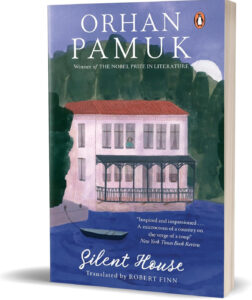
Pages: 352
Review by Anil Saxena
A Lonely House, a Lonely Woman
Silent House by Orhan Pamuk is a saga of a Turkish family, beginning with the life of a 90-plus-year-old widow, Fatima, living alone and unloved in a lonely house outside Istanbul, in a rustic setting.
Her only companion is her dwarf servant, Razzeb, who not only maintains the old mansion but also cares for her. Every summer, her three grandchildren visit during their vacations.
Fatima is the widow of Selahattin — a doctor, an avowed atheist, a self-proclaimed rationalist, and a man deeply imbued with the spirit of modern science, so much so that he even added Darwin’s name to his own. Selahattin dreamed of making Turkey an egalitarian republic, guided by science and Western progress. He despised orthodoxy, blind religiosity, backwardness, and superstition.
A Dreamer’s Obsession
Gradually, Selahattin’s dream became a dangerous obsession. He gave up his medical profession to write an encyclopedia of science for the benefit of society.
Fatima, by contrast, was steeped in the mores and norms of an orthodox, God-fearing Turkish upper-class family. She had little education and married young — making her a complete mismatch for the unrepentant iconoclast she wed. Despite Selahattin’s desperate efforts to educate her and share his worldview, she remained devout and considered him a sinner whose atheism could never be pardoned.
Because of his obsession, Selahattin moved the family to a less prominent town, built a house, pawned his wife’s jewelry piece by piece to fund his dream, took to heavy drinking, and died too young — before completing his encyclopedia.
A Family Marked by Loss
Fatima and Selahattin had a son who also died young, inheriting his father’s drinking habits and impractical nature. He married and had three children:
- Farooq – A professor and amateur historian, divorced, and as much a dreamer as his grandfather. He wishes to write a great work of history but has yet to achieve it.
- Nilgün – A beautiful and modern-minded girl with Communist leanings.
- Metin – The youngest, who aspires to go to America. He earns pocket money by giving tuitions, is recklessly in love with a girl, and even wishes to sell the family mansion to finance his ambitions.
The novel unfolds during their visit to their grandmother, told through a shifting narrative where each character speaks for themselves. The story moves fluidly between past and present, revealing each character’s inner world.
Hasan: Aspirations and Frustrations
Among the other characters, the most significant is Hasan — an adolescent student and nephew of Razzeb. He is ambitious, yearning for wealth and influence but lacking the education, skills, and means to achieve them.
A daydreamer, Hasan harbors feelings for Nilgün, his childhood playmate. When she shows indifference to his advances, frustration drives him toward the company of fascist street louts who hate both Communists and the upper classes. In the end, Nilgün pays a heavy price for this social and political animosity — with her life.
A Changing Turkey
The story spans from the early 1930s to the late 1970s — a period of shifting values and aspirations in Turkish society.
The early years, in Selahattin and Fatima’s time, saw Turkey awakening to Western science and political ideals. By the 1970s, the country was caught in the Cold War tug-of-war between Brezhnev’s Soviet Union and Carter’s America. Society became deeply divided — not just between rich and poor, but also between Communists and nationalists, with street gangs and political violence becoming part of everyday life.
Hasan, moving in the company of nationalist roughnecks, is sensitive yet constrained by class differences, personal shyness, and limitations that fuel his frustrations.
Bitter Truths and Lasting Resentments
Razzeb and his brother Kamal were the illegitimate children of Selahattin. Fatima never accepted them, despite Razzeb’s lifelong devotion and service to her. In her eyes, they remained bastards and objects of contempt.
Fatima outlived most of her family, spending her final years loveless, lonely, and absorbed in the past. Her relationship with her grandchildren was perfunctory, lacking warmth.
Razzeb, despite Fatima’s cruelty toward him and his brother, attends to her needs with rare tenderness, becoming the quiet emotional anchor for the family.
Style, Themes, and Impressions
Pamuk interweaves the perspectives of seven main characters, each given depth and empathy. The novel’s vast scope captures the tension between tradition and modernity, nationalism and communism, the old world and the lure of the West.
The narrative style — with its internal monologues, stream of consciousness, shifts between past and present, and multiple viewpoints — invites comparison with Gabriel García Márquez’s One Hundred Years of Solitude. Like Márquez, Pamuk creates a family saga that reflects an entire society in transition.
Verdict
Silent House is more than just the story of a family; it is a mirror to the transformations in Turkish society over half a century. The characters are richly drawn, the historical backdrop is compelling, and the emotional undercurrents are quietly powerful.
I enjoyed reading it and look forward to exploring more of Pamuk’s work.
Author Bio: Anil Saxena
 Anil Saxena is a retired Principal Chief Conservator of Forests and Head of Forest Force (HoFF), Maharashtra.
A lifelong nature lover and prolific reader, he brings depth, clarity, and insight to every book he reviews. As a Core Committee member of the Nagpur Book Club, he is known for his comprehensive reviews that make even complex subjects accessible and engaging.
Anil Saxena divides his time between Nagpur, Mumbai, and New York, enjoying the company of his children and grandchildren while continuing to explore the world of literature.