
Book Review of ‘Humankind: A Hopeful History’, by Rutger Bregman
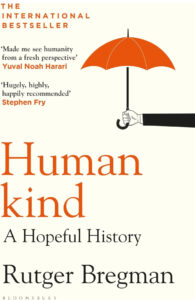
Pages: 496
Review by Anil Saxena
Recently, I came across a very thought-provoking book called Humankind: A Hopeful History. It reopens an age-old debate on the basic nature of humankind: are we basically mean and ugly, or decent and cooperative?
Two Schools of Thought
There are two schools of thought. One belongs to Hobbes, Locke, Machiavelli, and among the moderns — Dawkins, Nietzsche, psychologists like Jared Diamond, Stanley Milgram, Philip Zimbardo, and a host of others — who believe that humans are basically vile and brutal. Civilization, according to them, is just a veneer. Scratch it, and you get a mean, selfish human. It is only the state, as an institution, that can undermine these individual traits, and its control alone makes us sociable, law-abiding, and cooperative.
On the other hand, there is Rousseau, who believes in the innate goodness of human beings. He famously said: “Man is born free, but everywhere he is in chains.” For Rousseau, it is the ugly effects of civilization that alter our basic goodness and make us mean and ugly.
Where Do You Stand?
Which school do you belong to? Do we believe that all of us are scoundrels unless proven otherwise, or that everything is just right about us?
This book of over 480 pages tries to explore, dissect, and understand this aspect of humanity through critical analysis of past mass-psychology experiments. With empirical observations, the author throws new light on this most debated subject, one that interests all of us.
Bregman brings forth some uncanny revelations about our progress as a race.
Fascinating Insights from the Book
- Why Homo Sapiens Beat Neanderthals
Neanderthals, though physically stronger, with larger brains and greater individual power, lost out in the race of evolution to Homo sapiens — who were softer and less robust. It was cooperation and better community organization that beat the Neanderthals hollow. - The Blitz Spirit
In the Second World War, during the Blitz — the bombing of London by the German Air Force — Hitler expected the UK to be brought to its knees. But the reverse happened. Britishers from all walks of life showed exemplary solidarity, courage, and unity, refusing to bow down to the brutal carpet bombings intended to demoralize them. - The Myth of Soldiers’ Bravery
During wars, despite all chants of individual courage and bravery, not more than 15% of soldiers actually fire their weapons — and this is true of all wars. - The Human Eye and Empathy
The whites of our eyes are unique to humans, and we communicate a great deal through them. Blushing, too, is uniquely human. Eye-to-eye contact fosters positive group behavior. - From Nomads to Property Owners
For fifty thousand years, humankind remained nomadic, cosmopolitan, proto-feminist, inquisitive, and friendly. Once we settled in fertile deltas like those of the Nile and Tigris to practice agriculture, property ownership emerged — along with patriarchy, religion, military fortifications, governments, oppression, slavery, and other ills of civilization.
The Double-Edged Nature of Empathy
Humans are emotional vacuum cleaners. Books, movies, paintings, and poetry move us. We empathize with fictional characters or distant strangers if we can associate with them. But the tragedy is that we often remain untouched, unmoved, and even cruel toward those who remain invisible to us.
Empathy and xenophobia go hand in hand.
A man operating a drone can kill faceless people thousands of miles away without feeling remorse. George Orwell once recounted how, as a soldier in the Second World War, he refrained from shooting a Nazi soldier he saw running with his pants down — in that moment, he saw him as a fellow human being. We kill only when we dehumanize or keep our distance.
Interestingly, oxytocin — the so-called “love hormone” — increases affection within our own group, but can also intensify aversion toward outsiders.
Surprising Truths About Violence
Even war-mongers and jihadists often kill not for ideology, heavenly pleasures, or the lure of houris, but out of friendship, camaraderie, loyalty, and self-sacrifice — positive traits misdirected to destructive ends.
The book also reveals that infants have an innate sense of morality.
Challenging Famous Experiments
Bregman critically revisits famous mass-psychology experiments:
- The Robbers Cave Experiment
- Philip Zimbardo’s Stanford Prison Experiment
- Stanley Milgram’s Obedience Study
In each case, he finds that results were manipulated, facts cherry-picked, and ulterior motives at play. Contrary to their conclusions, human subjects often emerged as loving and caring.
The “Auschwitz question” looms large — how could such evil happen? Milgram believed it was blind obedience: under command, people lose morality. Yet Bregman’s reanalysis shows that the supposed cruelty of participants was vastly overstated.
Why, If We Are Good, Is the World So Violent?
Bregman offers several reasons:
- Media Sensationalism – News and entertainment profit from highlighting ugliness, revenge, and conflict.
- The Mirroring Effect – Humans imitate each other. Violence, trolling, and even genocide can spread through social contagion.
- Distance Breeds Contempt – Physical and emotional separation dulls empathy.
- The Psychology of the Powerful – Many authoritarian leaders share traits of narcissism, shamelessness, and lack of empathy.
- The ‘Nocebo’ Effect – Negative expectations breed more negativity.
The Way Forward
In the final chapters, Bregman offers hopeful remedies:
- Reform education to be non-regimental, non-authoritarian, and joyful.
- Walk in others’ shoes to foster understanding, as Nelson Mandela did with Afrikaners.
- Travel more — “The more you travel, the less of a bigot you become.”
- Give others the benefit of the doubt, even at the risk of being deceived.
- Love others as you love your own.
- Avoid sensationalist media; read more books and editorials.
- Don’t hide your good deeds; be openly kind.
- Above all, be realistic about human nature.
Verdict
This is a very well-written book. It is not an abstract theorization of social behavior, but one grounded in empirical studies. It breaks many myths about human nature and restores our faith in the basic goodness of humanity.
It brings hope — and in today’s world, that is no small thing.
Highly recommended.