
Immortality by Milan Kundera
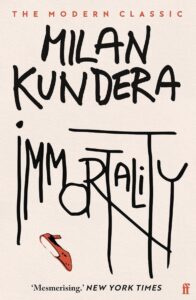
Pages: 354 | English
Review by Anil Saxena
Milan Kundera is a big name in literature, well known for blending philosophical speculation, dark humour, and politics in his fiction.
“To be mortal is the most basic human experience, and yet man has never been able to accept it, grasp it, and behave accordingly.”
Immortality speaks about the desire for immortality among common people and great artists, the crushing ordinariness of men and women, and the frivolity of modern consumerist society, where everyone resembles and imitates one another. Originality, what is it? Does it really exist?
Ideology and substance matter little. Only image matters, and not even pleasure. Humour has gone out of people’s lives because people now switch on the radio for amusement rather than enlightenment. Consequently, news of earthquakes and traffic congestion is treated with the same frivolity as any other mundane event.
The insensitive chatter of consumerist society is reflected in a stupid radio jockey who believes in remaining witty irrespective of the demands of a situation. The demarcation line between the ordinary and the extraordinary has disappeared from people’s lives, and so have the nuances of humour.
In this age, frivolity rules the roost. All ideologies are reduced to imagologies. It does not matter what the intrinsic content is. What matters is what is presented, how it is presented, and how it enhances one’s image.
These are some of the main themes of Immortality by Milan Kundera, a book considered nothing short of a modern classic.
My Tryst with Immortality
I first listened to this book on an audio platform, and even after listening to more than half of it, I could not make heads or tails of it. The author’s style, the dense and opaque characters, their tendency to interlace the narrative with snippets of classical literature and the insights of great minds, and the mixing of characters from the past and present on the same platform held little appeal for me.
Still, when my friend Ashok insisted that it was Kundera’s best work, I decided to reboot the book. This time, I read the text. I realised that some books are meant to be read and not merely listened to.
The Characters and Their World
It is the story of a father, a Spinozian philosopher who considers the universe a huge computer created by its maker and then left to run on its own. It is also the story of Agnes, his daughter, her sister Laura, Agnes’s husband Paul, their daughter Brigitte, and a host of oddballs.
Apart from the regular characters, the author himself appears in the narrative. There is also an eccentric, lewd professor who amuses himself with an equally ludicrous solution to one of the greatest nuisances of modern life, the automobile: he slashes car tyres.
On Immortality and Ordinariness
Is there anything worthwhile here, or is everything merely passing?
Why do all people, great and ordinary mortals alike, strive for immortality? Why does this feeble candle keep burning, even though we know all too well that it is posterity, not we ourselves, that decides what we will be remembered for, how we will be remembered, and why?
Peace creates ordinariness and consumerism, while crises create wars, ideologies, and great artists. But which is better, according to the author? Keep guessing.
Bertrand Bertrand, a radio commentator, receives a diploma for being a perfect ass because he cannot differentiate between a grave situation and an ordinary one. He uses the same brand of wit to explain an earthquake, a catastrophe, or any mundane event. He simply lacks the faculty to distinguish between them.
Paul: The Man Who Sees Through the Age
Paul is perhaps the only person who has a seasoned head on his shoulders. He has a vibrant personality, but surprisingly, he is anti-nature. A lawyer by profession, he considers himself a humanist guerrilla fighter who saves contrarians from the clutches of the law.
He also believes that wars and culture go hand in hand. There is always a relay race in progress, with each generation passing on to the next greater achievements in literature and art, along with increasingly varied methods of destruction.
Robespierre, Beethoven, Stalin, and Picasso are all runners in this relay race. They bring heaven and hell together, but all their sublimity has led mankind towards wars and catastrophes that have killed millions.
Paul is not unhappy that there has been no Picasso in the last forty years, because there have been no wars either.
He manages not one but three women, his wife, daughter, and sister-in-law, whom he eventually marries after his wife’s death, and serenades them all with aplomb.
Paul also understands that in this age of ordinariness, where everyone is merely a copy of everyone else, there is little room for great musicians, painters, poets, and artists. People cannot appreciate the nuances of musical notes because they cannot distinguish between the finer notes and the false ones. This metaphysical inequality is more devastating than class inequality.
What matters here is not substance but one’s image. Paul finds the greatest symphonies more useful if they are cut up and used as background music for toilet paper advertisements, thereby ending the terror of immortals such as Goethe, Beethoven, and Mahler.
Agnes: The Art of Being Oneself
Agnes is lovely in every respect. She is as original as it is possible to be and is not enamoured of her image, immortality, or what others think of her. She is as sublime as she is earthy.
She is her father’s daughter and, like him, has no ambition for immortality, name, fame, or recognition. Her only real love is for her father, a Spinozian philosopher, whose ideas have deeply influenced her.
Though happily married to a loving husband, Paul, and caring for him and their daughter, Brigitte, Agnes’s lasting ambition is to run away from all her living relationships and live alone somewhere, away from the clutter of familiar life and the expectations of those close to her.
Her escape ends in her accidental death.
Her natural charm attracts men of all sorts, including Rubens. One of her most captivating gestures is the simple, natural way she raises her arm to say goodbye to someone.
As Kundera writes:
“It is gestures that use us as their instruments, as their bearers and incarnations.”
Laura: The Eternal Seeker of Attention
Laura, Agnes’s sister, is another seeker of immortality and sympathy, a perfect specimen of ordinariness. Snappy, mercurial, and emotional, she wears her heart on her sleeve.
Agnes is her ideal. Laura emulates her, yet hates her guts and wants everything Agnes possesses, from her tantalising gestures to her husband. She is like a millstone hanging around Agnes’s neck.
Like Bettina, Laura wants to live permanently in the lives of others. She cannot bear the thought of being ordinary or forgotten.
Kundera’s observation is worth remembering:
“Man does not know how to be mortal, and when he dies he does not know how to be dead.”
Goethe, Bettina, and the Business of Immortality
Another important vignette concerns the relationship between Goethe and the aspirational Bettina, the daughter of his former lover.
Bettina has neither talent nor literary insight, but she has a desperate craving for immortality. She finds in Goethe the most formidable vehicle for achieving it. She writes about Goethe’s life in relation to herself, and posterity, ironically, becomes more enamoured of the juicy details of Goethe’s personal life than of his actual works.
The same problem confronts Hemingway and Beethoven. Posterity often fails to distinguish between their work and the spicy, colourful details of their lives.
In Goethe’s case, Bettina too becomes immortal, having attached herself to his fame and made herself almost as famous as the man whose reputation she sought to share. In the process, Bettina receives a greater share of fame than the unpretentious Christiane, Goethe’s wife.
Tears: Whom Do They Really Speak For?
The tears in Goethe’s eyes when he receives encomiums from Bettina and others reflect a banal truth about his own vanity.
Similarly, when Paul’s or Laura’s eyes grow moist upon learning of Agnes’s death, are those tears really for Agnes? Or are they for their own self-exaltation, for the caressing of their own images, which they love more than anything else?
Kundera makes us question even our most seemingly sincere emotions. Are we mourning another person, or are we mourning what that person meant to us?
Homo-Sentimentalist
“I think, therefore I am” is a statement favoured by intellectuals who underrate toothaches.
“I feel, therefore I am” is a truth that is much more valid, and it applies to everything that is alive.
There are many people but only a few thoughts. We borrow, and sometimes even steal, ideas from one another. But the moment someone steps on our foot, we suffer. Suffering, therefore, and not thought, is the basis of our real self.
Struggles for a better world and revolutions, according to this view, are often symptoms of a hypertrophied soul rather than genuine fights for a real cause.
It is a provocative thought, and Kundera leaves us to decide how much of it we are willing to accept.
What Should a Novel Be?
Milan Kundera tells us what a novel should be all about, and he tries to remain true to his own principles in Immortality.
He dislikes traditional novels that can easily be adapted for television or film. He says he writes novels that cannot simply be retold.
Normally, novels follow the rules of unity of action, with all causally related events leading towards a final resolution, as though someone were driving the characters with a whip towards a carefully planned ending.
Kundera hates this approach. For him, a novel should not be a bicycle race but a feast of many courses. Every episode should be a gem in itself, something to be savoured and appreciated.
Immortality follows this philosophy. It is a series of vignettes drawn from the past and present. Some are interrelated, while others may appear entirely disconnected. These episodes are interlaced with snippets of philosophy and penetrating psychological insights into the characters.
One may find this approach quirky, but that is precisely what it is.
My Verdict
I found the chapter on Rubens’s amorous life the most boring, longish, and disconnected from the main theme. But who am I to judge the acumen of an author who has displayed flashes of brilliance throughout the book?
I cannot say that I am floored by Immortality, but I would certainly call it an important work of modern literature.
For those who enjoy experimenting with their reading, relish philosophical digressions, and appreciate variety in both form and content, this book is worth exploring. It may not be an easy read, and it may not win everyone over, but it certainly gives you plenty to think about long after you have put it down.
Author Bio: Anil Saxena
 Anil Saxena is a retired Principal Chief Conservator of Forests and Head of Forest Force (HoFF), Maharashtra.
A lifelong nature lover and prolific reader, he brings depth, clarity, and insight to every book he reviews. As a Core Committee member of the Nagpur Book Club, he is known for his comprehensive reviews that make even complex subjects accessible and engaging.
Anil Saxena divides his time between Nagpur, Mumbai, and New York, enjoying the company of his children and grandchildren while continuing to explore the world of literature.