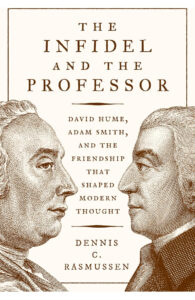
Book Review of ‘The Infidel and the Professor’, by Dennis C. Rasmussen
Review by Anil Saxena
“A wonderful read about two of the finest minds of 18th-century England who changed the course of philosophy and economics of our times.”
This 336-page book explores the extraordinary friendship between two Scottish intellectual giants—David Hume (1711–1776) and Adam Smith (1723–1790). Hume, the “infidel” and lifelong atheist; Smith, the professor and cautious believer—together, they left a profound impact on the Enlightenment, shaping modern philosophy, economics, and political theory.
Kindred Spirits: Friends in Thought and Inquiry
Despite being twelve years apart in age, Hume and Smith shared a deep affection, admiration, and intellectual influence. Hume, ever the iconoclast, and Smith, the careful academic, complemented each other.
Smith avoided direct confrontation with the rigid and often bizarre religiosity of the Scottish Presbyterian Church. Hume, on the other hand, openly criticized religion, calling into question its dogmas, miracles, and morality.
They corresponded frequently—more letters from Smith to Hume than vice versa—and their bond remained steady and respectful throughout their lives.
David Hume: The Fearless Skeptic
Hume entered university at the astonishing age of ten, but soon found himself disillusioned with subjects other than philosophy. Reading Locke and Clarke, he famously remarked that he became an atheist not because of them—but because of their ideas.
Hume’s Core Philosophy
- Knowledge arises only from human experience. Everything else is conjecture.
- Morality is a human invention, not dictated by God but shaped by social conventions.
- Moral acts are those widely approved; immoral acts are widely condemned.
“Whenever miracles are narrated, the first question to be asked is: Where is the evidence?”
Hume’s trenchant critique of religion reached its sharpest edge in his essays. He questioned the design of a divine being who created a world of injustice and suffering. He also dismissed the notion of an afterlife as empirically unverifiable.
Politically, Hume was an equal-opportunity critic—skeptical of both Whigs and Tories. However, one blot remains on his otherwise towering intellect: his deeply prejudiced view of race, particularly his declaration that Blacks were inferior—a view that continues to puzzle and disappoint scholars today.
Adam Smith: The Reserved Revolutionary
Smith was more circumspect in his views on God and religion. He took an oath as a theist to assume a university position and remained guarded in his writings. Yet, his early unpublished work stated:
“Fear, hope, and beauty are the causes of religion. Initially, humans ventured into polytheism and then monotheism.”
Smith remained deeply influenced by Hume’s philosophy and skeptical tone, yet always trod carefully.
Smith on Science and Morality
Smith believed that:
- Science is a human imposition of order over chaotic natural phenomena.
- It is not eternal truth, like religion claims, but a logical and empirical tool to interpret the world.
In The Theory of Moral Sentiments, Smith elaborated a richer moral theory than Hume’s, particularly on sympathy and utility:
- For Hume, sympathy is a passive resonance—like vibrating strings.
- For Smith, empathy stems from projection, a deeper moral instinct rooted in human experience.
“The consequences of actions matter—but the means by which we achieve those consequences matter even more.”
Smith gave striking examples:
- A late watch may still tell time, but we prefer punctuality.
- Unarranged chairs may serve the same purpose as arranged ones, but we prefer order.
- Wealth doesn’t guarantee happiness, yet we chase it obsessively.
Differences on Religion and Justice
Hume saw religion as a source of ignorance, prejudice, and cruelty. Smith was more pragmatic, distinguishing between “spurious” and “true” spirituality. To him, religion offered solace, and if not a foundation of society, at least buttressed its structure.
Both thinkers, however, saw justice as essential: a safeguard against cruelty, torture, and inhumanity.
Hume’s Final Years: Unrepentant and Unbowed
Despite numerous attempts by the Church to excommunicate him, Hume stood firm. In his final philosophical writings, like the Dialogues, he reiterated his view that human reason is insufficient to prove or even grasp divine truths.
Hume assigned Smith the task of publishing his Dialogues, but Smith, concerned for his own recent publication (The Wealth of Nations) and Hume’s notoriety, declined.
“Still, this did not sour their friendship.”
In his short autobiography My Own Life, Hume showed no signs of religious awakening. He remained cheerful, critical, and witty till the end. Boswell visited him hoping for a deathbed conversion—but came away disappointed.
One story he told Smith on his deathbed went something like this:
After death, Hume would cross a river where he’d rest forever. He asked the boatman to delay his journey until all clergy and religions were wiped off the earth.
The boatman scoffed, saying: “You couldn’t do it in 200 years. Get in the boat now.”
Smith later toned down this anecdote for public consumption.
Smith’s Final Tribute to Hume
Smith’s heartfelt eulogy for Hume shocked the religious establishment. Scholars, critics, and clergy denounced him. Boswell couldn’t fathom that someone could face death so cheerfully while remaining a skeptic.
“Smith eulogized Hume, in virtue of their friendship, as the greatest gift to humanity.”
Ironically, Smith’s own death in 1790 stirred less sentiment than Hume’s.
The Rousseau Episode: Drama Among Philosophers
The book also touches on Hume’s short-lived, tempestuous friendship with Jean-Jacques Rousseau. The two men, opposites in temperament and philosophy, fell out bitterly when Rousseau accused Hume of witchcraft—without any basis.
Smith advised Hume not to respond in writing. Though Hume was deeply hurt, he heeded the advice. Rousseau fled to France and lived in obscurity, while Hume found some satisfaction in his accuser’s downfall.
Interesting Anecdotes
- Hume once fell into a ditch and was rescued by devout Edinburgh women who made him pray for forgiveness.
- He attracted admiration and romantic attention in Paris.
- A society for literary debate in Edinburgh thrived in the 1760s due to his influence.
- Smith, the ever-absent-minded recluse, remained close to Hume, though not always physically present.
Smith’s Magnum Opus: The Wealth of Nations
Smith’s The Wealth of Nations is as monumental in economics as Newton’s work is in physics. It broke the hold of feudal economics and set the foundation for capitalism, while warning against its excesses.
Core Beliefs
- Commerce is the antidote to poverty and the path to human welfare.
- True wealth lies not in gold and silver, but in productivity and services.
- No nation can grow by impoverishing its neighbors.
- Trade is mutual prosperity.
Smith wasn’t blind to capital’s dangers. He opposed extreme inequality, the dehumanizing aspects of assembly-line labor, and supported fair wages, education, and training for workers.
He even suggested state regulation of clergy to prevent sectarian competition. While critical of medieval clergy, he praised the discipline of monks—marking a subtle difference from Hume.
On America and Empire
Contrary to public opinion in England, both Hume and Smith argued that colonialism was a financial burden, not a bounty. Hume strongly favored American independence. Smith imagined a post-colonial, free-trade relationship between England and the U.S.—akin to that between England and Scotland.
Verdict: A Meeting of Minds, A Clash of Beliefs
This is not just a book about friendship—it is a chronicle of intellectual history, moral exploration, and philosophical courage.
Hume, the unapologetic atheist, remained as irreverent as ever, even as death loomed. Smith, the cautious pragmatist, quietly revolutionized the way we think about morality, economics, and human society.
Together, they shaped the modern world—and their friendship, full of mutual admiration and complex contradictions, is as fascinating as their work.
A wonderful read about two of the finest minds of 18th-century England who changed the course of philosophy and economics of our times.
Author Bio: Anil Saxena
 Anil Saxena is a retired Principal Chief Conservator of Forests and Head of Forest Force (HoFF), Maharashtra.
A lifelong nature lover and prolific reader, he brings depth, clarity, and insight to every book he reviews. As a Core Committee member of the Nagpur Book Club, he is known for his comprehensive reviews that make even complex subjects accessible and engaging.
Anil Saxena divides his time between Nagpur, Mumbai, and New York, enjoying the company of his children and grandchildren while continuing to explore the world of literature.