Book Review of ‘Team of Rivals – The Political Genius of Abraham Lincoln’, by Doris Kearns Goodwin
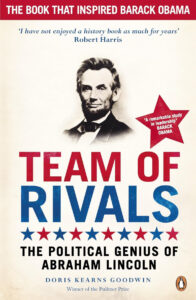
(1,305 pages)
Review by Anil Saxena
Abraham Lincoln: Establishing the Grammar of Constitutional Democracy
History is full of heroes, leaders, philosophers, spiritualists, emperors, and warriors who conquered nations and were anointed as conquerors of the world. There are heroes whose bravery is cast in stone and remains unparalleled. But if you were asked to name one statesman of the modern democratic era, whose name would first come to your mind? I’ll leave Gandhi out of this contest because, though he was a politician who carved his name as a practitioner of ethical politics, he never sat in the seat of power. A few other names like Churchill, FDR, Washington, and Jefferson come to mind, but they all fall short against the charisma of Abraham Lincoln.
When I recently read his biography, ‘Team of Rivals’, by Doris Kearns Goodwin, my first reaction was to make sure it was not a hagiography. Lincoln is one of the most researched and studied statesmen of the era of constitutional democracy. So I searched for his failings elsewhere. To my surprise, I found that the man had virtually no great flaws, and the many flaws he did have only led to his strength.
A Man of Contradictions
Someone once said:
‘Lincoln’s greatest flaw came out of his strength, which was generally liking people and not wanting to hurt them. He always wanted to give somebody a second or even a third chance. This weakness proved disastrous with George McClellan, who was head of the Union Army for some months near the beginning of the war.’
Another opinion on his flaws:
‘As a young man, Lincoln used his verbal skills and ability as a mimic to make others the butt of laughter. He once reduced a debate opponent to tears by mocking him. It was only after he insulted a man so cruelly that the man challenged him to a duel that Lincoln recognized how hurtful his remarks could be and began to modulate his remarks.’
His basic temperament was melancholic; he suffered from bouts of depression and had a very wry and trenchant sense of humor. But are these really flaws? He was too self-deprecating and was the last man to get carried away by pretentious applause. I believe if even a minuscule number of our politicians had such traits, the world would be a much better place to live in. Gandhi was one, and Lincoln was another who can be singled out from the horde of windbags who strut the scene in the name of politicians.
I quote from his biography, ‘Team of Rivals,’ which describes Lincoln so aptly:
”Lincoln had several exceptional attributes all living in harmony under a passive facade: he was an astute listener, a keen analyst, a skilled politician, and a highly reliable judge of character.”
Another author wrote about him:
“What is so great about Abraham Lincoln? How to even begin answering this: I once wrote in my private writings, If liberty was God’s gift to Americans in the 18th century, Abraham Lincoln was the gift He gave to America in the 19th Century. I have a hard time overestimating his importance because literally everything he did was so perfectly timed, so meaningful, and so effective that even his political enemies often marveled or became his friends and allies.”
Tolstoy considered him the greatest statesman of all time, much above many celebrated ones, and used an epithet of ‘Sun’ for him.
So, it’s time to know about the man and what he actually did to justify the opinion of millions of his admirers. ‘Team of Rivals’ provides a big chunk of insight on the man, but there is no dearth of sources on him.
The Man Behind the Legend
He was 6 feet 4 inches tall, thin as a reed, with a shaggy beard, melancholic eyes, sunken jaws, and long limbs always protruding out of his shirts and trousers. He had a gawky gait and was not a handsome man, but when he started speaking, everyone would be forced to listen to him. His mother died in his infancy, and he was never close to his father. He chopped wood at an early age and stayed in the vicinity of wolves. He didn’t go to any fancy schools or colleges; he was virtually a self-taught man, a loner, temperamentally given to gloom. But given a chance to speak, his misery would evaporate, and he would enliven the atmosphere around him like no one else.
His thin and emaciated frame had a tremendous strength; his physical prowess was such that, even as president in his late 50s, he could hit a nail deepest, and in his heyday, he could perform the physical tasks equivalent to three men. He lived on his scholarship and had an almost photographic memory. He was fond of Shakespeare and could recite any portion of his plays or poetry verbatim. Similarly, the Bible was another favorite, and quoting passages from it was a great pastime of his. Besides, he liked Longfellow, Robert Browning, Byron, Aesop’s fables, Arabian Nights, and Greek classics and could always be seen quoting them in his discourses.
Master Storyteller and Wit
He was a master storyteller and the best raconteur of tales and anecdotes. His jocularity was matchless. His sense of humor was a bit quaint, mostly self-deprecating, occasionally bawdy, and macabre but never dull. He basically had a very dark and gloomy temperament and would suffer from bouts of depression, but the presence of people around him would elicit guffaws from him and a ready, homespun wit. He was conscious of his looks and lanky limbs and enjoyed mocking himself.
He once told his audience about his encounter with a very ugly man on a train, and then what happened?:
The stranger said: “I have an article in my possession which belongs to you.” Taking a jackknife from his pocket, the man explained: “This… was placed in my hands… with the injunction that I was to keep it until I found a man uglier than myself… Allow me now to say, sir, that I think you are fairly entitled to the property.”
When one describes Lincoln as a politician, they exhaust almost all adjectives in his favor. I, too, tried and found his traits and achievements are a veritable list of values that we would like to observe in any statesman.
The Quintessential Politician
His magnanimity, charity, empathy, love for democratic ethics, political courtesies, perseverance, and pragmatism are the stuff that made him what he was: an exceptional statesman of all time. He was cool, trusted his colleagues wholeheartedly, was extremely democratic in decision-making, was ready to go overboard in applauding the good actions of his colleagues, and was ever ready to take on the blame if there was a mistake.
He was a firm believer in collective responsibility, was intuitive, and clairvoyant in timing his actions. His ready wit, self-abnegating humor, erudition, and the capacity to feel the pulse of the nation and its people were exceptional.
But with all these glorious qualities, he was still a quintessential politician who knew very well when to stand firm, when to accede, and when to be aggressive. In all, he, with all his aforementioned qualities, knew that he alone was a master of a theater, and the buck stopped with him. And he wore that crown with aplomb.
America was reeling under its worst phase. When he ascended to the presidency, the matter of slavery had become a bloody issue between the southern and northern states of America. The southern states wanted to continue with slavery unabated and would agree to its abolishment on their dead bodies only. The northern states wanted to do away with slavery soon, having a large number of radical abolitionists in their fold.
As a result of this conflict, 11 southern states seceded from the union and a bloody war, which almost threatened the very existence of America and whatever values it stood for, began. This war continued unabated for the entire term of his presidency for a full four years.
Team of Rivals: The Cabinet
‘Team of Rivals’ tells us that when Lincoln created his cabinet, it had three of his adversaries who had fought for the presidential nomination against him: William H. Seward, Edward Bates, and Salmon P. Chase. All were senior to him, much more popular, much more experienced, and had a much more gratifying career behind them than he could ever aspire to at that juncture. Much to the surprise of all, and more to the surprise of these adversaries who had not much charitable to say about him then, he made Seward his Secretary of State, Edward Bates his Attorney General, and Salmon Chase his Treasury Secretary. I think this act of statesmanship is unheard of from any other politician to date.
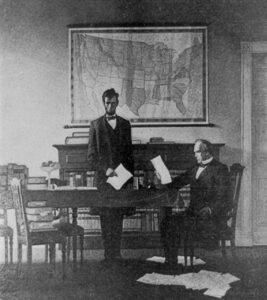
Abraham Lincoln and Salmon P. Chase Conferring About the National Bank Act of 1863 (Mural Painting by N.C. Wyeth)
Lincoln was not only extremely selfless and patriotic but also wise enough to know what the country actually needed at that juncture, and he never agreed to settle for the second-best options. Soon, he and his three colleagues were in the thick of the affairs of the state and kept giving their best. Seward took to Lincoln soon, and they became lifelong friends.
Opinion of Important Colleagues
When he took over the charge of president, the most fervent question faced by America was slavery and the unity of the nation. Among his colleagues, Chase was the most radical about anti-slavery, Bates was more of a conservative, while Lincoln’s heart was also for its abolition but knew very well that the conservatives were his bread and butter. So, being a pragmatist to the core, he knew that slavery could only be wiped out if his government survived long enough to bring that change. He bided his time, and when the right time came, he never hesitated to walk the talk better than many of his abolitionist colleagues.
Bates was the most senior, and he, too, started liking this exceptional leader and kindest human being. Though, he feared his tendency to procrastinate on matters pertaining to war or on issues of misdemeanor and incompetence of his Generals.
Chase was an exception; he, too, learned to admire Lincoln, but on account of his unbridled ambition and radical politics, he remained a headache for Lincoln throughout. He resigned at least four times. Lincoln kept persuading him and succeeded in changing his mind three times but accepted his resignation the fourth time.
It is just difficult to measure a man who knows fully well the harmful intentions of his rival but still rewards him. Chase had an ambition for the presidency, too, and did his best in securing that while even being in the cabinet. Lincoln, on his part, understood the game plan of this saboteur very well, but when in the second term, he was in search of his chief justice, Lincoln picked Chase only for the job.
Then there was Edwin M. Stanton; he was his rival solicitor against whom Lincoln had lost his first case. But when he was searching for a secretary of war, he found no better person than Stanton for the job. True to his expectations, Stanton also gave his everything for the job, and Lincoln admired, protected, and encouraged his secretary of war throughout. Their personalities differed from each other like cheese and chalk, yet they both gelled together for the greater cause of winning the war against the Confederate army and ultimately won it.
Stanton was a no-nonsense person who hated frivolity, a stern disciplinarian, unbending, and a harsh taskmaster; while the other was a thorough humanitarian, full of charity in dealing with human failings and deserters, a consensus man, and a visionary. Still, both pulled along well, vetoing and acceding to each other as per the demand of the situation. Stanton, Ulysses Grant, and Lincoln formed a triumvirate that respected each other and won the war, showing exemplary cooperation and understanding.
The book describes beautifully not only Lincoln’s wit but also the nature of his relationship with Stanton through this anecdote:
Once, out of impatience and being piqued with Lincoln, Stanton called him a damn fool in front of some minor officer. The officer went and reported this to Lincoln and sought his reaction to it. Lincoln questioned the officer, “Did he really say this thing about me?” When the officer nodded in agreement, Lincoln said calmly,
“Then he must be right for sure, as he is never wrong in his assessment of people.”
Perfect Timing and Political Shrewdness
With all his humane qualities, Lincoln remained essentially a shrewd politician. When Freemont, a General, issued a memorandum without consulting him to release captured slaves in war as free, not only did this indiscretion cause a big embarrassment to Lincoln and make him a butt of criticism of conservatives, moreover, he now feared losing Kentucky, too, to the Confederacy. When Freemont refused to step down and remained adamant not to withdraw his memo, Lincoln, by other means, spread stories of his incompetencies and, when the time was ripe, removed Freemont.
Again, for his second term, the same Freemont was a thorn in his flesh, as he, too, had put his hat in the ring of the presidential election. So, to placate Freemont, the resignation of Blair was essential. Lincoln successfully persuaded Blair to step down and neutralized Freemont.
On another occasion, Chase and disgruntled members raised a clamor against Seward. He resigned, but Lincoln diplomatically handled the situation, called a meeting of the cabinet of nine others, and opened the subject of Seward’s resignation. Due to his tactful handling, no one stood against Seward, and even Chase had to relent.
He knew how to use men better. Before Chase could use him, he would use Chase better. When Chase asked for his consent to go to Ohio to canvass in the election of the Ohio governor, Lincoln knew that he was going to publicize himself as a next presidential nominee. But he desired a victory for the Republican candidate more than Chase getting an advantage. He permitted it, and to his pride, the Ohio governor was now a Republican.
Democracy: A Way of Life
Lincoln was always acutely conscious of the fact that, like justice, democracy, too, not only has to be respected but practiced with utmost Tender, Love, and Care (TLC). He was a consummate consensus man. On many occasions, he controlled and withdrew his wishes against the contrary collective opinion of his cabinet colleagues and always bowed out with grace. He always gave credit to his colleagues when they earned it but occasionally even without their bona fide claims to it. He knew very well that if generosity is combined with democracy, nothing is unachievable. He was a perfect grammarian of democracy. To him, the institution of the cabinet was more sacred than the authority of the president.
On the question of the reunification of rebel states with the Union after the war, Lincoln’s position was for their legislatures to be allowed to be called to take a decision. The cabinet opposed, and Lincoln accepted the decision with grace and did not insist further.
Lincoln was ready to provide compensation of 400 million dollars to the South for the loss of slaves, which was also a cost of fighting a 100-day war. All disputed it. Lincoln was sad but accepted the collective decision.
Magnanimity and Forgiveness
South’s two representatives were going to England in an English ship to seek favor, were stopped, and both diplomats were arrested. Britain sought their release and an unconditional apology. Seward drafted a letter to seek a court route to settle this with the British. The country was not ready to enter into a war with Britain at that juncture, so Lincoln privately persuaded Seward not to aggravate the matter and ultimately prevailed upon him. So Seward released the prisoners while Lincoln remained in the background throughout. When things were over, he publicly praised Seward for his statesmanship. Later, Fred Seward (Seward’s son) praised Lincoln for his intellect and unselfishness in publicly giving credit to his father, which was actually his own.
When Lincoln wanted to appoint Stanton as his secretary of war, he made it look like a recommendation of Seward and Chase to appoint him, though he had already made up his mind, but just let them think that it was their idea.
Legendary Patience
He had a tremendous amount of patience when it came to dealing with his colleagues, generals, etc. He never hesitated to take his time in making decisions, much to the chagrin of others, and once he was clear about the step he had to take, there was never any going back. McClellan the General tested his patience to the maximum, but he kept giving him a long rope and earned lots of criticism from his colleagues. On the issue of slavery, too, he was always interested in creating a favorable situation first before abolishing it. His colleagues, like Chase, also tested his patience longer than he actually deserved.
Lincoln was quite a self-actualized person and many times overlooked a minor act of subversions of his subordinates. Many times, he bore the erratic McClellan and his willful insult of his office most stoically. Once, McClellan kept him and Seward waiting in his office for hours without turning up. When there was a clamor from all to remove McClellan, he put a counter question to those who believed that anybody would be better than him. He told them he was agreed to replace him but he could not do with ‘anybody’ as he needed ‘somebody’ for the job.
Collective Responsibility
Lincoln was the best sheet anchor for his erstwhile colleagues. All his colleagues faced lots of calumnies on account of their own failings or on account of wrong perceptions, but whenever he would find them in a mess, he always came forward to defend his colleagues on the grounds of collective responsibility and his own as a head of the government.
Cameron, Seward, Chase, and Stanton all and others faced crises many times, and Lincoln, much to his credit, never ditched his colleagues as long as he was convinced of their utility in governance or their innocence. He was also always on the front foot when it came to owning a failure, a rare gift to a statesman.
Ulysses Grant was the most successful general, but for his drinking habits, which were without any lessening of his fighting skills. When asked to respond to this negative streak of Grant, Lincoln joked that all generals should consume his brand of liquor.
Firm When Necessary
Lincoln never hesitated to reprimand even his supporters if he found them betraying the cause of the unity of the nation. Radicals were asking for the abolition of slavery in the entire union. Blair feared Chase, as he was a radical, and it would have helped him in his chance for the presidency. So Frank Blair gave a fiery speech in favor of Lincoln and against radicals. Lincoln, knowing the delicacy of the situation, reprimanded him publicly.
The Confederacy issued a diktat to kill each captured black soldier or to make him a slave. Recruitment suffered. Everyone expected Lincoln to respond to the threat. He delayed as usual but finally issued this proclamation against that order of the Confederacy: ‘For every black soldier killed or enslaved, the same number of soldiers of the Confederacy to be killed/enslaved.’
Emancipation Proclamation: A Masterclass in Timing
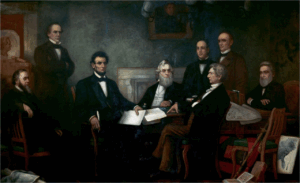
First Reading of the Emancipation Proclamation of President Lincoln. 1864 oil-on-canvas painting by Francis Bicknell Carpenter.
His Emancipation Proclamation and its background:
While the war was on, the District of Columbia passed a bill in 1862 to emancipate its blacks by paying $300 per person to their owner. Now it came to Congress for its clearance. Lincoln was under tremendous pressure from conservatives to veto it and for its approval by radicals. He felt the pulse right and made it a law on April 16th, 1862.
Lincoln was never, unlike his radical colleagues, in too much of a hurry to abolish slavery, but after passing this compensation bill, he realized that emancipation was now a military necessity. Therefore, in the midst of war, after a lot of mulling, he made a preliminary proclamation on September 22nd, 1862, for the emancipation of slaves in the defeated southern states. This EP shocked almost all his colleagues for different reasons. Chase criticized it for he feared Lincoln running away with his own idea. Seward feared a backlash from European nations, and Bates wanted to segregate the population of freed slaves from whites. Even blacks were not very enthusiastic about it because they wanted an unrestrained freedom and did not want to be ghettoized. But Lincoln knew that it was an idea whose time had arrived, and in January 1863, he signed the EP, and this action ultimately changed the course of the war, and all doubting Thomases were proved wrong.
In another great move, he created a strong regiment of 140,000 blacks at the right time to fight the war, though the idea was in the air for some time, but here timing was crucial.
When the war was in its last legs, Lincoln came out with a peace settlement with the following:
- National authority to be restored.
- Slavery to be abolished.
- Hostility should end before peace.
All radicals and conservatives were in agreement with it.
He was always very forgiving. He easily forgave his die-hard opponents. He was ever ready to forgive soldiers of the enemy flank if it was within his power. He hated seeing men getting shot or going to gallows. He was sad to see the enemy spy Lee being hanged. He was ultimately a man of consensus, and even his worst enemies admired him for this trait. On the question of how to treat enemy politicians and the army, he said, ‘Let’s not judge others so we are not judged.’
When asked about a hush-hush escape of Jefferson Davis (president of the Confederacy) and his reaction to it in the last throes of war, he cracked a joke about a soldier who quit drinks, but when asked to put brandy in his drink, he said,
“If it is unbeknownst to me, then only.”
An officer who was court-martialed for peeping at women. Lincoln laughed and asked to send the fellow to the chapel and be called Count Peeper-who-peeps-women.
Fearless
During his presidency, it was a common sight of Lincoln visiting fronts amongst the booming guns and mortars all around. Lincoln apart, Mary, too, visited the front to encourage soldiers despite tremendous risks to their lives and liked to meet Sherman and Grant on the front. Lincoln, in his visits, always took out time to cheer his fighting men. He took immense pleasure in indulging in light banter with them.
Along with ‘Team of Rivals,’ I tried to check with other sources and was astonished to fail to find even the slightest streak of pettiness, bigotry, intolerance, or cruelty in his character. Whatever he did, good or bad, was with utter objectivity and in the interest of the nation or public good at large. He is the only politician who occupied the seat of power and can aptly be described as sui generis in reality. As a leader, he is no longer the property of America alone but belongs to the whole world. His speeches, writings, witty sayings, and anecdotes have all become a heritage of humanity. His Gettysburg Address and his Emancipation Proclamation stand like a colossus in the garden of the progress of humanity in the company of Magna Carta, the Bill of Rights, and other great reforms.
The love of theater and Shakespeare brought his end, too, and that was too tragic to bear. It is our great misfortune that we humans are the only species in the animal kingdom who can kill their best specimens out of hatred, vengeance, envy, sheer pride, and ignorance (predatory animals, too, kill their territorial rivals, but it is just for survival), and so Christ was put on the cross, Socrates was poisoned, Gandhi was shot in the chest, and likewise. Lincoln, too, was killed by blind ignorance and hatred, and we humans remain condemned to hold the guilt of their killings on our shoulders for eternity.
Some Specimens of His Wit and Humor
He loved to regale audiences with the story of a collector of relics, who hears about an old lady with a dress she had worn during the Revolutionary War. The collector visits her and asks her to produce the dress to satisfy his love of aged things. He then holds it up, saying: “Were you the dress that this lady once young and blooming wore in the time of Washington? No doubt, when you came home from the dressmaker, she kissed you as I do now!” As he does so, the owner quips: “Stranger, if you want to kiss something old, you had better kiss my ass. It is 16 years older than that dress.”
As a trial lawyer, Lincoln used humor strategically within and outside the courtroom. During the lunch break of one particular trial, he told jurors about the small boy who ran to summon his father. “Paw, come quick,” he panted. “The hired man and sis are up in the haymow, and he’s a-pullin’ down his pants and she’s a-liftin’ up her skirts and paw they’re gettin’ ready to pee all over our hay!” The father replied: “Son, you’ve got your facts absolutely right, but you’ve drawn a completely wrong conclusion.”
Later, in court, following his opponent’s lengthy winding-up speech, Lincoln told the jurors: “My learned opponent has his facts absolutely right, but has drawn completely wrong conclusions.” He won the case.
He was no elegant drawing-room wit, but Lincoln was a clever conversationalist, and his swift rejoinders came to his aid in socially awkward situations.
Particularly memorable were his words to a young woman whose deep interest in a hospitalized soldier led her to press the question: “Where were you wounded?” The infantryman, who had been shot through the testicles, repeatedly deflected her inquiry with the answer: “At Antietam.” After she asked the president to assist her, Lincoln talked privately with the soldier and then took the young woman’s hands in his own, explaining: “My dear girl, the ball that hit him would have missed you.”
Final Verdict: A Breathtaking Journey into Statesmanship
Team of Rivals is more than just a biography; it is a masterclass in political leadership, human psychology, and the art of governance. Doris Kearns Goodwin’s meticulous research and narrative brilliance bring to life a period of profound national crisis and the extraordinary man who navigated it. The book masterfully details Lincoln’s journey, not as a solitary hero, but as a leader who deliberately surrounded himself with his most formidable opponents to forge a stronger, more resilient government.
This is a must-read for anyone interested in American history, political science, or the enduring qualities of effective leadership. It is a dense, yet thoroughly captivating read that proves that the best leaders are those who are humble enough to learn from their rivals and wise enough to unite them for a greater purpose. Goodwin’s work is an unparalleled achievement, offering a rich and intimate portrait of a man whose legacy continues to shape the world. It is a book that will inspire and educate long after the final page is turned.
Author Bio: Anil Saxena
 Anil Saxena is a retired Principal Chief Conservator of Forests and Head of Forest Force (HoFF), Maharashtra.
A lifelong nature lover and prolific reader, he brings depth, clarity, and insight to every book he reviews. As a Core Committee member of the Nagpur Book Club, he is known for his comprehensive reviews that make even complex subjects accessible and engaging.
Anil Saxena divides his time between Nagpur, Mumbai, and New York, enjoying the company of his children and grandchildren while continuing to explore the world of literature.