Book Review of ‘Enlightenment Now’,
by Steven Pinker
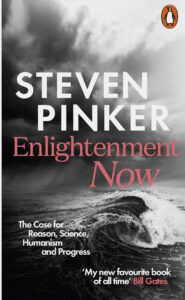
576 pages
Review by Anil Saxena
“If triangles had a god, they would give him three sides.” – Montesquieu
“First grub, then ethics.” – Bertolt Brecht
A World of Pessimism vs. Pinker’s Optimism
The 20th century and the first quarter of the 21st have given very little room for optimism about the future of mankind. Yet Steven Pinker thinks otherwise. He is an inveterate optimist who builds a robust case for humanity’s progress. His arguments are logical, well-balanced, unemotional, and backed by sturdy empirical proofs.
Where the book struggles, however, is in its length—there are avoidable repetitions, and it certainly has 200 extra pages. Still, Pinker’s faith in science, reason, enlightenment, and humanism defines the book.
The Building Blocks: Entropy, Evolution, and Information
The book opens with three fundamental forces of the universe: entropy, evolution, and information.
Evolution
It follows no design and no God; it is self-organizing.
Entropy
With Murphy’s law ever at work, we are more prone to annihilation than survival.
Information
Human brains, through millions of years of evolution, have become extraordinarily adept at making sense of floods of data—pixels, sounds, patterns.
This triad sets the stage for Pinker’s central theme: how reason and enlightenment help humanity overcome the forces that constantly push toward disorder.
The Cognitive Revolution and Ancient Thinkers
Only a few hundred thousand years ago did humans develop higher cognitive abilities. These reached their finest expression around 500 BC, with an explosion of revolutionary ideas across continents. Thinkers like Buddha, Mahavira, Lao Tse, Confucius, Pythagoras, and Socrates reshaped human thought.
Why then? Because settled agriculture and urban life freed up mental energy for higher reasoning beyond mundane survival.
Science vs. Literature: The Clash of Worldviews
Since the 18th and 19th centuries, there has been a tug-of-war between doomsday prophets and messengers of progress.
- Many literateurs had a phobia of science, believing that only literature could provide ultimate peace and value.
- Scientists and optimists were mocked as Dr. Pangloss, the foolishly optimistic character from Voltaire’s Candide.
- Early 20th-century philosophy leaned toward angst, alienation, and loneliness, with nihilism and existentialism declaring progress and science meaningless.
But Pinker counters: “Reason, science, and enlightenment are the only way for the betterment of this world.”
Exposing the Contradictions of Anti-Reason Thinkers
Pinker brilliantly skewers postmodernists, existentialists, and structuralists who condemn reason while using reason to do so. He asks:
- If their theories are not based on reason, why should we listen to their “unreasonable prattle”?
- If they admit their theories are based on reason, then reason is valid—and better than the alternatives.
This neat paradox highlights the hypocrisy of anti-reason schools of thought.
Evidence for Progress
The core of Enlightenment Now is Pinker’s data-driven demonstration that the world is far better than the pessimists claim. Over 100 graphs and charts show upward trends in:
- Life expectancy
- GDP per capita
- Human rights and liberal values
- Literacy and education
- Female empowerment
- Leisure time and well-being
And downward trends in:
- Child mortality and maternal mortality
- Wars, genocides, famines, and poverty
- Deaths from natural disasters
- Racism, child labor, and undernutrition
As Pinker puts it, “The Enlightenment has worked. Progress is real.”
Why Negativity Dominates
If life is improving, why do we feel surrounded by doom? Pinker explains:
- Availability bias: Negative news captures more attention.
- Confirmation bias and tribalism: People see only what fits their worldview.
- Cognitive blindness: Good news is invisible because stability is not newsworthy.
“A plane crash grabs headlines, but the millions of safe flights go unnoticed. A famine shocks the world, but the billions eating daily are invisible.”
This bias fuels the perception of decline even when statistics show progress.
Inequality and Envy
While inequality has increased, Pinker argues it is not as catastrophic as portrayed. If the poorest continue to gain modern amenities—food, health, education, housing—then inequality is not inherently a disaster.
He illustrates with a Soviet joke:
Two peasants owned a goat each. When offered a boon, one wished for the other’s goat to die—choosing envy over self-betterment.
Similarly, Pinker cites J.K. Rowling’s immense wealth from Harry Potter: she created happiness and value for millions who freely bought her books, so begrudging her success is misplaced.
Democracy and Freedom
Democracy, Pinker argues, is thriving:
- More nations are democratic today than 50 years ago.
- Accountability, free speech, and informed citizens strengthen governance.
- Democracy should be judged by empirical results, not intuition.
Wars, Terrorism, and Violence
Wars have declined drastically, thanks to democracy and commerce, which make them less rewarding.
Terrorism, while frightening, causes far fewer deaths than car accidents or diseases. Its prominence is due to media amplification—“oxygen of publicity”. Pinker urges zero tolerance for terrorism, regardless of ideology.
Happiness and the Hedonistic Treadmill
Despite progress, unhappiness persists. Pinker attributes this to the hedonistic treadmill: happiness adjusts to circumstances, and comparisons with others breed dissatisfaction.
Environmental Concerns
Pinker acknowledges real threats:
- Climate change is undeniable, but solvable through decarbonization, afforestation, nuclear energy, and innovation.
- Resource depletion will not doom humanity, since we shift to new solutions before resources vanish.
- Organic farming, he argues, is romantic but impractical for feeding billions.
“The Stone Age did not end because we ran out of stones. It ended because we found something better.”
The Nuclear Shadow
The threat of nuclear war remains real, despite 80 years of restraint. Pinker stresses the need for international monitoring and a strict no-first-use policy. Optimism here must be conditional, not complacent.
What Lies Ahead
In his final analysis, Pinker maintains that humanity’s future depends on science, reason, and enlightenment. Challenges like climate change, nuclear risks, and resource scarcity are solvable if approached rationally.
He warns against pseudosciences like social Darwinism and racialism, which caused immense suffering in the past. Science, with its commitment to empirical results, peer review, and correction of errors, remains our best hope.
Beyond the Book
In its closing chapters, Pinker draws on two fascinating works:
- Just Six Numbers by Martin Rees – showing how six fundamental constants shaped the universe.
- 36 Arguments for the Existence of God by Rebecca Newberger Goldstein (Pinker’s wife) – exploring “atheism with a soul.”
Both, Pinker suggests, complement his own project of marrying rationality with meaning.
My Conclusion
Steven Pinker’s Enlightenment Now is a formidable, data-rich defense of human progress. It challenges the culture of pessimism by showing that science, reason, and humanism have steadily improved human life. While the book is overly long and sometimes repetitive, its central message is powerful:
“The Enlightenment has worked. Progress is real. And it is worth defending.”
Author Bio: Anil Saxena
 Anil Saxena is a retired Principal Chief Conservator of Forests and Head of Forest Force (HoFF), Maharashtra.
A lifelong nature lover and prolific reader, he brings depth, clarity, and insight to every book he reviews. As a Core Committee member of the Nagpur Book Club, he is known for his comprehensive reviews that make even complex subjects accessible and engaging.
Anil Saxena divides his time between Nagpur, Mumbai, and New York, enjoying the company of his children and grandchildren while continuing to explore the world of literature.