Book Review of ‘Zorba the Greek’, byNikos Kazantzakis
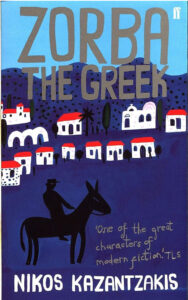
Pages: 312
Listening Hours on Audible: 12 hrs 35 mins
Review by Anil Saxena
Life—where from, wherefore? Whereto? Why? Suffering, reason, aesthetics, rationalism, faith—what is its worth? Does God exist? If it exists, does it reside in the hearts of men and women, or elsewhere?
This is a book that tells about commitment, trust, loyalty, and gratitude. It is the story of spiritual journeys and the quest for purpose in the lives of two entirely different personalities on the Greek isles.
One is a bookish poet and philosopher; the other is an uneducated, uncouth man of flesh and blood. They form a deep friendship—a rare mingling of souls—making it difficult to discern who is the master and who is the student. Ultimately, it is revealed that the so-called master is the student, and the employee is the guru who teaches the bookish, equivocating master the beauty and essence of life, and how to surpass its sorrows.
“A man needs a little madness, or else he never dares cut the rope and be free.”
Who is Zorba?
Zorba is a unique individual—mad or great, perhaps both—but like a child with awe and curiosity. Not only untutored but also untutorable, he has deciphered the world but purposely remained immune to the charm of donkey-loads of tomes on philosophy and metaphysics. He is a rugged philosopher who sets his own moral values in this universe.
Extremely sensual and sublime simultaneously, his soul was his flesh and his flesh a soul. He is original in whatever he does.
He has his own brand of feminism, which may not pass the test of modern feminists and may brand him a male chauvinist. Yet, his concerns are not about how others perceive him. His academy of learning is the sun, sky, sea, its creatures, the eyes of women, the smile of a child, and so on.
He claims to understand women better than any man. He behaves like a knight in shining armor with women. To him, women are ephemeral, narcissistic, and fragile like porcelain vases—frivolous enough to be admired, cajoled, loved, cuddled, given warmth and security, but much inferior in intellect and instinctive in nature. They are, in his eyes, easy to be deceived with promises that never materialize.
At one place he says:
“Hold their breast and they surrender.”
This may not be agreeable to many readers today, but it is a stark reflection of Zorba’s character. Love him or loathe him—he remains unforgettable.
The Social and Cultural Backdrop
The book vividly depicts the patriarchal society of the late 19th century in the Greek Isles. Women were considered subhuman, to be treated with kindness, love, and tenderness—but always from a place of dominance. For men, it was their duty to fulfill women’s needs, both sexual and emotional. Not cohabiting with a young and ripe woman was not only seen as a sin against her, but against nature and God itself.
Zorba the Taskmaster
The master owns lignite mines in Crete and wants to extract ore to make a fortune. Zorba proves to be an excellent taskmaster and efficient organizer of men. He knew the veins and galleries of the lignite mines like the lines of his palm.
He wanted to create a ropeway from the top of the mountain to the mines to carry wood from the pine forest, making extraction smoother. An excellent hands-on man, he always gave his best and never let his workers perform half-heartedly.
Zorba’s Philosophy of Life
Zorba is a man who does what he believes in and hates God for all the misery around us. As told earlier, he had no respect for conventional morality; he had his own compass to navigate it.
He is not an existentialist or nihilist. He occasionally quotes Buddha, yet he cannot be a Sufi either. He is, however, deeply authentic and primitive in whatever he does, says, and believes.
Having undergone life’s travails—marriage, children—he still remains unattached to allurements. He knew the innards of men—their brutalities, weaknesses, and temptations. He was vigilant, “a knave for a knave.” Always just, he was a true karmayogi, a man of instinct and action.
He abhorred armchair moralists who endlessly discuss injustices, bigotry, and brutality, yet fall short of action.
“Life is trouble. Only death is not. To be alive is to undo your belt and look for trouble.”
The Master and His Dilemma
His master, the narrator, is a young, sophisticated philosopher—kindhearted, well-intentioned, and an aspiring writer who becomes enamored of Zorba upon their first meeting. Yet, being a brooding intellectual, fond of Marcus Aurelius and Buddha, he is inactionable and cowardly. Perhaps his love for Zorba comes from the old truth that opposites attract.
Once, when the roof collapsed, Zorba saved everyone’s lives at the risk of his own. The master, however, jumped out to safety without thinking of others. He carried the guilt of cowardice ever after.
Zorba even wanted his master to cohabit with a sinuous widow, but the master’s Buddhist way of life prevented him from falling into Mara’s trap.
Society, Religion, and Brutality
The novel depicts a late 19th-century Cretan society that was abhorrently patriarchal and misogynistic. Hypocrisy of religion, decline of a once-great civilization under Christianity, and unredeemed Islamic influence formed its cultural backdrop.
Widows were seen as sluts, stripped of dignity and the right to live. Human brutality, cloaked in religion and nationhood, was rampant.
Zorba’s Loyalty and Sense of Justice
Zorba’s loyalty to work and to his master is unimpeachable. He would never die without repaying a debt to anyone. He distinguished between right and wrong without philosophizing.
In the novel, he tries to save the widow who was persecuted by a patriarchal and sadistic society—but tragically, he fails.
Themes and Reflections
The novel is replete with striking reflections:
- Life has its own hieroglyphics—only a few can understand it.
- One must live with an eternal rhythm.
- Food, wine, women, and dance are the essentials of life.
- Fear disappears when you lose everything.
- One should live each day like a child, seeing things as if for the first time.
“Every man has his folly, but the greatest folly of all… is not to have one.”
The Book, the Author, and Its Legacy
Written in the 1940s, the book is semi-autobiographical. Nikos Kazantzakis, twice nominated for the Nobel Prize, infused much of his own spirit into it. It was also said to be Osho’s favorite book.
In 1965, the famous film adaptation was made, with Anthony Quinn immortalizing the role of Zorba. The film went on to reap many laurels and Oscars.
My Verdict
The book may not appeal to all, given its genre and unapologetic cultural context. But for those who love to raise questions about life’s infirmities—and still embrace life despite them—it is a profound and unforgettable read.
My Rating: ★★★½
Author Bio: Anil Saxena
 Anil Saxena is a retired Principal Chief Conservator of Forests and Head of Forest Force (HoFF), Maharashtra.
A lifelong nature lover and prolific reader, he brings depth, clarity, and insight to every book he reviews. As a Core Committee member of the Nagpur Book Club, he is known for his comprehensive reviews that make even complex subjects accessible and engaging.
Anil Saxena divides his time between Nagpur, Mumbai, and New York, enjoying the company of his children and grandchildren while continuing to explore the world of literature.