In-depth Book Review of Zen and the Art of Motorcycle Maintenance, by Robert M Pirsig
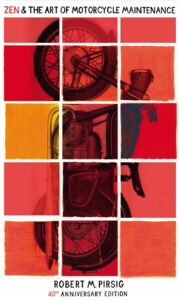
432 Pages
Review by Rohit Tokhi
My first reading: A Motorcycle Trip
I still remember how I first found this book—an unremarkable volume from a second-hand kiosk near Flora Fountain in Fort, Mumbai. I was just a college boy, intrigued by the Japanese art of Zen, thrilled by motorcycles, the smell of petrol, the clatter of engines, and the thrill of mechanical tinkering. The title Zen and the Art of Motorcycle Maintenance alone was enough to lure me in—I suspected it would be about Zen and motorbikes, so I picked it up with eager anticipation.
When I first read it, I read as a biker, not a philosopher. I followed the story of a father and son on a 17-day journey across America, on a Honda CB77. I absorbed the descriptions of long desert stretches, sudden rainstorms, mountain passes, and even the subtle hum of an engine riding high or sagging under load. I was fascinated by the way the narrator—seemingly casually—would turn to a detail of spark plugs, engine tuneups, or carburetor jets, and tether it back to some deeper notion of “care” or “precision.”
But after the final page, I closed the book thinking I’d just read a road trip memoir—with motorcycle detail—but I missed the undercurrent. I didn’t see that the ride, the tinkering, the inner crises, the digressions into metaphysics, were all part of something much larger.
Twenty years later: Reading with new eyes
Two decades later, curiosity nudged me to pick it up again. This time, the words leapt differently off the page. I had read some philosophy, grappled with the idea of “meaning” and “value.” I recognized Pirsig’s name; I had heard about his “Quality” philosophy; I had seen debates around this book online and in essays. The same sentences that seemed quaint earlier now resonated with urgency, and I saw the paths he had laid—paths I had missed in my youthful reading.
It struck me: this book is not really about motorcycling. It’s about how we choose to live. It’s about the relationship between rationality and intuition, art and technology, self and world. The motorcycle is a vehicle—literal and metaphorical—for exploring these tensions.
So here is my attempt to explain why Zen remains a deeply rewarding book, and also where I think it’s imperfect.
Structure, Narrative, Philosophy: How Pirsig weaves them
One of the marvels of Zen is how Pirsig gradually leads the reader from surface narrative into philosophical inquiry—almost by sleight of hand.
“Pirsig dips your toes in with descriptions of the motorcycle parts … then pulls you out … before you begin to feel lectured to or over your head.”
He frames the work as a “Chautauqua”—a kind of traveling lecture or show, mixing storytelling, didactic passages, reflection, and digression. Early chapters feel very much like a travel memoir; later ones shift into philosophical terrain. The result is that the reader is carried along the road while also being asked to reflect on what kind of road is being traveled—and why.
Because of this structure, many readers (as I did) first see the narrative as dominant, only later realizing that the philosophical core is quietly but ineluctably rising.
Key themes and ideas
Here are some of the major themes and ideas that I found most compelling (and also where the tension lies) the second time around.
Romantic vs Classical modes of understanding
Pirsig draws a contrast (not a rigid dichotomy) between what he calls the romantic mode (intuition, aesthetics, immediate experience) and the classical mode (analysis, structure, logic). He argues that modern culture tends to valorize the classical at the expense of the romantic, and that this imbalance impoverishes our experience of life.
One telling passage:
“In a car you’re always in a compartment … you’re a passive observer … In a cycle the frame is gone … you’re in the scene, not just watching it anymore.”
Another:
“There is no manual that deals with the real business of motorcycle maintenance … Caring about what you are doing is considered either unimportant or taken for granted.”
He suggests that mechanics, artists, and philosophers might not be so far apart: in each case, part of excellence lies in care—in being attuned, paying attention, not divorcing mind from hand.
The notion of Quality
Perhaps the central mystery of Zen is the concept of Quality (with a capital Q). Pirsig tantalizes the reader: you know what it is, yet you can’t define it. He writes:
“Quality … you know what it is, yet you don’t know what it is… But some things are better than others, that is, they have more Quality.”
This becomes the pivot around which Pirsig builds a kind of metaphysics: that Quality is prior to subjectivity and objectivity. In other words, before “subject” and “object” division, before “good” and “bad,” there is quality. In this view, values are not superimposed but discovered in the act of caring.
I found this idea thrilling: that we don’t need to derive values from some external authority, but that Quality is embedded in lived relations—between craftsman and tool, rider and road, mind and world.
Gumption Traps, Stuckness, and Mental Crisis
Another striking strand is the notion of gumption traps—those psychological pitfalls that sap enthusiasm, confidence, or initiative. Pirsig catalogs several: boredom, anxiety, impatience, physical discomfort, and others. These traps don’t merely block mechanical repair—they block creative, intellectual, and personal projects too.
One quote:
“If your mind is truly, profoundly stuck, then you may be much better off than when it was loaded with ideas.”
Part of the book’s tension comes from Pirsig’s own inner struggle—his dissociation with his alter ego Phaedrus. You sense that Phaedrus pushed too far in his pursuit of Quality and was broken by it. The narrator is trying, in a sense, to reconcile with his own past, to integrate the extremes he once embraced.
Reconciliation of Technology and Spirit
One of the book’s most powerful ambitions is to bring together technology and spirit, rationality and mysticism—not by discarding one, but by dissolving the barrier between them.
“The way to solve the conflict between human values and technological needs is not to run away from technology … but to break down the barriers of dualistic thought … so that technology becomes a fusion of nature and human spirit …”
I love how Pirsig refuses the romantic’s warning that machines corrupt the soul, or the rationalist’s fear that art is secondary. For him, handling a wrench, adjusting a carburetor, diagnosing a misfire, is a spiritual act when done with presence.
What works — and what stumbles
No book is perfect, and Zen has its share of critiques. Here’s where I think it shines, and where it strains.
What works
-
Bridging the everyday and the profound
Many philosophical books remain abstract or remote. Zen grounds its inquiry in the everyday medium of mechanical care. The very fact that you can ride the road, tinker with engine valves, and yet be asking “What is Value?” is a brilliant move. It connects life and thought seamlessly.
-
Emotional resonance
The father-son relationship, the anxiety over mental breakdown, the tension between responsibility and creativity—these are not abstractions but felt dramas. It isn’t just an intellectual treatise; it’s a human story.
-
Inviting the reader’s participation
Pirsig rarely gives clean answers. He often leaves the reader in a liminal state: you feel the question, sense the shape of an answer, but must inhabit it yourself. That openness is courageous.
Quotable gems
Pirsig is full of lines that lodge in the mind:
“The place to improve the world is first in one’s own heart and head and hands, and then work outward from there.”
“The truth knocks on the door and you say, ‘Go away — I’m looking for the truth,’ and so it goes away. Puzzling.”
These are the kind of sentences you want to pause on, reread, and chew over.
What stumbles
-
Occasional digressions and density
There are stretches—especially when Phaedrus’s philosophical exposition is at its densest—where the prose becomes heavy, circuitous, or repetitive. Some of these parts felt lecturing or tiresome.
-
Ambiguity and lack of closure
Because Pirsig resists offering final solutions, some may find the net result too vague. What exactly is Quality? Does the narrator fully reconcile with Phaedrus? The book ends not with a crescendo of certainty, but with an open horizon. That’s a strength for some, a frustration for others.
-
The balance of ego and humility
At times, the narrator appears self-confident to the point of hubris. Critics have observed that Pirsig seems to present himself as a kind of high intellect, dismissing many counterpositions as simplistic. Some my interpret that as arrogance creeping into the text.
-
Cultural and historical distance
Written in the 1970s, the book sometimes carries the flavor of its era—especially in its romanticism of the open road, masculinity, and the biker mythos. Modern readers may occasionally chafe at the implicit assumptions of technological culture, or the privileging of singular “greatness.”
Still, by and large, the places where it stumbles are precisely the places that challenge you as a reader: prompting you to wrestle, re-read, question.
Why this book continues to matter
- Timeless tension: We are still grappling with how to live well amidst technology. Zen invites us to hold the tension rather than collapsing it.
- Autonomy of value: In an age when value is often marketed or delegated, Pirsig reminds us that caring, discernment, and personal engagement are themselves elemental sources of meaning.
- Mind-body integration: The split between mind and hand, thinker and maker, abstraction and embodied action—Zen challenges that split and offers a way back.
- Catalyst for conversation: Over the years it has become a touchstone. Some embrace it; others critique it. But it continues to provoke readings, debates, and reflections.
This structure of the book – where the medium is the message – is part of its power.
A few quotes to reflect on
“You look at where you’re going and where you are and it never makes sense, but then you look back at where you’ve been and a pattern seems to emerge.”
“We’re in such a hurry most of the time we never get much chance to talk … the result is a kind of endless day-to-day shallowness … years later … sorry it’s all gone.”
“Each machine has its own, unique personality … This personality constantly changes … and it is this personality that is the real object of motorcycle maintenance.”
“Is it hard?’
Not if you have the right attitudes. Its having the right attitudes that’s hard.”
These are small beacons scattered in the text—sweet spots of insight you’ll find yourself returning to.
My Final thoughts
Zen and the Art of Motorcycle Maintenance is a rare book: it wears many faces. To a youthful biker it may look like a travelogue with mechanical detail. To someone with philosophical interest, it becomes a deep, challenging inquiry into value, meaning, and the art of living. In either case, the ride itself—the tangles, the misfires, the breakthroughs—is the teacher.
What Pirsig offers is not doctrine but a companionable invitation: a path to think about how we live, how we make, how we care, how we find balance. He doesn’t give all the answers, but he gives language, metaphor, struggle—and in that light, the reader becomes co-investigator.
If there is a fault, it is that sometimes the journey feels fragmentary, unfinished. But perhaps life is, too. And that is, in a way, the point: to keep riding, to keep reflecting, to keep seeking quality in small acts, small choices.
I would recommend this book to anyone who wants more than a story—and to anyone who wants not just to ride, but to understand why the ride matters.
About the Author: Rohit Tokhi
 Rohit Tokhi is a Tech Entrepreneur, Web Developer, and co-founder of the Nagpur Book Club, as well as the Founder of the Nagpur Film Society. A lifelong reader and cinema enthusiast, he is equally passionate about sports administration and social work, having organized several community initiatives, including blood donation camps.
An avid bibliophile, Rohit often reads several books at a time and organizes monthly book meets that bring together hundreds of fellow readers. Through his expertise in digital marketing, he is dedicated to recognizing and giving exposure to talent in art, books, and culture.
Beyond his professional and social pursuits, he enjoys vegetarian cooking, exploring world cuisines, traveling, photography, and is an avid admirer of Vintage and Classic cars, Formula 1, and the art of motoring.