Book Review of ‘Understanding Power’, by Noam Chomsky
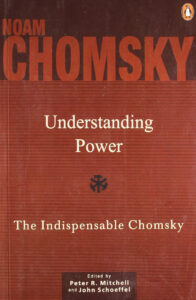
Pages: 432
Review by Anil Saxena
Chomsky is a big name—not just as a linguist, but also as a cognitive scientist, political theorist, and tireless critic of American foreign policy. He has written extensively on issues of U.S. interventions abroad, censorship, freedom of speech, and the hidden machinery of power.
I had heard about him and read an article or two in the past, but I never had the chance to read any of his books until now. I knew he belonged to the libertarian community of writers and public intellectuals.
‘Understanding Power’ contains small chapters of 5 to 15 minutes on average, written in a lively question-and-answer form.
The audio version of this book had been lying with me for a year, but I hesitated to start it, fearing it might be too heavy and nuanced, making the listening experience cumbersome. But when I finally pressed play, it pleased me no end.
The Timeframe of the Book
The book contains his conversations from the 1990s era; therefore, the events covered mainly belong to that or to an earlier period.
If you want to know:
- Which country is the greatest mafia don of the world,
- Which country has shed the maximum amount of innocent blood worldwide in the name of democracy, liberty, and freedom of speech,
- Which country has consistently destroyed grassroots movements, people’s initiatives, budding democracies, and public welfare projects across the globe,
- Which country has fomented the maximum number of coups d’état in the developing world—
then read this book.
And the answer to all those questions?
Neither the Soviet Union of the past, nor Russia, nor China, nor any other so-called totalitarian regime. It is America—ironically, the very nation that proclaims itself the guardian of democracy, free speech, and humanitarian values.
Chomsky reveals this with remarkable calmness and clarity:
“The U.S. has supported every imaginable form of terror, violence, and repression. If the Nuremberg laws were applied, then every post-war American president would have been hanged.”
The Layered Unfolding of Truth
In his most sedate and lucid manner, Chomsky unfolds, layer by layer, examples after examples of America’s real face.
According to him, the mainstream media—The New York Times, The Washington Post, and major TV news networks—are nothing but sham libertarians, loyal to the status quo. They echo only the concerns of authorities and, above all, of those who control the authorities: the corporate houses and business empires of all sorts.
They are, as he famously puts it, the “manufacturers of consent.”
America’s Dealings With the World
Chomsky insists that America’s dealings with the first, second, and third worlds are not guided by liberty, equality, humanity, or social progress, but by the vested interests of the American business class.
This business class wields the real power behind U.S. regimes, shaping both foreign and domestic decisions. And they have never hesitated to dine with dictators—of any kind—as long as those dictators served American business interests.
They have actively supported totalitarian regimes in El Salvador, Cambodia, Saudi Arabia, Afghanistan, Pakistan, and Egypt—through overt and covert operations, often with help from their mercenary client, Israel.
At the same time, they have devastated Nicaragua, Cuba, Haiti, Palestine, Libya, Vietnam, and Iraq—because these nations refused to follow Washington’s diktats and, by doing so, threatened American business interests.
The tragedy, as Chomsky highlights, is that many of these latter countries had better human development indicators, stronger democratic norms, and healthier social indices. Yet, none of that mattered to the United States—a country that was itself born with slogans of liberty, equality, and fraternity, and which still projects itself as the paragon of virtue and the world’s moral watchdog.
A Scathing Commentary
His categorical (sometimes bordering on cynical) denunciation of American media, authority, and business empires is a genuine epiphany.
We may have known some of this in passing—through satire, anecdotes, or scattered reports—but when someone of Chomsky’s stature reveals them systematically, one after another, with his penetrating analysis, it becomes compulsive reading.
“Propaganda is to a democracy what the bludgeon is to a totalitarian state.”
I strongly recommend that observant individuals do not miss his writings, because they form a toolkit to understand the behavior of power and authority in our times.
Chomsky’s Enduring Critique
Chomsky has been actively writing since World War II and remains remarkably active and unsparing in his criticism.
Unlike other countries—and even present-day India—where dissenting voices are often silenced, his critical views are still tolerated in America. To me, that is nothing short of a wonder.
Why Was He Tolerated?
To the query, how could the establishment tolerate him for so long?, Chomsky responded candidly.
First, he admitted that he was white and privileged. If not completely, this removed at least the major threat—something that would not have been the case for a Black libertarian intellectual.
Secondly, he pointed out that in an out-and-out capitalist country, everything is a commodity—including freedom. Those who are privileged and wealthy can afford and buy it far more easily than marginalized groups living in Black ghettos.
Manufactured Consent in India and America
For more than 10 years in India, we have seen the emergence of a strong body of gullible yet committed media and public opinion. We call it by various euphemisms, but it was striking to notice that in America, this has been the case since the very beginning.
American media and citizens have long lived under this “manufactured consent.” They are, in Chomsky’s words, the most indoctrinated people in the world.
America is a country where the state and business class hold totalitarian control over the realm of ideas. That control, he argues, is absolute.
Does that not shock you? It certainly did me.
This is what you learn when you read Chomsky’s Understanding Power—a book written in the 1990s, yet still echoing the present.
My Verdict
Chomsky’s Understanding Power is not just a collection of dialogues—it is an intellectual toolkit for dissecting how propaganda, corporate interests, and power structures shape our world.
The clarity of his arguments, his fearless critique, and the depth of his evidence make this book a classic in political thought.
A must-read for all observant and critical thinkers. It may shake your faith in mainstream narratives, but that is exactly what makes it powerful.
I strongly recommend it to anyone who wishes to see beyond the polished façade of American democracy—or, for that matter, any democracy.
My Rating: ★★★★☆ (4.5/5)
Author Bio: Anil Saxena
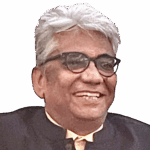 Anil Saxena is a retired Principal Chief Conservator of Forests and Head of Forest Force (HoFF), Maharashtra.
A lifelong nature lover and prolific reader, he brings depth, clarity, and insight to every book he reviews. As a Core Committee member of the Nagpur Book Club, he is known for his comprehensive reviews that make even complex subjects accessible and engaging.
Anil Saxena divides his time between Nagpur, Mumbai, and New York, enjoying the company of his children and grandchildren while continuing to explore the world of literature.