Book Review of ‘The Possessed’ (Demons / The Devils), by Fyodor Dostoevsky
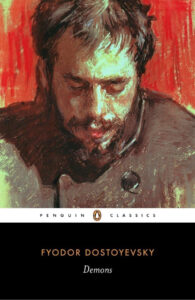
(Pages – 880)
Review by Anil Saxena
A Journey with the Book
I started this book when I was visiting Dallas to be there with my daughter, who was undertaking training prior to taking up an appointment. Then, on account of some audio deficiency, I had to abandon it. Later again, I had to start and shelve its reading two or three times until I restarted for the last time and finally finished it.
A Political Tragedy
The Possessed (also known as Demons or The Devils) is one of the most intensely political novels of Dostoevsky—a tragedy that unfolds in the heart of provincial Russia. It tells the story of a small town that falls into the grip of violent upheavals brought on by the spread of nihilism.
As Dostoevsky wrote:
“If God does not exist, then everything is permitted.”
The novel dramatizes the frightening consequences of this idea.
Historical Backdrop
Written around 1871, when Russia was undergoing severe political and ideological upheavals, the book reflects the influence of the French Revolution, its suppression, and the rising tide of socialist and romantic revolutionary writings. These currents ultimately led to the celebration of atheism and nihilism.
Russia’s intellectuals, proud of their French, their literature, and their radical ideals, often sought to put them into practice in their homeland. In these turbulent times—serfs liberated, the Tsar’s authority challenged, socialism spreading—rebellion without a cause became the credo of the young and the brilliant. As man usurped the place of God, Christianity was relegated, and atheism became the byword among intellectuals. This sinister turn gave rise to nihilism. Dostoevsky’s novel is a serious indictment of this ideology.
Stepan Verkhovensky: The Parasite Intellectual
Professor Stepan Verkhovensky is introduced as a worn-out, retired professor—more a relic of past glory than a man of substance. Though still respected, he thrives on contacts rather than talent. Fond of gatherings, gambling, and arranging evening addas with young students and writers, he peppers his Russian speech with French and carries himself with misplaced pride.
A perfect parasite, he clings to Varvara Petrovna, his patron, and lives off her crumbs. By the end, completely disillusioned with life, society, and even his loved ones, he leaves the provincial town to die in peace. Whether he truly finds peace or not is vividly and ambiguously depicted.
Varvara Petrovna: The Aristocratic Manipulator
Varvara Petrovna, on the other hand, is a rich and worldly-wise aristocrat who moves in elite circles but lacks true talent. She cultivates Stepan Verkhovensky, using him as a social stepping-stone while simultaneously exercising despotic control over him—financially and emotionally. She remains ambitious, opinionated, and strong-willed, embodying both strength and manipulation.
Nikolai Stavrogin: The Enigmatic Protagonist
Her son, Nikolai Stavrogin, becomes one of the central figures of the novel. Handsome, aristocratic, and once close to Stepan in childhood, he later joins the army but soon becomes an outcast for his erratic and often scandalous behavior.
Rumored to be the leader of a faithless, godless cult of anarchic revolutionaries, Stavrogin remains an enigma. His contradictions are striking—at times noble (willing to marry a disabled girl), at times despicable, and always unpredictable. His life, riddled with oddities and mystery, ends in suicide. Dostoevsky presents him as a riddle that resists all attempts at resolution.
As Dostoevsky notes about such souls:
“The mystery of human existence lies not in just staying alive, but in finding something to live for.”
Pyotr Verkhovensky: The Dark Ideologue
Pyotr, the son of Stepan, at first lurks in Stavrogin’s shadow. But gradually he emerges as the true ideologue and leader of the nihilists. Unlike Stavrogin, Pyotr is not enigmatic—he is deliberate, cunning, and purely destructive.
For him and his followers, there are no principles, no gods, no decencies—only the ruthless goal of dismantling society. Treachery is his tool, destruction his creed. These nihilists despised the hypocrisies of older intellectuals like Stepan, yet shamelessly exploited them as fodder for their destructive cult.
Dostoevsky’s Denouncement of Nihilism
The Possessed emerges as a categorical denouncement of nihilism. Dostoevsky understood its inner workings and portrays its evil machinations with unflinching clarity. He paints it in the darkest hues, showing how ideas, once loosed from morality, can corrode both society and soul.
The Flow of the Novel
The plot is tight, the narrative fast-paced—typical of Dostoevsky. His long ideological discourses, surprisingly, do not weigh the reader down but instead sharpen the philosophical tensions.
The oddities of Stavrogin, the hypocrisies of Stepan, the cruelties of Pyotr, the manipulations of Varvara, and the sorrows and intrigues of many other characters keep the reader engrossed.
As Dostoevsky himself once remarked:
“Man is sometimes extraordinarily, passionately, in love with suffering.”
This novel exemplifies that truth.
My Final Thoughts
A tragedy, a classic— The Possessed deserves to be read. It is both a gripping narrative and a profound meditation on politics, ideology, and the human soul.
Author Bio: Anil Saxena
 Anil Saxena is a retired Principal Chief Conservator of Forests and Head of Forest Force (HoFF), Maharashtra.
A lifelong nature lover and prolific reader, he brings depth, clarity, and insight to every book he reviews. As a Core Committee member of the Nagpur Book Club, he is known for his comprehensive reviews that make even complex subjects accessible and engaging.
Anil Saxena divides his time between Nagpur, Mumbai, and New York, enjoying the company of his children and grandchildren while continuing to explore the world of literature.