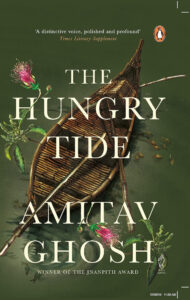
Book Review of ‘The Hungry Tide’, by Amitav Ghosh
Pages: 439
Review by Anil Saxena
The Setting: The Sundarbans
Amitav Ghosh’s The Hungry Tide is set in the hauntingly beautiful yet treacherous landscape of the Sundarbans, “a land half submerged at high tide, yet never dry at low.” Here, land and water are inseparably bound, forming a labyrinth of islands, rivers, and creeks.
The Sundarbans lie beyond Kolkata on the eastern coast, an archipelago before the waters merge with the Bay of Bengal. This geography is among the harshest in the world—racked by cyclones, scoured by tides, and guarded by mangroves. Tigers adapted to swim across wide rivers, saltwater crocodiles, and other predators complete this unforgiving environment. Yet amid this danger, millions of people carve out a precarious existence.
Ghosh evokes awe and admiration for this realm where “the tides reach in like a hand and flood the land twice a day.” The novel speaks not just of nature but of the human struggle within it.
The Protagonist: Piya and Her Quest
At the heart of the novel is Piyali Roy (Piya), a fiercely independent field zoologist of Bengali origin but raised in America. She comes to the Sundarbans to study the population dynamics of the Irrawaddy dolphins (Orcaella brevirostris). On her way to Canning—the gateway station to the delta—she meets Kanai Dutt, a suave Bengali businessman from Delhi. Their acquaintance sets in motion a series of events that drive the novel forward.
Piya’s journey takes a dramatic turn when she encounters Fokir, an illiterate but intuitive local fisherman. Though they share no common language, an unspoken bond grows between them.
“Although she could not speak his tongue, she felt as if he understood her silences,”
Ghosh writes. This bond, tender and poignant, cuts across barriers of education, class, and culture.
Human Tragedy and Conservation
One of the novel’s strongest undercurrents is its portrayal of forcible evictions of settlers by government agencies in the name of conservation. Ghosh raises the disturbing question: whose wilderness is being preserved, and at what cost?
The settlers—many from Bangladesh or Bihar—face not only storms, crocodiles, and tigers, but also the cruelty of human systems.
“In Morichjhapi, it was not the tigers or storms that destroyed them, but men,”
writes Ghosh. The narrative unveils a tragic saga of people who belong to “nowhere,” highlighting their fight for survival in a land that both nurtures and devours.
Myths, Folklore, and Belief Systems
The novel is also enriched with mythology and folklore. The locals worship Bon Bibi, the forest goddess, along with her brother Shah Jangali, while their adversary is the demon-king Dokkhin Rai. These oral traditions, infused with both Hindu and Muslim influences, provide not just spiritual comfort but also a code of survival in a treacherous world.
“In the tide country, transformation is the rule of life—not death. Death is merely the last transformation.”
This worldview, rooted in folklore, defines how the people negotiate danger with resilience and ingenuity.
Nirmal’s Diary: A Voice of Resistance
Through the character of Nirmal, an idealist retired schoolmaster, Ghosh injects political history and ideology into the narrative. Nirmal becomes deeply influenced by Kusum, Fokir’s fearless mother, and records in his diary the struggle of the Morichjhapi settlers against the authorities.
The diary, passed on to his nephew Kanai, becomes a testimony of injustice and an appeal for compassion. It highlights how personal histories intertwine with political tragedies.
The Climax: Heroism and Loss
As the story builds to its conclusion, the pace quickens. The final fifty pages are lyrical, elegiac, and suspenseful. In a devastating climax, Fokir rescues Piya from the jaws of death during a storm but sacrifices his own life in the process.
“Piya had thought of him as an oarsman, a guide. But at the end, she knew he had been something more—an anchor, a savior.”
This act of raw courage leaves the reader heavy-hearted, the grief lingering long after the book is closed.
Style and Scholarship
Ghosh is among the finest voices in Indian English writing. His prose is lyrical yet scholarly, weaving together ecology, cetology, folklore, and human drama without being pedantic. He demonstrates not only a deep understanding of scientific fieldwork but also a rare sensitivity to the human heart.
His descriptions of the Irrawaddy dolphins, the omnipresent mangroves, and the tidal cycles are both precise and poetic. “Every tide is a story,” he reminds us, making the landscape itself a living character.
Why This Book Matters
The Hungry Tide is more than a novel—it is a meditation on survival, love, loss, and the fragile balance between humans and nature. It compels us to ask difficult questions about conservation, displacement, and belonging.
This book should be read by all who are curious about the interplay of ecology and humanity, and by those who seek novelty and depth in reading. It lingers in the mind, like the ebb and flow of the tides themselves.
Author Bio: Anil Saxena
 Anil Saxena is a retired Principal Chief Conservator of Forests and Head of Forest Force (HoFF), Maharashtra.
A lifelong nature lover and prolific reader, he brings depth, clarity, and insight to every book he reviews. As a Core Committee member of the Nagpur Book Club, he is known for his comprehensive reviews that make even complex subjects accessible and engaging.
Anil Saxena divides his time between Nagpur, Mumbai, and New York, enjoying the company of his children and grandchildren while continuing to explore the world of literature.