Book Review: The Calcutta Chromosome by Amitav Ghosh – A Postmodern Medical Thriller
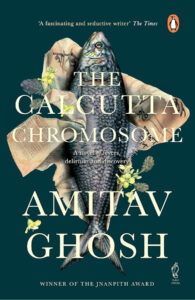
Pages: 180
Review by Anil Saxena
Amitav Ghosh, winner of the Jnanpith Award, is regarded as one of the most significant voices in Indian English fiction. I had earlier read his ‘The Great Derangement’, and was moved by his deep concern for climate change and the environment. Since he became the first English novelist to win this prestigious award, I was keen to explore more of his works.
Fortunately, I came across The Calcutta Chromosome in my collection of free downloaded texts. At just 180 pages, it drew me in instantly and refused to let go.
The Story Begins
The novel opens with Antar, an Egyptian widower, a loner, and a computer buff working in New York with an NGO concerned with water conservation. One day, while working on his highly advanced computer Ava, he stumbles upon a mysterious digital trace—a visiting card, and then the image of a man. That man is Murugan, another employee of the same NGO, who has suddenly gone missing in Calcutta.
Thus begins a layered narrative that unfolds like a thriller, weaving together past, present, and future.
“You don’t find stories, they find you.”
Murugan’s Obsession
Murugan is a scientist obsessed with challenging the contribution of Ronald Ross, the Nobel Prize–winning researcher who isolated the malaria parasite in 1896 in Calcutta and was awarded the Nobel in 1906.
Through years of obsessive research, Murugan concludes that the true credit for the discovery does not belong to Ross but to others who have been erased from history. Though the scientific establishment dismisses him, Murugan pursues his investigation with relentless passion. This pursuit eventually brings him to Calcutta—where he vanishes.
The Cast of Characters
During Murugan’s 1995 visit to Calcutta, he encounters a host of fascinating figures:
- Sonali Das – a glamorous actress, daughter of a famous Jatra performer.
- Urmila – a journalist at the Calcutta Chronicle.
- Phoolboni – a celebrated Bangla author who romanticizes tribal life.
- Romen Haldar – a wealthy builder.
- Mrs. M – an Englishwoman running a guesthouse.
Threading through all of this is the elusive figure of Lutchman (Lakhan), first introduced as a servant to Ronald Ross in Hyderabad in 1894. He reappears across decades and guises—sometimes as a ghost, sometimes as a humble worker, always marked by his deformed hand and gap-toothed face.
“In every story there is always someone waiting to be found.”
The Mystery of Mangala
A shadowy figure in the narrative is Mangala, a syphilitic sweeper woman picked up by Dr. Cunningham (Ross’s predecessor). In the eyes of the American scientist who visits Ross’s lab, it is Mangala—not Ross—who truly holds the keys to discovery.
The American’s clandestine visit reveals her presiding over a strange congregation of diseased patients, surrounded by slaughtered pigeons, revered like an oracle. In her mysterious experiments, malaria parasites and pigeon blood appear as conduits for healing. Soon after, the American vanishes without a trace.
The Theme Beyond Science
Though the novel begins like a medical thriller, it gradually becomes something far deeper. The real story is not about malaria at all—it is about alternative knowledge systems, occult practices, and the limits of Western science.
Ghosh suggests that Mangala and Lakhan manipulate both past and present figures—Cunningham, Ross, Murugan—to achieve a kind of immortality. Their tool is the enigmatic Calcutta Chromosome: a non-hereditary, unpaired substance that allows transmigration of souls across bodies, facilitated through malaria and ritual.
The narrative is deliberately convoluted, sometimes baffling, but always gripping.
“The world is never what it seems to be. There is always another story beneath the story.”
Haunting Moments
Certain scenes stand out for their haunting intensity. For example, Phoolboni’s eerie visit to the abandoned Renupur station in 1937, where he encounters a ghostly Lakhan. Or Urmila’s bizarre encounter with a slippery fish seller—once again Lakhan in another form—who sells her rotten fish wrapped in a Gazette notification, cleverly linking past and present.
These moments create a surreal, gothic atmosphere that is both unsettling and mesmerizing.
The Ending
By the time you reach the end, the novel feels like a grand feast that, despite its rich flavors, leaves you oddly unsatisfied. The intricate threads Ghosh weaves do not resolve into a clear pattern, but perhaps that is the point. The story thrives on ambiguity, resisting neat closure.
Who is it for?
In the final analysis, The Calcutta Chromosome is not just about malaria or Ronald Ross’s Nobel Prize. It is about what lies beyond the certainties of science—occultism, mysticism, ghosts, and the possibility of alternate realities shaping our lives.
It is not a book for everyone. But for readers who enjoy postmodern fiction, speculative narratives, and intellectual puzzles, it is a thrilling experience. Some chapters, with their racy narrative and haunting detail, are worth revisiting more than once.
My Verdict
An intriguing, unsettling, and ambitious novel. Ghosh keeps you riveted with his fast-moving flashbacks, flash-forwards, and multiplicity of characters. But he also challenges you to embrace mystery over resolution.
“Reality is not a given—it is always being rewritten.”
Next time I revisit this book, I will read more carefully, determined not to miss the hidden clues.
Author Bio: Anil Saxena
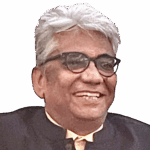 Anil Saxena is a retired Principal Chief Conservator of Forests and Head of Forest Force (HoFF), Maharashtra.
A lifelong nature lover and prolific reader, he brings depth, clarity, and insight to every book he reviews. As a Core Committee member of the Nagpur Book Club, he is known for his comprehensive reviews that make even complex subjects accessible and engaging.
Anil Saxena divides his time between Nagpur, Mumbai, and New York, enjoying the company of his children and grandchildren while continuing to explore the world of literature.