Book Review: Swami Vivekananda – The Living Vedanta by Chaturvedi Badrinath
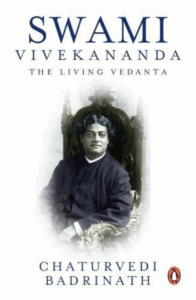 480 pages | Buy Book
Book Review by Anil Saxena
A Remarkable Work Beyond Biography
Chaturvedi Badrinath, an IAS officer and a philosopher, offers in this book not just another account of Swami Vivekananda’s teachings. This is no run-of-the-mill biography. It is a scholarly, sensitive, and profound work that seeks to get under the skin of Vivekananda — not as a mere celebratory saint, but as a man of flesh and blood, with contradictions, passions, empathy, and a rare humanity.
With rare insight, the author not only illuminates Vivekananda’s philosophy but gives us a compelling glimpse into the personality of a man who was not only a zealous missionary but someone who loved and cared for his fellow humans with unmatched sincerity.
“The only God that exists, the only God in whom I believe, the sum total of all souls — and above all, my God the wicked, my God the miserable, my God the poor of all races.”
Vedanta: The Core of His Philosophy
Vivekananda was a proponent of Vedanta, a philosophical system within Hinduism propagated by Adi Shankaracharya in the 8th century AD. The Vedanta doctrine declares this world as maya, or illusion, and affirms the only reality as Brahman. All sentient beings, according to this view, are mere reflections of that one universal consciousness. There is no existence of individual souls — the belief in separate selves is itself an illusion caused by maya.
Swami Vivekananda, however, took this to a new level. While agreeing that all beings are reflections of Brahman, he emphasized that this realization should lead to unconditional love, respect, and service toward others — without charity, condescension, or superiority.
“They alone live who live for others. The rest are more dead than alive.”
He did not engage in metaphysical debates merely for intellectual delight. Unlike Shankaracharya, who expressed Advaita through polemics and logic, Vivekananda brought Vedanta to life by living its ethical and compassionate essence.
A Spiritual Heart with Human Tenderness
Vivekananda loved Jesus Christ and Gautama Buddha not as distant figures but as contemporaries. He once said he would have loved to be in Christ’s place when he washed the feet of the downtrodden. He tried to understand Buddha by embodying his spirit, not just studying his teachings.
“To understand Vivekananda, one has to feel him from within. His writings and speeches may illuminate, but it is only by going under his skin that one gets truly rewarded.”
Though a sannyasi, he was never removed from worldly joys. He loved ice cream, cracked jokes during discussions on the Upanishads, and carried deep affection for his mother. There was no contradiction in being both a renunciate and a loving son. He was a monk with a vibrantly beating heart.
Rejection of Orthodoxy and Social Ills
Vivekananda had no patience for the orthodoxy, rigidity, and ritualism that plagued Hinduism. His greatest anger was reserved for the customs, dogmas, and misinterpretations perpetuated by the priestly and ruling classes, which he believed hindered the realization of true Hindu spiritual ideals.
He abhorred untouchability, especially the caste-based discrimination that condemned millions to a life of misery and poverty.
“What right has a handful of people to label three-fourths of the population as untouchables?”
He advocated for universal education, women’s emancipation, and an open, progressive reinterpretation of ancient texts.
Embracing the World, Without Attachment
Unlike other ascetics who renounce the world, Vivekananda enjoyed good food, conversation, even a good smoke. But he never let material possessions or comforts define him. His detachment was total — he could give away his golden watch or smoking pipe to a stranger without hesitation.
He was not bound by false notions of sanctity or self-denial. His detachment was real — not theatrical.
Comparison with Gandhi
Badrinath draws a pointed contrast between Gandhi and Vivekananda. According to the author, Gandhi’s understanding of Hinduism was limited and uni-dimensional, whereas Vivekananda had a deep command of Indian philosophical traditions as well as Western thought — from Kant, Hegel, Mill, to John Stuart Mill and Herbert Spencer.
For Gandhi, India had nothing to learn from the West. But Vivekananda saw immense value in Western systems of thought, science, and social action. He believed in dialogue between civilizations, not confrontation.
Arrival in America and the Parliament of Religions
Even before the famous 1893 Parliament of Religions in Chicago, he arrived in America in a state of penury. Yet he was hopeful — “The son of Nazareth will take care of me,” he said.
When he addressed the Parliament with the now-famous words “Sisters and Brothers of America”, thunderous applause followed. He made two powerful assertions:
- No religion has exclusive claim on morality or godliness.
- Religions must learn from each other rather than compete.
“The Christian is not to become a Hindu or a Buddhist, nor a Hindu or a Buddhist to become a Christian. But each must assimilate the spirit of the others and yet preserve his individuality and grow according to his own law of growth.”
He was equally critical of Hinduism’s internal injustices and urged Hindus to learn from the West — especially social action, philanthropy, and respect for all.
A Monk with a Cult Following
In America, his commanding presence, ochre robes, and mesmerising eyes, combined with his fiery oratory, turned him into a cult figure, especially among women. He formed deep friendships with many of them, including Sara Bull (his “Dheer Mata”) and Sister Nivedita.
His eating habits and lifestyle in America were far from ascetic — he enjoyed meat, smoked, relished ice cream and spicy food, and lived with humility in modest lodgings.
Calumny and Controversy
Jealous evangelists in America, threatened by his popularity, accused him of licentiousness. Back home, members of the Brahmo Samaj and orthodox Brahmin lobbies, also tried to tarnish his name. Yet, he rose above all criticism, supported by his American well-wishers and enlightened Indian admirers.
Swami and Women
Swami Vivekananda had immense respect and affection for women. His empathy extended even to prostitutes, whom he considered victims of a cruel system. He believed men and women are two wings of the same bird — a bird cannot fly with one wing.
He praised American women for their strength and support and was deeply grateful to them. His conversations with women like Sara Bull and Sister Nivedita show a depth of intellectual and emotional engagement that he perhaps could not share as easily with his Indian disciples.
Unique Traits of Vivekananda
A. He never liked blind worship. He encouraged followers to retain their critical faculties, knowing that blind faith turns into hatred when idols fall.
B. He rejected the one-sided concept of “grace”. Grace, he believed, flows both ways — from saint to disciple and vice versa.
C. He abhorred ingratitude and bore no grudges. He debated passionately but never held resentment.
D. He warned that disciples often miss the true teachings of masters. Like Buddha, Jesus, and Kabir, he was often misunderstood.
E. He never hesitated to speak hard truths, even at the risk of losing friends. He remained untouched by flattery or criticism.
F. He lived simply, avoided elite circles, and kept his doors open to all. His admiration for the British grew when he met thinkers like Max Müller and Paul Deussen.
Differences with Buddha
Buddha was his Ishtadev, but he disagreed with his views on women. Buddha allowed women in the Sangha reluctantly and under strict conditions — something Vivekananda viewed as chauvinistic. He admired Buddha’s heart and intellect, but not necessarily all his doctrines.
His Final Years: A Man Torn Between Two Worlds
In his last years, Vivekananda often spoke of death. Suffering from diabetes and asthma, he was torn between his mission and his personal longing for moksha. As an organizer, he wanted Ramakrishna Math to follow transparency and accountability — like Western institutions. But his disciples often failed to grasp his intent.
He was caught between impersonal, universal love and his deep personal attachment to his mother and a few close friends. He considered this a failing, but it made him more human, more relatable.
Death and Legacy
On 4th July 1902, his tired body gave way. He was just 39.
He was perhaps the greatest interpreter of Vedanta after Shankaracharya. But his Vedanta was not cold or indifferent — it was living, breathing, loving, and full of service.
“My ideal indeed can be put into a few words, and that is: to preach unto mankind their divinity and how to make it manifest in every movement of life.”
Vivekananda in Contemporary India
Today, his ochre-clad image is a household symbol of Hindu pride. Unfortunately, right-wing groups have appropriated him without understanding the soul of his teachings. They ignore that he was the antithesis of bigotry, casteism, and intolerance — the very traits they promote.
“Sectarianism, bigotry, and its horrible descendant, fanaticism… have filled the earth with violence, drenched it often with human blood, destroyed civilization and sent whole nations to despair.”
His Vedanta was humanitarian, progressive, and practical — a way to uplift the masses, not to divide them.
Vedanta – A healing balm for the world
Swami Vivekananda: The Living Vedanta by Chaturvedi Badrinath is a masterful tribute to one of India’s greatest minds and hearts. It doesn’t merely chronicle events — it explores the inner storms, contradictions, and the sublime harmony of a man who was both human and divine.
If understood and practiced in the spirit that Vivekananda lived, his Vedanta can still serve as a healing balm for a deeply fractured, unequal world.
Author Bio: Anil Saxena
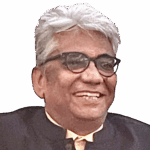 Anil Saxena is a retired Principal Chief Conservator of Forests and Head of Forest Force (HoFF), Maharashtra.
A lifelong nature lover and prolific reader, he brings depth, clarity, and insight to every book he reviews. As a Core Committee member of the Nagpur Book Club, he is known for his comprehensive reviews that make even complex subjects accessible and engaging.
Anil Saxena divides his time between Nagpur, Mumbai, and New York, enjoying the company of his children and grandchildren while continuing to explore the world of literature.