Book Review of River of Fire ( آگ کا دریا ) Aag ka Darya, by Qurratulain Hyder
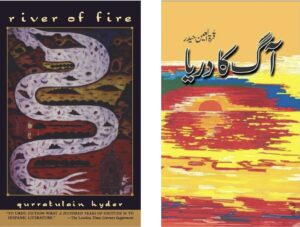
428 pages
Review by Anil Saxena
Reading ‘River of Fire’ feels like returning to a first-rate classic after a long time. Though written in 1959, the novel appears strikingly contemporary and modern even after more than half a century. Its central theme is India’s composite civilization, stretching from Mauryan times up until the mid-20th century (around 1956).
It was originally published in Urdu in 1959 under the title Aag Ka Darya (“River of Fire”) and later translated by the author into English in 1998. In 2019, the novel was reprinted by New Directions Publishing.
Time-Spans and Historical Epochs
Hyder spans more than two thousand years of history, beginning with the time of Chandragupta Maurya (4th-century BC) and moving through classical, medieval, colonial, and modern post-national periods.
The narrative follows four souls—Gautam, Champa, Kamal, Cyril—through these different epochs. Their lives intersect, diverge, re-form, and reshape themselves in romance, war, possession, dispossession.
Characters Across Eras
The principal characters—Gautam, Champa, Kamal, Cyril, and others—are eternal presences. They reappear across centuries, yet each time they endure the same pain of living, separation, and existential angst.
- Gautam appears first as a student of mysticism at the forest university of Shravasti in the fourth century BCE.
- Champa embodies the enigmatic experience of Indian womanhood across ages.
- Kamal arrives when Muslim culture becomes one of the threads in India’s tapestry; he loses himself in its landscape.
- Cyril, the Englishman, appears in the colonial/late colonial eras.
Hyder’s narrative is profoundly philosophical and multi-layered, offering glimpses into her extraordinary intellectual depth. At its core, the novel celebrates India’s composite culture, a culture that absorbs, assimilates, and transforms everything into its own.
As Hyder suggests:
“If the threads of Hinduism, Buddhism, and Jainism were deeply interwoven in ancient times, then the later arrival of Islam—especially of Sufi vintage—and the liberal Englishmen of colonial times, all melted into the crucible called India, producing a unique civilization that no other nation can claim.”
Philosophical Undertones
On a personal level, the novel is deeply sad. Loneliness and suffering confront individuals across eras, but their nature is universal.
A recurring theme recalls the essence of Buddhist philosophy:
“The world is full of sorrows, and our loneliness can only be overcome by turning inward. No one else can provide us solace.”
Hyder argues for a humanity that persists across national, religious upheavals—indicating that at the root, human nature is one.
Themes of Partition, Identity, and Syncretism
One of the novel’s major themes is the critique of purist nationalism or ideological separatism. Shortly before Partition, Kamal reflects:
“The Indo-Muslim life-style is made up of the Persian-Turki-Mughal and regional Rajput Hindu cultures. So, what is this Indianness which the Muslim League has started questioning? Could there be an alternate India? Why?”
This thought encapsulates the core struggle: identity formed by intermingling, resisting simplification. Hyder uses the depth of history to show that the sharp divisions of 1947 did violence to a continuity that had evolved over millennia.
Style and Literary Craft
Hyder’s style in River of Fire is ambitious and technically resourceful. She employs diverse narrative forms—letters, chronicles, parables, journals—to present her melancholic vision of time’s corrosion.
Critics have noted that her style combines lyricism, wit, allusiveness. She brings together classical Urdu poetics and Western modernism; in her prose one feels echoes of Faiz Ahmed Faiz mingling with Virginia Woolf or E. M. Forster, with occasional parabolic or chronicle-like modes.
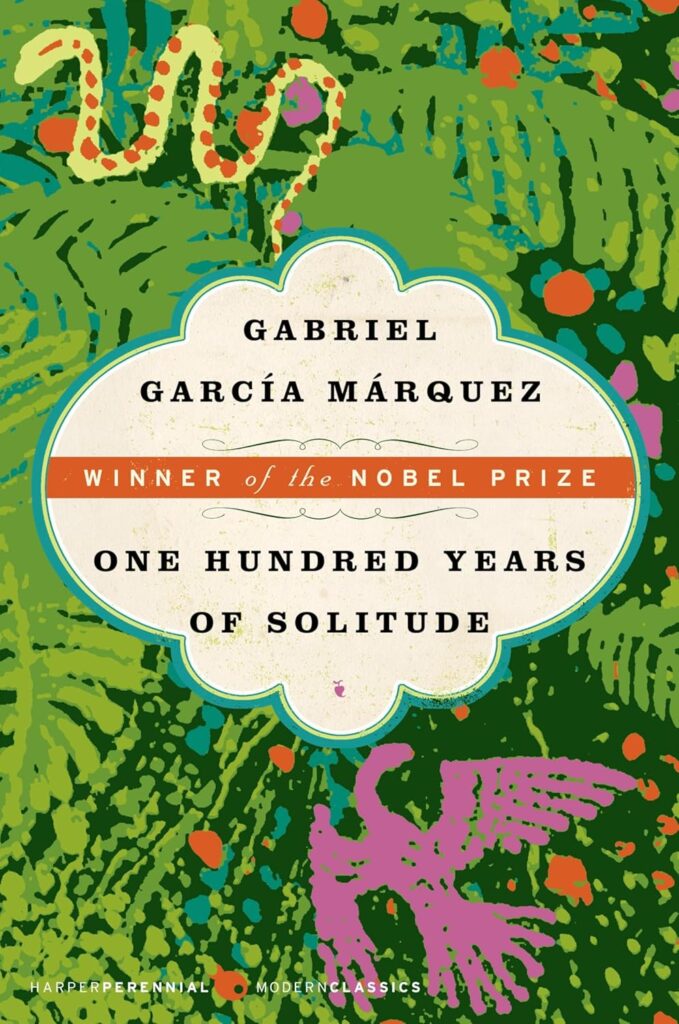
One critic wrote that River of Fire is to Urdu fiction what One Hundred Years of Solitude is to Hispanic literature.
Reception and Legacy
From its first publication, Aag Ka Darya was hailed as a landmark. It is widely described as “one of the Indian subcontinent’s best-known novels.”
In later years, especially after translation and reprint, critics continue to affirm its relevance. Aditi Sriram (in 2019) writes that the novel “is as relevant in 2019 as it was when she first wrote it in 1959.”
It features in lists of influential books, and is especially noted for how it offers a syncretistic version of history, resisting purist mythologies.
My Personal Reflections
On a personal level, it is a sad novel, as there is loneliness and suffering which are faced by individuals, but are of a universal nature. One underlined theme of the novel leads to the basic philosophy of Buddhism, that the world is full of sorrows, and our loneliness and suffering can only be solved by looking inwards and through our own searching. No one else can provide succor to us.
The bonhomie of Hindus and Muslims during the Gadar of 1857 and mutual respect, cooperation, and awe for each other’s customs is refreshing and is quite endearing. The aftermath of partition is heart-rending, but this is what life is, and man has no control over the events beyond his own.
Author’s narration on the resplendence of bygone Lucknow is captivating, and it comes alive with the full force of its etiquettes and nafasat. She is equally at home in elitist London and with contemporary avant-garde movements prevalent during the writing of the novel. It is a tour de force of Indian civilization, its inclusivity and shared past assayed in a manner that does not make the text pedantic.
The pain and anguish of Kamaal and Gautam are personal as well as universal. The scourge of devastating bifurcation of the nation rendered the first generation sufferers on both sides of the divide listless, alienated, and completely shattered. The loss of moorings of Kamaal is genuine, and his sorrow is internalized by the reader.
Quratulain Haider was among the few Indian writers in English in the 20th century whose writings can be compared to the best of Western authors, and this novel of hers is considered a finest specimen of Urdu/English literature, and I, too, hold the same opinion after reading it rather belatedly. The only regret is that I read it in English only, though it is available in Urdu (in Hindi script). I always believe in reading literature in its own native language, so those who can get hold of its Hindi script version, that is the best.
My Verdict
River of Fire / Aag Ka Darya is not only a profound historical novel—it is an epic span of civilizational memory and identity. It entwines four souls across four epochs to show that what we might think of as rigid divisions—religion, language, nation—are often more porous, shared, blended, and fragile than they seem.
Its style, ambition, and emotional depth ensure that it remains as vital today as when it first appeared. For readers interested in history, identity, or simply the human condition, this is a novel that rewards deeply.
Rating: 4.5 / 5
★★★★☆
Author Bio: Anil Saxena
 Anil Saxena is a retired Principal Chief Conservator of Forests and Head of Forest Force (HoFF), Maharashtra.
A lifelong nature lover and prolific reader, he brings depth, clarity, and insight to every book he reviews. As a Core Committee member of the Nagpur Book Club, he is known for his comprehensive reviews that make even complex subjects accessible and engaging.
Anil Saxena divides his time between Nagpur, Mumbai, and New York, enjoying the company of his children and grandchildren while continuing to explore the world of literature.