Book Review of Point Counter Point, a Philosophical Masterpiece by Aldous Huxley.
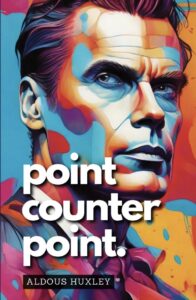
550 pages | English
Review by Ashok Rathi
It’s a common phenomenon in the world of art and literature that a single masterpiece can bring its creator to enduring fame, etching their name into cultural immortality. However, this very success often casts a long shadow over the artist’s broader body of work.
Many equally profound works are not broadly noticed.
Discovering the novel
I noticed Point Counter Point after reading its introduction posted by our dear friend Dinesh Dawane on Nagpur Book Club’s WhatsApp forum, which read…
Aldous Huxley is the writer people remember for Brave New World, and that’s a shame, because Point Counter Point is the book that shows what he was capable of when he stopped warning us about the future and started dissecting the present.
This very exciting introduction continued for a few paragraphs. That was more than enough for me to look for the book and explore old Brave New World again.
What is this all about?
Point Counter Point (1928) by Aldous Huxley is not really a conventional novel with a defined plot driven by a protagonist; instead, it functions more like a sophisticated book of “conversations”, a sort of melange fabric where intellectual debates and philosophical exchanges take central stage as the primary source for exploring ideas.
The characters and loosely woven storyline serve largely as secondary scaffolding to facilitate these discussions rather than some centralized narrative. It is only towards the end that the reader suddenly grasps the profound cumulative significance of these fragmented threads evolving into a cohesive commentary on human existence and the idea of God.
Multiple storylines and intellectual context
The novel interweaves numerous parallel storylines, recurring characters, and contradictory viewpoints. They talk about love, infidelity, science, religion, and politics.
Characters are drawn from the interwar English upper-class intellectual circle. There are views, and more exciting out-of-the-box counter views. Throughout the book, the dialogues are exceptionally brilliant, highly exciting, and intellectually stimulating.
The issues tackled remain strikingly contemporary even today, yet many of the specific viewpoints appear dated now.
Most discussions are rooted firmly in the post–First World War socio-political environment, the rise of communism and fascism, the influence of Victorian morality, emerging Freudian psychology, and new scientific ideas challenging the age-old divine world and the very existence of God.
Satire and real-life inspirations
Many of the exchanges are deliberately satirical, putting ideas to extremes, exaggerating, and at times even defying logic to shock the reader; witty, dramatic, and humorous.
Many characters emerge from the real world, Huxley himself as Philip, D. H. Lawrence as Mark Rampion, and a few more reflections from real life.
One of the philosophical tones of the novel is captured in a reflective line:
All ideas are instruments; they are not answers.
Was this Musical?
Somewhere in the novel, through the character Philip, Huxley reveals the structure in a meta paragraph, which he calls the “musicalisation of fiction”, mainly created through abrupt shifts between scenes and moods, mimicking musical modulation.
There is a shocking jump from one theme to another and its counter-theme; to me it appears as a far-fetched but interesting imagination.
Another reflective passage in the novel reinforces this structural intention:
In music, themes are stated, then developed, then contradicted.
However, I would like to compare this with the sounds and chatter emerging from a very busy railway platform and the cumulative sound aesthetics.
Either way, there are multiple independent melodies played together. Are they harmonising or clashing? The reader has to find out.
An uphill task: the reading experience
Reading a 550-page book with densely packed philosophical conversations, too many Greek mythological metaphors, and intellectual discourse about fine arts is surely not an easy journey.
Let me confess, while reading the book I missed fully deciphering many conversations due to certain inadequacies, but one can always make some sense from the essence of what the writer means to convey.
While reading, I often felt that the author was becoming showy or too ornate, but finally the reader accepts the essentiality of such metaphorical expressions. Indeed too dense, but not out of place.
A thought from the novel resonates with this intellectual intensity:
We live as we think, because thinking has become our deepest habit.
Readers can be assured that despite being a bit cumbersome, throughout the book it never loses the reader’s attention and grip, and remains exciting.
What a climax: God or no God?
The climax and ending of Point Counter Point are a startling and apparently tragic culmination of chaos in the storyline with the demise of two important characters.
But the story’s climax was just a byproduct.
Primarily, it was meant to argue about the survival or demise of God. The writer presented both scenarios in a very dramatic way. Me being an atheist, I will go for the final version – the world without God.
About the Author: Ashok Rathi
 Ashok Rathi, born in 1952 in Vidisha, Madhya Pradesh, is a postgraduate in Chemistry and a seasoned textile chemist and colourist with nearly four decades of professional association with the textile industry in India and the Philippines. A world traveler and voracious reader, his intellectual curiosity spans history, philosophy, comparative religion, and socio-political thought.
A Core Committee member of the Nagpur Book Club, Ashok’s insights are marked by clarity, depth, and an ability to connect ideas across cultures and centuries. His reflections on history and human civilization often blend scientific precision with a philosopher’s curiosity — making his perspectives both incisive and deeply human.