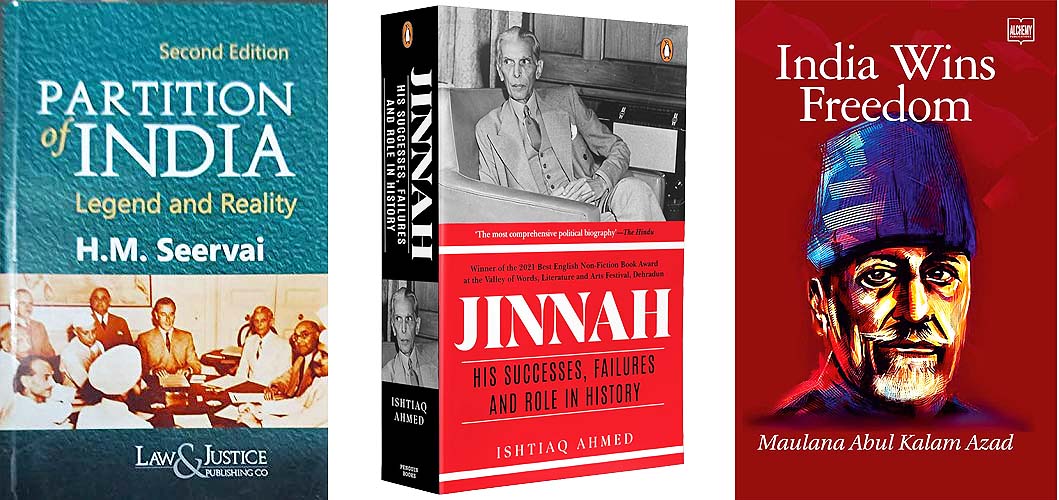
A Reading of ‘India Wins Freedom’, ‘Partition of India: Legend and Reality’, and ‘Jinnah: His Succesees, Failures, and Role in History’
Read Part 1
Reflections and Analysis by Anil Saxena
Editor’s Note
The debate on Partition cannot be complete without engaging the figure of Muhammad Ali Jinnah and the intellectual foundations of Pakistan’s creation. In Part One, the discussion centred on the arguments of Maulana Abul Kalam Azad and H. M. Seervai, both of whom questioned the inevitability of Partition and emphasised constitutional alternatives that might have been pursued.
This Part Two turns to Ishtiaq Ahmed and his influential work Jinnah: His Successes, Failures and Role in History, which reassesses Jinnah’s political evolution, ideological commitments, and strategic choices. This concluding essay does not seek to deliver a final verdict, nor does it endorse any single interpretation. Its purpose is to present arguments as they appear in the cited works and to encourage informed, critical engagement with a subject that continues to shape the subcontinent’s political and intellectual life.
As with Part One, the views expressed in the essay are those of the respective authors and are published to promote scholarly discussion and thoughtful reflection on the Partition.
– Rohit Tokhi
PART 2
The saga of Partition continues. It has often been said that truth is a chimera, even more so if one is acquainted with our Sanatani civilizational ethos or has watched Akira Kurosawa’s Rashomon. The same facts assume different meanings depending on the vantage point from which they are seen.
I now turn to another major work, by the Pakistani scholar Ishtiaq Ahmed, whose biography of Jinnah takes a position very different from that of Seervai. In his detailed and critical analysis, Ahmed argues that Jinnah would not have been satisfied without Pakistan and categorically rejects Ayesha Jalal’s bargaining theory. He views Congress with greater sympathy and is often more understanding of its position vis-à-vis Jinnah and the Muslim League. After outlining his arguments, I shall offer my own reflections and then await the readers comments below.
Jinnah by Ishtiaq Ahmed
This is a substantial volume of nearly 780 pages. Ahmed traces the evolution of Jinnah in three distinct phases:
- As a nationalist, up to 1920
- As a communitarian, from 1920 to the early 1930s
- As a communalist, from the 1930s onward
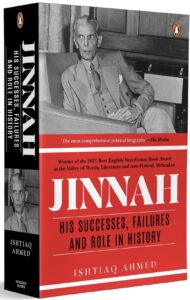 Jinnah shone brightest in 1916 with the Lucknow Pact, when Congress and the League agreed to cooperate for independence. He was hailed as the ambassador of Hindu-Muslim unity and acted as a bridge between the two organizations. His speeches of that era were music to the ears of nationalists across communities.
However, matters changed drastically with Gandhi’s emergence. In terms of Indian politics, Jinnah was senior to Gandhi. He could never reconcile himself to the fact that an outsider, newly returned from South Africa, had displaced him at the center of the national movement.
His Meeting with Gandhi and Their Subsequent Relations
Jinnah first met Gandhi in 1916 at a function organized to felicitate him after his successful struggle in South Africa. Gandhi addressed him not as a nationalist leader but as a Muslim leader, a description that displeased him deeply. Gandhi’s rapid rise marginalized Jinnah, and he increasingly found himself playing second fiddle.
At one meeting, when he referred to Gandhi as “Mr. M. K. Gandhi” instead of “Mahatma,” he was heckled by Gandhi’s followers and left in anger.
Jinnah could never comprehend the essence of Gandhi’s Civil Disobedience Movement. A legal luminary, accustomed to a refined Western lifestyle and constitutional methods, he regarded Gandhi’s mass mobilization, infused with religiosity, as alien to his temperament. Gandhi’s use of religious symbolism, especially during the Khilafat movement, seemed to Jinnah a dangerous departure from constitutional politics.
Although both criticized the British over the Rowlatt Act and the Jallianwala Bagh massacre, their temperamental and strategic differences widened. According to Ahmed, more than ideological divergence, it was pride and the unwillingness to remain subordinate to Gandhi, and later Nehru, that prevented Jinnah from returning to the Congress fold.
Communal Policies of the British
After 1857, the British systematically employed divide and rule. Separate electorates for Muslims were introduced in 1909, Bengal was partitioned, and separate electorates for Sikhs followed in 1919.
Gandhi’s attempt to forge Hindu-Muslim unity during the Khilafat movement alarmed the British. When the movement collapsed after Chauri Chaura, the possibility of united mass action was irreparably weakened, and Jinnah’s nationalist phase effectively ended.
The Nehru Report and Jinnah’s Objections
The Nehru Report of 1928 was a comprehensive constitutional blueprint drafted under Motilal Nehru. It envisaged a federal structure with a strong center, minority safeguards, and universal franchise. It refused one-third representation to Muslims at the center but guaranteed one-fourth seats.
Jinnah initially refused participation unless four conditions were accepted:
- A federal structure with residuary powers vested in provinces
- Separate electorates for Muslims
- One-third Muslim representation in the central legislature
- No constitutional amendments without Muslim consent
These demands later evolved into his Fourteen Points. His refusal to engage constructively hardened positions.
Ahmed criticizes Jinnah for avoiding the spirit of give and take. He argues that participation might have allowed compromise. He writes:
“Considered in this light, one can understand that the Congress, as an inclusive nationalist movement seeking to bring all people into one fold to assert the right to self-rule and freedom vis-à-vis the colonial government, perceived separatist movements of an ethnic or religious nature demanding special rights for their group members as a divisive factor, weakening its struggle against colonialism. The Muslim League represented forces which were against the Congress type of nationalism”.
He further observes:
“Jinnah’s communitarianism was hardly a model for establishing a viable, cohesive and coherent India. A patchwork of nationalities constituted…”
The Turn Toward Communalism
The 1937 provincial elections proved decisive. Congress achieved sweeping victories. The League performed poorly and was seen largely as a party of landlords. Nehru declared he would not negotiate with League members unless they resigned and joined Congress.
Simultaneously, Nehru’s socialist leanings, anti-zamindari rhetoric, and advocacy of structural reforms alarmed conservative Muslim elites and Hindu capitalists alike. Jinnah increasingly positioned himself as their defender.
By 1940, with the Lahore Resolution, and in speeches such as Aligarh in 1944, Jinnah asserted the Two-Nation theory. Ahmed argues these were not bargaining tactics but ideological commitments.
Congress Resignation and Jinnah’s Gain
Ahmed considers Congress’s resignation from provincial ministries in 1939 a grave blunder. With Congress leaders imprisoned during the war, Jinnah consolidated his position and strengthened ties with the British. He portrayed Congress as a Hindu organization hostile to Muslims.
Ahmed also advances the controversial view that Britain, under Churchill, favored Pakistan as a future bulwark against Soviet expansion. I remain skeptical of this claim, as the Transfer of Power documents do not substantiate it.
Overtures and Rejections
Despite Jinnah’s hostility, Gandhi and others repeatedly sought compromise. Rajaji’s 1944 proposal offering Pakistan after a plebiscite was rejected. Gandhi even suggested to Cripps in 1946 that Jinnah be invited to form the government, an offer reportedly dismissed by Wavell.
Ahmed argues that Jinnah consistently rejected compromise because Pakistan was his ultimate objective.
The Cabinet Mission Plan
Ahmed maintains that Jinnah accepted the Cabinet Mission Plan reluctantly, not as a preferred solution. He suggests Jinnah may have anticipated Congress rejection, which would then justify Pakistan.
Congress, meanwhile, opposed compulsory grouping and a weak center. Ahmed defends Congress’s insistence on a strong federation, writing:
“The Congress insistence on an effective Centre was legitimate…”
He compares India’s needs to federal models such as the United States and warns that weak centers invite disintegration.
Rebutting Ayesha Jalal
Ahmed strongly rejects Ayesha Jalal’s theory that Pakistan was merely a bargaining counter. He states:
“There is not a single speech of Jinnah which showed his intention to join hands with Congress for united India, rather there are speeches where he derogatorily dismisses those who consider his fight for Pakistan just to extract more concessions for Muslims in United India”.
However, it is noteworthy that he does not discuss the Desai-Liaqat Pact in detail.
Jinnah’s Achilles Heel
Ahmed highlights a paradox. Of 90 million Muslims in India, 35 million lived in Hindu-majority provinces. Jinnah’s strategy left them vulnerable. He portrays Congress as a Hindu party, yet statistical realities of Muslim representation in the army and police complicate that narrative.
Wavell and Mountbatten
Ahmed is critical of Wavell and more measured regarding Mountbatten. He notes Mountbatten’s haste in advancing the transfer of power and his failure to anticipate violence.
I find the British role far more troubling. Mountbatten reportedly knew the Punjab boundary before independence but delayed announcing it. Adequate precautions were not taken. This was, in my view, criminal negligence.
Britain cannot evade responsibility for the scale of the ensuing carnage.
Jinnah’s Pakistan – El Dorado, or Moth-Eaten State
Ahmed writes:
“The problem was, Jinnah was obsessed with having India partitioned…”
He further argues that Jinnah’s vision of Pakistan was ambiguous and opportunistic, appealing simultaneously to ulema, landlords, and communists.
Jinnah’s August 11 speech emphasized minority rights. Yet later references to Islamic Sharia created ambiguity. Unlike Gandhi and Nehru, he was not a visionary in statecraft. His conception of Pakistan’s polity remained vague.
My Reflections
The personalities of Gandhi, Nehru, and Jinnah were profoundly incompatible. Gandhi was a moral revolutionary, Nehru an impatient socialist visionary, Jinnah a constitutional lawyer with aristocratic instincts. Pride, ego, and mistrust compounded ideological differences.
Several moments offered possibilities for reconciliation, the Nehru Report, the 1937 ministries, the Rajaji formula. Each failed.
By 1946, bitterness was entrenched. Partition became a tragic inevitability, not because it was destined, but because human actors failed to bridge divides.
India and Pakistan were like Siamese twins. Separation may have become necessary, but it was executed not with surgical care but with butchery. The tragedy lies not in separation, but in the manner of it.
I invite readers to share their views and comments on the topic, in the Comments box below.
Responsibility of His Majesty’s Government
Mountbatten’s preponement of independence, delay in announcing the Radcliffe Award, and inadequate security arrangements raise grave moral questions. The British departed in haste, leaving devastation in their wake.
Post-Independence Trajectories
India adopted a secular, pluralistic constitution and stabilized its democratic institutions. Pakistan underwent repeated constitutional revisions and military interventions. The contrast in trajectories invites reflection.
A Small Trivia
It is said in ‘Freedom at Midnight’ that Jinnah concealed his terminal illness. Had his condition been widely known, would history have unfolded differently? A minor quirk of destiny can alter the fate of nations.
Author Bio: Anil Saxena
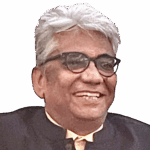 Anil Saxena is a retired Principal Chief Conservator of Forests and Head of Forest Force (HoFF), Maharashtra.
A lifelong nature lover and prolific reader, he brings depth, clarity, and insight to every book he reviews. As a Core Committee member of the Nagpur Book Club, he is known for his comprehensive reviews that make even complex subjects accessible and engaging.
Anil Saxena divides his time between Nagpur, Mumbai, and New York, enjoying the company of his children and grandchildren while continuing to explore the world of literature.