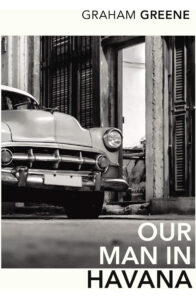
Book Review of ‘Our Man in Havana’, by Graham Greene.
Pages – 256
Review by Anil Saxena
A slim novel—my first by Graham Greene. A dark comedy based in Cuba, written in 1956 (just before the communist takeover), it tells the story of a bored salesman of vacuum cleaners that are hard to sell despite their very contemporary, catchy brand names.
“One never knows when the blow may fall.”
The protagonist is a widower and lives with his teenage daughter, whose personality alternates between that of a devout, pious, and stern Catholic nun and a coquettish prankster. He has a good friend and drinking companion in a German doctor, Hasselbach.
The Beginning of Espionage
Constantly worried about poor sales and not having enough money to secure his daughter’s future, he finds himself entrapped by an agent of the British government’s secret service. Initially unwilling, he eventually warms to the job when he starts receiving a substantial amount of money to run the supposed network.
He is even given the freedom to hire sub-agents, to be paid by the British government. Quick to grasp the benefit of this windfall, our clever hero begins drawing large sums—not only for himself but also for his fictitious agents. The only problem: he hasn’t dispatched a single report to headquarters, and that begins to worry him.
Inventing the Fiction
To sustain the pretense, he sends design drawings of vacuum cleaner components, presenting them as missile blueprints being installed in the Cuban forests. He attributes this “intelligence” to a retired Cuban pilot he pretends to have hired as a sub-agent.
The British Secret Service proves gullible and is delighted to receive these encrypted messages. Things go on merrily, with our hero receiving reimbursements for himself and his imaginary network, until the chief of the service, thoroughly impressed, decides to send him a lady secretary, a radio operator, and a host of communication equipment.
“Innocence always calls mutely for protection when we would be so much wiser to guard ourselves against it.”
Twists and Tensions
The novel brims with parallel layers. Captain Segura, the dreaded police chief rumored to carry a cigarette case made of human skin, falls in love with the hero’s daughter.
Eventually, with the arrival of the secretary and the new equipment, our hero tries to dismantle his own creation. But matters spiral out of control. He is unaware that he himself is under watch—not only by Captain Segura but also by double agents. His encrypted messages are known to the local police as well as to Dr. Hasselbach. Tragically, in the course of espionage intrigues, Hasselbach is murdered by a double agent.
The secretary, however, grows fond of the father-daughter duo and remains unsuspecting of the fictitious world he has spun. Strangely, when he tries to eliminate his invented agents, he discovers that they coincidentally turn out to be real people who meet bizarre ends.
Close Calls and Comedy of Errors
Warned of an assassination attempt by poisoning at a Havana trade seminar, he narrowly escapes by discarding the poisoned whiskey under the table—only for a dachshund to drink it and die instantly. The murder of Dr. Hasselbach compels him to seek revenge.
In one of the most memorable episodes, he challenges Captain Segura to a game of checkers, manipulating the rules to his advantage. Later, in a drunken tussle, he seizes Segura’s revolver and kills him.
Resolution in London
With his cover blown, he is summoned to Britain along with his daughter and the secretary. Expecting punishment, he is instead astonished to receive an Order of the British Empire and is offered a position as a visiting professor in their training school.
The novel ends on a note of irony: the secretary has grown close to him, and together with his daughter, they begin a new life in London.
“It is easy to laugh at spies, but one forgets that they can be the most lonely of men.”
Characters that Shine
The novel is enlivened by unforgettable characters—Captain Segura, the secret service chief (more grey than black), Hawthorne the recruiter, the assassin Carter, the loyal Dr. Hasselbach, the secretary, Millie (the daughter), and even the British Ambassador in Cuba. Greene handles each with skill, sketching them vividly and sharply.
Satire, Setting, and Significance
Written just before the Cuban Revolution, the novel foreshadows the coming police state and even anticipates the Cuban Missile Crisis of 1962. At the same time, it satirizes the incompetence and self-importance of British intelligence in the Cold War era—a once-great power desperate to maintain its relevance through espionage, even at the cost of absurd misadventures.
Unable to admit its blunders, the establishment sustains the farce by rewarding the fraud rather than exposing him.
My Verdict
Our Man in Havana is a lighthearted yet intelligent comedy, full of wit and irony. Greene offers no moral lessons except one: the true value of life lies in human relationships. If loyalty is to mean anything, it must be toward one’s family and loved ones.
A brilliant satire, a comedy of errors, and a deeply human story—it is no wonder this remains one of Greene’s most celebrated works.
Author Bio: Anil Saxena
 Anil Saxena is a retired Principal Chief Conservator of Forests and Head of Forest Force (HoFF), Maharashtra.
A lifelong nature lover and prolific reader, he brings depth, clarity, and insight to every book he reviews. As a Core Committee member of the Nagpur Book Club, he is known for his comprehensive reviews that make even complex subjects accessible and engaging.
Anil Saxena divides his time between Nagpur, Mumbai, and New York, enjoying the company of his children and grandchildren while continuing to explore the world of literature.