Book Review of ‘Middlemarch’, by George Eliot
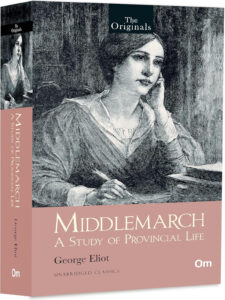
880 pages
Review by Anil Saxena
I completed the audio version of Middlemarch, a study of provincial life, a book that runs into 800 and odd pages. George Eliot is a pseudonym; the real name of the author was Mary Ann Evans. The question is generally asked—why did she use a masculine name for herself? Some say she didn’t want her book to be treated as a frivolous romance because, in those times, women writers were often associated with such material. She wanted to write something serious. Virginia Woolf famously called it “the first novel in English literature for grown-ups.”
The book was published in 1871 and narrates the provincial life of Middlemarch in the 1820s and 1830s.
The Characters and Families of Middlemarch
The book is a grand narrative centering on the lives of Dorothea Brooke, Arthur Brooke, Rev. Casaubon, Will Ladislaw, Dr. Tertius Lydgate, Rosamund Vincy, Mary Garth, and Fred Vincy, along with the families of Vincys, Bulstrodes, Farebrothers, Garths, and Chettams.
Dorothea and her sister live with their bachelor uncle, Arthur Brooke, a genteel landowner, liberal in outlook but fickle-minded, unclear in thought, and, as per the norms of his time, sexist in approach.
“Our deeds determine us, as much as we determine our deeds.”
Dorothea and Casaubon
Our heroine, Dorothea, is an angelic beauty, different from glamorous dolls. Fiercely independent, intelligent, highly moralistic, and empathetic to the problems of the have-nots, there is no iota of malice in her. Given to Christian charity and with a love for science, she yearned for scholarly pursuits. This yearning led her to marry Rev. Casaubon, who was 30 years older than her.
Casaubon was a scholar of sorts, researching ancient Christianity and myths. Dorothea, bowled over by his scholarly charm, married him against the wishes of her well-wishers. She hoped not only to help her husband but also to expand her own horizons in ancient languages and history.
But soon, disillusionment set in. Casaubon proved to be a decrepit intellectual windbag. His research was derivative, his mind egoistic and jealous. He resented Dorothea’s sharpness and suspected her of harboring feelings for his cousin Will Ladislaw. In his pettiness, he ensured in his will that Dorothea would lose her inheritance if she married Will.
Will Ladislaw – The Rebel Spirit
Will Ladislaw, bohemian and free-spirited, was everything Casaubon was not—modern, liberal, artistic, and principled. A skilled orator, writer, and painter, he charmed Dorothea, though misunderstandings kept them apart for a while. His troubled family background and scandals made him an object of gossip in Middlemarch, but ultimately, his love for Dorothea prevailed.
“It is a narrow mind which cannot look at a subject from various points of view.”
Dr. Lydgate and Rosamund
Dr. Tertius Lydgate, a progressive and scientific physician, represented modern medicine. Upright and independent-minded, he had the potential to revolutionize the medical profession. But his marriage to Rosamund Vincy sealed his misfortune.
Rosamund, delicate and beautiful, groomed to charm, lacked intellect and empathy. Self-possessed and vain, she could not grasp her husband’s struggles. Instead of supporting him through financial difficulties, her envy, frivolity, and illusions worsened his plight. Lydgate’s ambitions were thwarted by the hostile, gossiping milieu of Middlemarch society.
The Virtuous Garths and Fred Vincy
Then there are the amiable, capable, and virtuous Garths. Caleb Garth, honest and hardworking, raised his family with integrity. His daughter Mary Garth, though not conventionally beautiful, was intelligent, honest, and upright.
Fred Vincy, Rosamund’s brother, began as a carefree gambler and profligate but was redeemed by his love for Mary. Her ideals brought out the best in him, and he transformed into a responsible man, finally becoming worthy of her love.
Bulstrode and the Hypocrisy of Evangelism
Nicholas Bulstrode, arriving as an outsider, became a banker and property owner. Outwardly evangelical, he was inwardly hypocritical, with a shady past involving Will Ladislaw’s mother. Blackmailed and disgraced, he epitomized the moral rot beneath pious facades.
The Wider World of Middlemarch
The novel meanders through gossip, scandal, and the vicissitudes of provincial society. It is, at its heart, a saga of mismatched marriages and how they ruin even the worthiest individuals. Eliot portrays a provincial world where railways, science, and new ideas meet with resistance, and where gossip fuels daily existence.
“What do we live for, if it is not to make life less difficult for each other?”
The Three Women – Dorothea, Rosamund, and Mary
The three central women are as different as can be:
- Dorothea – angelic, ardent, selfless, and idealistic.
- Rosamund – delicate, vain, and materialistic.
- Mary Garth – intelligent, virtuous, and inspiring.
Through them, Eliot explores love, morality, vanity, and sacrifice in the Victorian world.
Strengths and Shortcomings
There are too many characters, and not all receive the justice they deserve. Mary Garth and Farebrother, for example, deserved more space. The novel’s slow pace and the layering of multiple subplots may deter some readers. Yet, despite these misgivings, it stands as a monumental classic, ahead of its time.
My Verdict
Middlemarch pivots upon the universal values of fairness, righteousness, and moral principles. It teaches us how mismatched marriages can suffocate the brightest minds, but also how love, integrity, and moral courage redeem human life.
It is a novel that speaks of the ordinary and the extraordinary, of the failures and triumphs of human beings. As George Eliot reminds us:
“The growing good of the world is partly dependent on unhistoric acts; and that things are not so ill with you and me as they might have been, is half owing to the number who lived faithfully a hidden life, and rest in unvisited tombs.”
A classic—rich, humane, and ahead of its time—Middlemarch ought to be read by lovers of literature and those who appreciate the benevolent and rebellious genius of George Eliot.
Author Bio: Anil Saxena
 Anil Saxena is a retired Principal Chief Conservator of Forests and Head of Forest Force (HoFF), Maharashtra.
A lifelong nature lover and prolific reader, he brings depth, clarity, and insight to every book he reviews. As a Core Committee member of the Nagpur Book Club, he is known for his comprehensive reviews that make even complex subjects accessible and engaging.
Anil Saxena divides his time between Nagpur, Mumbai, and New York, enjoying the company of his children and grandchildren while continuing to explore the world of literature.