Book Summary & Analysis of ‘J. Krishnamurti: A Biography’, by Pupul Jayakar
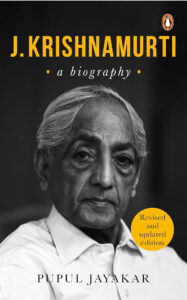
528 pages
Analysis by Anil Saxena
The Socrates of Our Times
Nāgārjuna or Bodhisattva—many names have been given, but Jiddu Krishnamurti remains the least understood of the great teachers of the 20th century. He has been called the Socrates of our times. Unlike traditional gurus, he consistently refused to sanctify his ideas or encourage discipleship.
He abhorred cults, disowned followers, and never claimed to be a guru. Instead, he believed in sitting together in dialogue to perceive the world as it is—not as it is shaped by our “I,” our memories, religions, and ideologies.
As he said:
“Truth is a pathless land.”
Krishnamurti’s mission was not to give answers but to awaken timeless questions within us.
Why He Remains Misunderstood
Krishnamurti did not gain the attention he deserved because his philosophy shattered myths, authorities, and texts that people cling to for comfort. His radical demand—the annihilation of the “I”—was stark and unsettling.
To the Western mind, where the self endures until judgment day, his precepts were alien. To Hindus, his rejection of an omnipotent, omniscient Being clashed with the comfort of “Tat Tvam Asi.” His path was lonely, uncompromising, and too direct for many.
About the Biography
If you wish to truly know this man who lived until 1986, Pupul Jayakar’s 545-page biography is indispensable. Jayakar, his close associate for over 40 years, had the deepest access to his thought process. She captures his dialogues and discourses with clarity and authenticity.
I have already read many of his works, but I remain in thrall to his intelligence, honesty, compassion, and grace. Osho once said he was the nearest modern man to a Buddha.
Early Life and Theosophical Years
- Born: May 11, 1895, in Madanapalle, Andhra Pradesh.
- Family: The eighth child of Jiddu Narayaniah and Sanjeevamma, Telugu-speaking Brahmins.
- Childhood: Frail health, recurring malaria, and regarded as intellectually slow.
- Visions: Early psychic experiences, including seeing his deceased mother and sister.
- 1909: Family moved to Adyar, home of the Theosophical Society. Krishnamurti and his brother Nitya were taken under the care of Charles Leadbeater and Annie Besant.
- Proclaimed World Teacher: Leadbeater declared him the long-awaited messianic figure. The Order of the Star in the East was established in 1911 to prepare for this role.
But fate struck: his beloved brother Nitya died young, leaving Krishnamurti grief-stricken.
The Turning Point (1929)
In a dramatic move, Krishnamurti renounced his role as World Teacher, dissolved the Order, and walked away from Theosophy.
He declared:
“Truth is a pathless land. You cannot approach it by any path whatsoever—by any religion, by any sect.”
Despite rejecting the Theosophists, he remained loyal and respectful to Annie Besant. From then on, he worked independently until his death in February 1986 at the age of 90.
Basic Tenets of His Philosophy
Total Perception
- See without filters of memory, prejudice, or knowledge.
- Immediate action must follow perception.
- Freedom from authority, conditioning, and the self is essential.
Dialogue over Sermons
He disliked sermonizing. Like Socrates, he used questioning to draw people into exploration. The question—not the questioner—was central.
“The ability to observe without evaluating is the highest form of intelligence.”
Krishnamurti on the Brain and Mind
- The brain is millions of years old, an evolutionary tool bound by time. It cannot grasp eternity.
- Thought and the thinker are one.
- To perceive reality, one must move beyond memory and time.
- Humanity has remained inwardly primitive despite 10,000 years of religion and ideology.
On Knowledge
Aldous Huxley, his admirer, said: “Knowledge has spoiled me.” Knowledge may take one to the shore, but not across the ocean.
Science and Humanity
Krishnamurti admired science’s precision but noted its limits: it deals only with the known. He often dialogued with scientists like David Bohm, believing that only two kinds of minds may endure—the scientific and the spiritual (not ritualistic).
Key Themes in His Teachings
- Authority & Ideology: Reject all authority—“स्वयम दीपो भव” (Be a light unto yourself).
- Change: True change is immediate, never gradual.
- Miseries: Observe thought processes without guilt, suppression, or escape. Let feelings flower and die naturally.
- Society vs. Individual: A good society depends on good individuals.
- Love: Where there is “I,” there is no love. Love blossoms only when self and desire are absent.
- Death: The true death is the dissolution of the “I.” Religions comfort us with false assurances of eternal self.
“It is no measure of health to be well adjusted to a profoundly sick society.”
Dialogues with Vinoba Bhave
Krishnamurti once met Vinoba, who was astonished that he had never read the Gita. Though their worldviews diverged, Vinoba acknowledged him as a great sage. Krishnamurti opposed meditation, rituals, and scriptures—his way was “choiceless awareness.”
Selected Questions & Answers
Q: Would torture of the body and meditation lead to realization?
A: Meditation with memory and knowledge intact is useless.
Q: Can the brain, conditioned for millions of years, change instantly?
A: Yes. If we stop treading the same tracks, other dormant parts of the brain can awaken.
Q: What is love?
A: Without self, desire, or attachment, true love blossoms. With “I,” love is indulgence, not compassion.
Q: What is God?
A: God is not belief or fear. It is beyond self, time, and motives.
Q: Should we worship sages like Buddha or Krishnamurti?
A: Their persona is irrelevant. Only their questions and insights matter.
Influence on Thinkers, Artists, and Leaders
Krishnamurti’s impact crossed cultures and disciplines:
- Aldous Huxley: Friend and admirer.
- Bruce Lee: Drew strength from his teachings during recovery.
- George Bernard Shaw, Henry Miller, Alan Watts, Eckhart Tolle: Influenced by his philosophy.
- David Bohm: Engaged in deep dialogues with him.
- Osho: Called him “a modern Buddha,” though said he lacked appeal to the heart.
- Marlon Brando, John Frusciante, Dalai Lama: Inspired by him.
- Indian leaders: Nehru and Indira Gandhi often sought his counsel.
Notable Works
- The First and Last Freedom (1954)
- Commentaries on Living (1955–60)
- Freedom from the Known (1969)
My Final Thoughts
J. Krishnamurti is too vital to be ignored. His teachings—demanding freedom from authority, annihilation of the “I,” and direct perception—are essential for humanity’s survival. Pupul Jayakar’s biography is not just a chronicle but a window into his penetrating mind.
“He is necessary if we want to survive as humanity. Even if we cannot reach his pedestal of insight, we must study him.”
I strongly recommend this book, even for those already familiar with his works. It is a milestone in understanding the radical simplicity and depth of J. Krishnamurti.
Author Bio: Anil Saxena
 Anil Saxena is a retired Principal Chief Conservator of Forests and Head of Forest Force (HoFF), Maharashtra.
A lifelong nature lover and prolific reader, he brings depth, clarity, and insight to every book he reviews. As a Core Committee member of the Nagpur Book Club, he is known for his comprehensive reviews that make even complex subjects accessible and engaging.
Anil Saxena divides his time between Nagpur, Mumbai, and New York, enjoying the company of his children and grandchildren while continuing to explore the world of literature.