Book Review of Ishmael, by Daniel Quinn
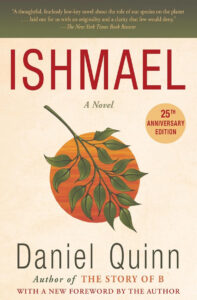 336 pages
Review by Anil Saxena
Recommended by someone close, Daniel Quinn’s Ishmael is an intriguing and exceptional book that narrates the growth of the human species, a journey that started three million years ago. It casts a serious aspersion on the anthropocentric attitude of us human beings and brought to my mind the saying that “mankind is a cancer of the earth.”
A Teacher Unlike Any Other
The book—as the author confessed—is a version he wrote after abandoning seven previous attempts. Quinn’s perspective is presented in the form of question-and-answer sessions between a teacher and a student. Strangely enough, the teacher here is a full-grown gorilla, while the student is a human.
It starts with a man, who has a thirst for truth, answering an ad in a local newspaper from a teacher seeking a serious student. On reaching the location, he finds, contrary to all expectations, that the teacher is not a human but a full-grown gorilla quietly nibbling a slender branch. The man gets the shock of his life at first, but as he listens to the ramblings of this gorilla teacher, he is more and more charmed by his original thinking on the origin and saga of life on earth, the role and place of humanity in this saga, and the trajectory it is leading to.
The Story of the Takers and the Leavers
The gorilla, Ishmael, was reared, trained, and educated by a Jewish benefactor who escaped the Nazi holocaust. In brief, the theme of the novel runs like this: The chain of evolution of species was going on uninterrupted for billions of years until *Homo sapiens* appeared on the scene. Though even after their appearance not much happened for another three million years, a turning point occurred when the human species took up a settled way of life, abandoning the life of the hunter and food-gatherer to become agriculturists somewhere around 10,000 years ago.
The woes for the Earth and the entire community of species started unfolding then. This settling of humans for agriculture over hunting and food-gathering divided humanity into the categories of ‘Leavers’ and ‘Takers’.
“Takers believe in a story… The story is that the world was made for man, and man was made to conquer and rule it.”
‘Leavers’ are those who continued to live the life of hunting and food-gathering, who are now confined only to the fringes of civilization and are termed as primitives or aborigines in common parlance.
The ‘Takers’ are those who form the mainstream of humanity, who adopted agriculture as a profession and settled down. The author has taken a cue from the narrative of the Bible in associating ‘Leavers’ with Abel, the pastoralist, and ‘Takers’ with Cain, the agriculturist. Cain killed Abel to usurp his domain for the growth of his settled way of life.
The Mother Culture’s Myth
The Takers preached religions, created prophets, and progressed through the last 2,000 years in almost all physical and material aspects of life, proudly flaunting it as their achievement. Their “mother culture,” their paradigm of development, signifies the unprecedented growth of human beings at the cost of all other species. They falsely consider themselves the epitome of evolution; their prophets, their thinkers, and their engines of civilization created a myth about the infallibility of their civilizational values. Their almost mythological belief that the clock of evolution stops at their level is nothing but self-deception.
“As the Takers see it, the gods gave man the same choice they gave Achilles: a brief life of glory or a long, uneventful life in obscurity. And the Takers chose a brief life of glory.”
Their disdain for natural laws and usurpation of the role of gods have led them to grow to six billion human beings, while killing and smothering all other species—along with the ‘Leavers’—to almost non-existence. They have despised the laws of nature, of the struggle for existence and the survival of the fittest, and propagated their own species by usurping more and more land for farming and settlement.
They created a chain of events where more population requires more food from agriculture, forcing them to convert more and more land to agriculture to feed them, which in turn means more spurts in population growth. So now we are six billion at the cost of the accelerated extinction of all other species. So much so, this is all leading our mother Earth to a premature death.
A Law to Live By
The author believes that if human beings had continued to live as they did for three million years alongside other associated species while abiding by the law of nature (which is perhaps brutish and diabolical from the point of view of modern man), they would have survived for another million years to come, while perhaps playing a subdued and not very significant role in the game of evolution.
In the course of the dialogue, Ishmael asks his student a fundamental question: with all their progress, does mankind know the law of how to live a life?
As the answerer remains baffled, he realizes that all our religions, scientific progress, and culture do not provide an answer to this question—a question that other species know by instinct, abide by, and have lived by for billions of years until humans arrived on the scene. After their arrival, humans abandoned those very cardinal laws that were responsible for the survival of the entire gamut of species and had kept the clock of evolution ticking.
As long as living species, whether a single cell or a predator of humongous proportion, lived as if they belonged to the world rather than the other way around, they continued to evolve.
Man, after his arrival, believed that the world exists for him alone, propagated his own species, destroyed the diversity of life on this Earth, and halted evolution.
A Poignant Conclusion
The novel ends on a sad note when the erudite teacher is thrown out of his sanctuary, sold to a carnival, becomes sick and dejected, and tells his pupil—after enlightening him—that he has nothing more to teach. He dies unceremoniously two days later.
After the death of his mentor, the pupil for the first time sees the poster of Ishmael from both sides. The message he had always seen written was:
“WITH MAN GONE, WILL THERE BE HOPE FOR GORILLA?”
The message on the other side, which the pupil noticed for the first time after Ishmael’s death, reads:
“WITH GORILLA GONE, WILL THERE BE HOPE FOR MAN?”
Final Verdict
The novel ends but keeps us disturbed about the future of all of us, this beautiful Earth, and the community of species all around us. It is a unique book, narrated in the simple form of a catechism, that always keeps you on your toes. Not a voluminous one, it should be read with patience and understanding.
The question is whether this angst and despair that overpowers you while reading the book will continue to burn inside you enough to make a real change in the way you live, or if it will soon become a passing fancy like many other issues which, though important, fade from our memory with the passage of time.
Author Bio: Anil Saxena
 Anil Saxena is a retired Principal Chief Conservator of Forests and Head of Forest Force (HoFF), Maharashtra.
A lifelong nature lover and prolific reader, he brings depth, clarity, and insight to every book he reviews. As a Core Committee member of the Nagpur Book Club, he is known for his comprehensive reviews that make even complex subjects accessible and engaging.
Anil Saxena divides his time between Nagpur, Mumbai, and New York, enjoying the company of his children and grandchildren while continuing to explore the world of literature.