Book Review of Indian Nationalism: The Essential Writings, by S. Irfan Habib
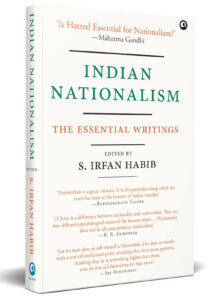
Pages: 285
Review by Anil Saxena
This important anthology on Indian nationalism, by a renowned history scholar, is remarkably relevant to our present times. The country suffered the scourge of colonial domination for almost 250 years until its patriotic leaders and their milieu fought against it through a long and arduous nationalist struggle to attain freedom in 1947.
But before we go any further, I must tackle a few questions that always rankle my mind; the first and foremost is when and where did the nationalism we know today emerge?
The Emergence of Modern Nationalism
Nationalism, as we understand it today, first emerged in the late 18th and early 19th centuries in Europe. A few key points:
Nationalism is a modern phenomenon, not something that existed throughout history. Before the late 18th century, people were attached to their native lands and traditions, but nationalism as an ideology was not yet recognized.
Nationalism arose due to a number of complex developments, including the creation of large centralized states, secularization of life and education, the growth of commerce, and new theories of popular sovereignty and revolutions. This led to the identification of the state with the nation and the rise of emotional fervor similar to religious movements.
In summary, nationalism as a modern ideology based on loyalty to the nation-state first emerged in the late 18th century in Europe, with the American and French revolutions as key early manifestations, before spreading to other parts of the world in the 19th century.
The issue that remains closest to my heart is patriotism versus nationalism. Am I a patriot, a nationalist, or both?
Patriotism vs. Nationalism
Patriotism, as I understand it, is love for one’s motherland irrespective of its shortcomings, failures, and its ugly underbelly. It is a love that you assign to your mother, family, brethren, soil, rivers, the village you were born in, school, classmates, its music, its poetry, its culture, its value system, its cuisines, its seasons, its local slang. But it never stops you from being its worst critic of what you find horrendous and ugly in it.
Nationalism, on the other hand, is an ideology that elevates one’s nation above all others. Nationalists, especially aggressive ones, believe their country is superior and should promote its interests at the expense of other nations. Nationalism often involves suspicion or contempt for other countries and intolerance of criticism. So, where patriotism nurtures a sense of responsibility, nationalism breeds blind arrogance. Where patriotism emphasizes a nation’s values and beliefs, nationalism emphasizes its heritage, culture, and language to compare them with other cultures and many times overzealously projects them to the point of ridicule.
Of course, both these terms are not contradictory to each other. One can be a patriot and a benign nationalist who wants their nation to progress and prosper without othering its fellow citizens and minorities or at the cost of the prosperity of other nations.
This being a starting point, the author, in his seminal 36-paged introduction, has classified the viewpoints of our freedom movement stalwarts according to their own beliefs and writings into 12 categories. He has also taken pains to write about some other greats whose views are left out of this anthology, and for what reason.
Classifying the Freedom Movement Stalwarts
In an early liberal view of nation and culture, he incorporated the views of M.G. Ranade and S.N. Bannerjee.
In religion-centric nationalism, we find the views of Tilak, Lajpat Rai, Bipin Chandra Pal, Sri Aurobindo, Maulana Madani, and Allama Iqbal.
In cosmopolitan vision and nationalism, we find the writings of Gurudev Rabindranath Tagore.
In the category of inclusive nationalism and syncretic culture, we find Sarojini Naidu and P.C. Ray.
Gandhi alone is found in his category of empathy and nationalism.
Sardar Patel stands for combating fissiparous forces and nation-building. In his short and crisp essay, he had warned the RSS, Muslims, and communists who were working against the spirit of the constitution. He had asked the RSS to shelve secrecy and the communists to shelve their tendency to look toward foreign powers for inspiration. He believed that the partition was over and it was good for all. Now, everyone should strive to shun communal violence and avoid double-speak.
JLN stands for his eclectic views and culture.
Ambedkar defines nationalism in his thought-provoking essay, while C. Rajagopalachari takes a right-liberal view of nationalism.
Subhash Chandra Bose, Bhagat Singh, and M.N. Roy represent its revolutionary vision, while Khan Abdul Ghaffar Khan and Maulana Abul Kalam Azad consider nationalism indivisible.
J.P. takes pains to define nationalism and nationhood, whereas Khawaja Ahmed Abbas speaks for an integrated nationalism.
Abbas, known for his communal amity, wanted an integrated India where all individual identities of religion, caste, and class merge into an identity of common men and women. Muslims should shun their loyalty to Pakistan, while Hindus should shun their hatred against Muslims.
The Excluded Ideologues
Now, what about the elephant in the room? Why has he excluded Savarkar, Golwalkar, and Syama Prasad Mukherjee from this anthology? Were they not nationalists? Had they not influenced many and are they not still the torchbearers for the ruling dispensation? I was curious to know and tried to find the answer in the author’s introduction itself. He has clearly mentioned that he has deliberately avoided both Savarkar and Golwalkar for their narrow, parochial vision of nationalism, which holds antipathy toward all minorities and particularly toward Muslims for their extraterritorial loyalty. They both believed Muslims to be traitors and internal enemies of the nation. While quoting from their own texts, he has probably found them misfits in the community of other greats.
I differ here with him. Merely leaving them out would neither undermine their influence over the millions of their followers nor would it validate the point of view of liberal nationalists in any better way, but it would definitely give a handle to their followers to criticize the editor for his bias against them. It is said that sunlight is the best disinfectant, so he should have faith in his readers to be able to choose their heroes from the lot presented to them by bringing to light contrarian writings too in this anthology.
Moreover, these ideologues of aggressive Hinduism (now called Hindutva) want to confine Muslims to second-grade citizenship on the one hand, while on the other hand, they keep harping on the vision of realizing ‘Akhand Bharat’ (undivided India). This paradox of theirs is beyond my understanding.
It is not possible here to discuss the views of all, but there are some whose views I found too attractive not to emphasize. So, I find the views of Ranade, Lal, and Bal, and especially of Maulana Madani and Allama Iqbal, to be noteworthy. Gurudev’s views are valuable. We already know enough about Gandhi and JLN in many ways, but we can only neglect the brutally honest views of Ambedkar, Subhash Chandra Bose, iconoclastic Bhagat Singh, and Maulana Abdul Kalam at our own peril. JP had given a scholarly account of the history of nationalism and its features. He defined Indian nationalism, commented on its origin, and also emphasized Tagore’s cosmopolitanism while articulating his own idea of nationalism.
Diverse Perspectives on Indian Nationalism
M.K. Ranade
M.K. Ranade, in his book ‘Revival or Reform: Imagining a New Nation’, questions the orthodoxy and ills of Hindu society in the most trenchant manner. He points out its tormenting patriarchy, its cruel caste system that lowers the dignity of humans, its ugly practices of sacrifices, the cult of sati, infanticide in the name of religion, the cruel persecution of aborigines, the supremacy of Brahmins and Kshatriyas in all walks of life, Vamacharya, etc., as the greatest barriers in our achieving nationhood.
Bal Gangadhar Tilak
Tilak, who believed in religion-centric nationalism, considered religion a most important ingredient in public and social life. The restoration of dharma was his ultimate goal. He did not believe anyone should forsake his or her religion for any cause. Similarly, he did not believe in the fusion of religions as he thought it was an impossible task. On the topic of Muslims, he was more generous and believed that those who had come to stay in India for generations also wanted good for the country and could not be termed aliens. Anyone, even a British person, if they wanted to do good for the country, was not an alien. The color of skin, religion, or trade did not make one an alien. He believed it was a king’s duty to work for the progress of the nation, and if he failed in it, then he was alien to it.
Lala Lajpat Rai
Lala Lajpat Rai perhaps had strong views on Hinduism. He considered it wrong to believe that Hindus have no nationalist feelings and had always remained fragmented. He was critical of an era when Hindus (Marathas) fought alone without the help of fellow Hindu kings. On the other hand, there were so many good examples when Hindu kings fought cohesively. He traced the origin of nationalism to the war of Aryans with Dasyus, Chandals, and Mlechhas. He wanted Indians to be proud of the heritage of the Vedas. He had a grouse that history had never been written from the point of view of Hindus. On the one hand, he exhorted educated Hindus to read the Vedas for their messages and beauty; on the other hand, he was critical of the priestly class who were selfish and hid the true spirit of religion. However, he was buoyant about ironing out our differences when we would choose independent nationhood as our goal. On Muslims, he was more circumspect. He believed that Muslims, in general, never rose above their communal bias, even the best among them. He found three types of Hindus: those who did not bother about Hindus unless they were caught in an adverse situation vis-à-vis Muslims; and two other groups, one that had a bias against Hindus and the other that had a pro-bias toward Hindus. To give him credit, he said: “For the hundredth time, I repeat, I am a Hindu and not free of bias, but I am ready to place myself in the shoes of a Muslim to see things from his point of view.” Still, he never hesitated to mention that he would be the last person to sacrifice the interests of his co-religionists over the interests of other communities.
Iqbal vs. Madani
Allama Muhammad Iqbal and Maulana Hussain Ahmad Madani, two prominent Muslim intellectuals in early 20th century India, held differing views on nationalism: Iqbal believed that Muslims should have a separate homeland based on their distinct religious identity. He rejected territorial nationalism and argued that nations are formed based on shared religion, not geography. Iqbal’s concept of nationalism was part of his wider critique of Western civilization and its secular political ideologies. In contrast, Maulana Madani insisted that in the modern age, nations are defined by shared territory (watan), not religion (mazhab). He defended the idea of a culturally plural, secular democracy as the best future for India’s Muslims. Madani argued that this vision was not only pragmatic but also had Quranic sanction. With the differentiation of Qaum (कौम) and Millat (मिल्लत), he nailed his point of view. The two scholars engaged in a public debate in Urdu newspapers in the late 1930s. Iqbal, in poetic form, accused Madani of heresy. But Madani wrote a scholarly tract defending his position. With hindsight, Madani was right about the viability of a non-religious, pluralist state, if the survival of India for the last 75 years and the creation of Bangladesh is any proof. In summary, Iqbal favored Muslim separatism based on religion, while Madani advocated for a pluralist, territorial nationalism. Their debate illuminates the diversity of Muslim political thought in colonial India.
Rabindranath Tagore
He abhorred the aggressive and militant nationalism of the West. His cosmopolitan ideas would have earned him, in present times, the label of an anti-nationalist. To him, cooperation, the moral power of love, empathy, spiritual unity, and no enmity toward foreigners would lead us to the glorious path. He told the British that they never made any effort to understand the soul of India beyond conquering it. He told Indians that Indians never had a true sense of nationalism. India’s greatness lies in practicing humanity, not in physical conquest. The fireworks of power play subside early, but those of love endure. He did not believe in any nation that believed in physical aggrandizement, leaving the soul to perish. To him, nationalism, as it was understood, was a great menace. He hated our rigid caste system and the authority of traditions. The caste system might have kept society gelled, but it has brought more adversities than merits. It degrades humanity and kills individual endeavor. He was critical of the blind economics of demand and supply and believed in the social fulfillment of each community through cooperation and understanding. He hated the excesses and grossness of mass production, which killed creativity and ingenuity. To him, political freedom for enslaved minds and amidst social inequities was of no worth. The tyranny of caste and race would ultimately cripple the nation. Mass production and mass communication, like an offering of predigested morsels, lacked grace, taste, without any merit. He believed that no power on Earth would save India if it lost its soul to the power of money.
Gandhi’s Empathetic Nationalism
Is hatred essential for nationalism? Hate the vice, not the person who commits the vicious act. Instead of punishment, he called for one’s reformation. One should never cooperate with evil but fight against it in a nonviolent way. He believed in being a nationalist first to be an internationalist. Untouchability was a curse but should go by persuasion and not by coercion. He believed in the survival of the entire human race without any hatred toward any race or religion. His nationalism sees no evil; it is without any narrowness of mind. It is unselfish and did not believe in profiting at the cost of others.
Additional Perspectives
Jawaharlal Nehru
Jawaharlal Nehru, in his eclectic view of nationalism, believed in both internationalism and nationalism. Internationalism in the realm of finance, trade, commerce, and science is beneficial. Nationalism, as a non-violent creed, yields dividends and is too deep-rooted in all of us to neglect, as long as it brings out the best in us. We should respect the past but look ahead. He also believed in integrating inner life with outer life to get the best out of a person. He was a firm believer in the exchange of cultures to prosper, as no culture was pristine and no race was pure. This constant intermingling, this fusion, brings out the best. While roots are important, so are the stems and flowers, and they too need nourishment. Religion is not the final word on humans because it also makes the mind static, dogmatic, and bigoted if it is absorbed unquestioningly. Cultured minds accept the viewpoints of others and gain a lot. Nationalism is good as long as it prospers life, unity, and strength without leading to arrogance and aggressiveness—a fine balance if maintained. He feared that when we know each other more, we tend to quarrel more, but he believed this could also be sorted out by a give-and-take policy. He had praise for ancient men as they were wiser than us, whereas we just accumulate knowledge and experience to get muddled and confused.
B.R. Ambedkar
Never a fetishist about nationalism, he was perhaps the most clear-eyed realist of his time. He had a unique perspective on Hindu-Muslim relations and the possibility of nationhood in togetherness. He raised a crucial question on why some groups saw themselves as a different nation than our Congress stalwarts or Hindu patriots who believed in integrated nationhood where Hindus and Muslims could live as one nation against the observations of the British who believed that India was never a nation. Ambedkar even referred to Tagore, saying even he was also of the same view. He agreed with almost all aspects of similarity between Hindus and Muslims, be it racial, social, similar marriage customs, prevalence of caste and class systems, and many others. He attributed these resemblances to a common environment and the passage of incomplete conversion and believed the process of Akbar’s amalgamation of the two communities to be a thing of the past. The history of Europe has suggested that neither race, language, nor country sufficed to mold people into one nation. On the question of what constituted a nation, he believed that common memories, common heritage, and common glories brought people together, not language, race, or geography. Hindus revere Rana Pratap, Prithviraj, and Shivaji, whereas icons of Muslim worship are Bin Qasim, Gazni, the Quran, Hadis, and Aurangzeb. Unfortunately, the icons of both remained mutually incompatible, and both parties could never forget their past. Hence, the common nationhood remained only on paper, and there was no meeting of minds there. He also did not accept the charge of Congress that the Muslim League awakened to its Muslim identity very late, for it did not matter when and how they began to feel separate. The moment they realized their quest for a national identity, it became difficult to put the genie of communalism back in the bottle. This realist cautioned the Congress that the Muslims might still be persuaded to remain as one nation, but they could only plead with them and could not command their compliance. One may not agree with this viewpoint, but no one can ignore his power of observation and clarity of mind on the matter.
Subhash Chandra Bose
He was very much perturbed by the cancer of communalism and believed that if the leaders of Congress and the Muslim League both tried to combat it, it might dissipate. He considered the foremost task before the nation lay in getting rid of the British first. Cultural rapprochement, education, scientific spirit, and socialism alone would combat communalism. Muslim peasants were closer to Hindu peasants than to their Muslim zamindars; they and the youth should have been at the forefront of this battle for nationalism and independence.
Bhagat Singh
The Hindu Right, out of their ignorance and in their zeal to bait Gandhi and Congress without knowing an iota of what Bhagat Singh stood for, extol him to no end. But they would be in for a real shock if they truly understood what he stood for and died for. A lifelong atheist and a person who believed in the ideology of the Left, he considered religion a curse as it was decimating society. His ire toward newspapers was palpable as they had become a hotbed of ignorance, bigotry, and communalism. He believed that the sacrifices of the martyrs of 1914-15 of the Gadar Party succeeded because they separated religion from politics. He was critical of our leaders who treated Dalits badly; he said, even the British treated them better. They criticized Muslims for conversions but failed to realize their atrocities on their Dalit brethren. Our so-called leaders worship animals but treated the lower castes worse than beasts. Leaders like M. M. Malviya would wash themselves thrice if they were touched by a Dalit. He castigated that all communities were in competition to get a better share in governance and power. So he believed that unless we believed in the equality of all humans, there was no hope for us. There is another very original and thought-provoking article provided in the text, “Why I Am an Atheist.” This provocative article merits separate attention and is by no means less important, but it would be a digression to discuss it in this review. The only thing that can be said about this revolutionary who died too young is that he was the most inspiring figure of our national movement and stands like a North Star, unwavering in his atheism and other beliefs, and extremely forthright in his honesty. It requires tremendous guts to request the British govt. to consider him a war criminal as he had launched a war against them and so instead of being hanged ought to be shot by a firing squad. What bravery!
M.N. Roy
M.N. Roy, a renowned communist who was steeped in revolutionary fervor, in his two essays, “Patriotism” and “Bourgeois Nationalism,” has acknowledged the patriotism of the centrist Congress and its independence movement as a sincere attempt but knew it to be a futile endeavor. He believed that only the fight of peasants, workers, and the masses for freedom would deliver us from colonial power. The scourge of slavery was borne mostly by the labor classes and the least by the upper classes, as these upper classes remained tied to their self-interests. These mainstream and spiritual idealists were completely out of sync with the sufferings and materialistic necessities of the masses, which could only be quenched by the revolution of these subject classes and not by the self-seeking bourgeois nationalism of centrist parties.
Maulana Abul Kalam Azad
Maulana Abul Kalam Azad spoke of the indivisible unity called Indian nationality. He implored his Muslim brothers that being devout Muslims did not stand in their way to becoming proud Indians as well. Muslims had arrived 1,000 years before and since then had been an inseparable part of this great heritage. Both India and Muslims had been nourished by each other. Shakespeare and Kalidasa had both nurtured them, and parochial instinct was nothing but a curse. He believed that in India all schools of thought were respected because its greats and the present Mahatma Gandhi believed in teaching tolerance and not in undermining others. In his address at AMU, he cautioned Muslims to forget the communal atmosphere prior to 1947 and to live in present India as their future was tied to the present secular India. He told them to believe in education that was distinctive and non-discriminatory. Hindus and Muslims both had a claim over the best of Urdu and Hindi literature. Jayasi, Abdul Rahim Khan Khana, Khusro, and many others wrote in Braj Bhasha and other vernaculars, and that should continue as that cements the bond.
The Bengal Perspective
Besides these stalwarts, there are interesting renderings by Pal (Bipin Chandra Pal), Sri Aurobindo, and Prafulla Chandra Ray, all from Bengal. Pal was inspired by the militant Hinduism of Anand Math and aggressive nationalism and was for Poorna Swaraj. He defended the caste system as it made Hindu society an organic whole. He said, “We learnt many things from Islam in the last 1000 years and taught them too, so the Hindu way of life is under no threat of oblivion.” Sri Aurobindo had a firm belief that without spiritual awakening, a mere intellectual understanding of nationalism would not take us any further. He believed that the regeneration from outside is transient but when the spirit of God is awakened among us through extreme forbearance and sacrifice then the results would be everlasting. An interesting observation comes from P. C. Roy who, in contradiction to his other illustrious predecessors, believed in syncretism and considered Muslims as an integral part of Indian culture. He was an admirer of Akbar’s attempt at the synthesis of two religions and sought a marriage between the awakening Vaishnavite spirit of the Bengali renaissance with the democratic ethos of Islam. To him, regression to the ancient past by Hindus was unrewarding, and the caste system was anathema.
My Verdict
So this was the entire spectrum of our leaders of the late 19th and first half of the 20th century on nationalism. Bal, Pal, and Lal (a moniker for the trio of Tilak, Lajpat Rai, and Bipin Chandra Pal) who espoused the cause of Hindus in nationalism and who stood on one side of the spectrum on Hindu-Muslim relations were sagacious and pragmatic enough to acknowledge the bona fide presence of Muslims in the nation and the necessity to maintain bonhomie between the two communities for the overall good of society. They were unlike Sawarkar, Golwalkar, and other Hindu Mahasabhaites who considered Muslims as pariahs and had no hesitation in wishing them away or treating them as second-grade citizens in the scheme of an emergent nation. In the midst of this debate stands Ambedkar like a colossus. He saw the emergence of Hindu-Muslim communalism from a practical point of view and was the most astute among them.
This is an extremely relevant, slim anthology that has arrived at the most crucial period of our existence as a nation. It needs to be read by all who want to understand the making of India and love it despite all its contradictions and faults.
My rating: 5/5
Author Bio: Anil Saxena
 Anil Saxena is a retired Principal Chief Conservator of Forests and Head of Forest Force (HoFF), Maharashtra.
A lifelong nature lover and prolific reader, he brings depth, clarity, and insight to every book he reviews. As a Core Committee member of the Nagpur Book Club, he is known for his comprehensive reviews that make even complex subjects accessible and engaging.
Anil Saxena divides his time between Nagpur, Mumbai, and New York, enjoying the company of his children and grandchildren while continuing to explore the world of literature.