Book Review of ‘Godan’, by Munshi Premchand
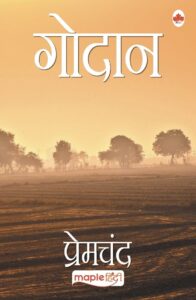
392 Pages | Hindi
Review by Ashok Rathi
Revisiting a Legend
A casual chat with a friend about the language of Hindi literature – where Premchand was held up as the gold standard – sparked my interest in revisiting him after almost forty years.
I began with his popular short stories, but soon arrived at his towering classic, Godan.
The idea behind this brief reflection is not to explore the linguistic brilliance of Premchand, nor to retell the storyline or indulge in yet another literary analysis of this much-discussed masterpiece. Rather, it is to dust off our memories of having read it long ago, and to view history once again through the story of Godan.
This remarkable novel opens a window into the socio-economic, cultural, and political life of both rural and urban India during the late colonial period—particularly the 1920s and 1930s.
The narrative unfolds through two contrasting yet connected vantage points: the humble view from Hori’s hut, and the grand view from Rai Sahab’s kothi.
Through these alternating frames, Premchand presents a panoramic portrait of a nation in flux. The struggles of Hori, a poor peasant, intertwine with those of landlords and the urban elite. From their intersecting lives emerges a powerful social chronicle that mirrors the realities of pre-independence India.
1. Feudal Agrarian System and Rural Poverty
By the 1920s and 30s, the age-old feudal zamindari system was crumbling under its own weight. It had bred deep poverty and relentless indebtedness among peasants who lived at the mercy of middlemen and moneylenders, prey to exorbitant interest rates, recurring droughts, and epidemics.
Hori’s simple dream of owning a cow—a symbol of dignity and prosperity—drags him further into the whirlpool of debt. Premchand paints this tragic cycle of servitude with brutal honesty, showing how the system left no path to escape.
He was deeply aware of British colonial policies that maximised land revenue (lagan) through cruel, dehumanising mechanisms. The moral compass of society had collapsed. It was, as Premchand shows us, a “survival of the fittest” world where everybody exploited everybody.
“When your neck is being trampled under the tyrant’s heel, the safest course is to keep on tickling his feet.”
This bitter wisdom captures Hori’s fatalistic acceptance of oppression—his quiet endurance amid despair.
2. Caste and Social Hierarchy
The rigid caste system ruled over rural life, dictating every social interaction and ensuring power remained with the upper castes. Landlords and priests colluded to maintain their control, while the lower castes were systematically excluded from opportunity and dignity.
Hori, a low-caste farmer, lives in a world where Brahmins like Matadin wield both spiritual and economic power, manipulating villagers through religion. The cow—sacred yet divisive—becomes a flashpoint for conflict.
Premchand’s handling of caste is objective, never polemical. Through moments of quiet realism, he suggests that while caste barriers begin to blur, money and muscle soon replace birth as the new social currency.
“A man is not a man without wealth, power and education. We are no better than bullocks, born to be yoked.”
It’s a line that echoes the despair of millions caught in invisible chains.
3. Gender and Patriarchy
Women in Godan inhabit a world hemmed in by patriarchy – but Premchand’s women are far from meek.
Dhania, Hori’s wife, stands out as a pillar of resilience, her strength often counterbalancing her husband’s weakness. She argues, questions, and defies.
Jhunia, from a lower caste, breaks moral conventions by eloping with Gober. Yet Dhania, after initial anger, accepts her—a remarkable act of empathy and defiance in that social milieu.
At the other end of the social ladder, Malti, an educated and independent woman, represents the changing face of urban India—liberated, flirtatious, yet emotionally unanchored.
Premchand’s portrayal of women is strikingly modern. They are not passive victims, but complex, moral anchors in a crumbling society.
4. Colonial Exploitation and the Rural-Urban Divide
Under British rule, the countryside bled—over-taxed, impoverished, stripped of industry. The rural economy decayed even as the urban middle class began to rise, buoyed by new professions, education, and early industry.
This duality is vividly captured in Premchand’s twin perspectives—the dusty desolation of Hori’s hut and the comfortable verandas of Rai Sahab’s kothi.
Between them stretches the gulf of inequality.
In the city, we meet enlightened characters like Malti, Mr Mehta, and Rai Bahadur—symbols of an India awakening intellectually yet detached from its rural soul. The contrast is sharp, painful, and prophetic.
5. Religion, Symbolism, and Cultural Values
At the heart of Godan lies the cow, both as a literal and symbolic presence. In 1920s India, the cow had become a political and religious emblem, often deepening communal divisions. Premchand, a secular humanist, transforms it into a universal metaphor—of purity, sacrifice, and exploitation.
For Hori, the cow is not just wealth—it is salvation, a connection to divine order.
The title Godan – the ritual of gifting a cow to a Brahmin at death – embodies this yearning for spiritual redemption. Yet Premchand turns the symbol on its head, exposing the hypocrisy of those who exploit faith for gain.
“We have to do what the world calls duty, though our necks are broken under the burden.”
In this single line lies the tragedy of countless Horis—dutiful, crushed, and yet unwavering in their moral endurance.
My Conclusion : A Mirror to India
Godan is more than a novel—it is a historical document, a living chronicle of 1930s India.
The view from Hori’s hut—parched fields, hunger, ceaseless toil—contrasts starkly with the genteel comfort of Rai Sahab’s mansion.
Premchand encapsulates an era of extreme inequality, where human values eroded under poverty and power, yet the indomitable human spirit endured.
Reading Godan again after decades, I found it still speaks with startling immediacy. Its people breathe, its soil smells of sweat and hope, its questions remain painfully relevant.
It reminds us that literature, at its best, is not just about language—it is about truth.
And Premchand, through Godan, gave us one of the truest mirrors ever held up to Indian society.
About the Author: Ashok Rathi
 Ashok Rathi, born in 1952 in Vidisha, Madhya Pradesh, is a postgraduate in Chemistry and a seasoned textile chemist and colourist with nearly four decades of professional association with the textile industry in India and the Philippines. A world traveler and voracious reader, his intellectual curiosity spans history, philosophy, comparative religion, and socio-political thought.
A Core Committee member of the Nagpur Book Club, Ashok’s insights are marked by clarity, depth, and an ability to connect ideas across cultures and centuries. His reflections on history and human civilization often blend scientific precision with a philosopher’s curiosity — making his perspectives both incisive and deeply human