Book Review of ‘Go Set a Watchman, by Harper Lee’.
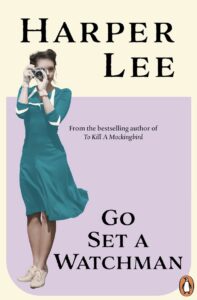 288 Pages | English
Review by Pushpa Rathi
‘Go Set a Watchman’, by Harper Lee invites us back into the world of Maycomb — now not through the eyes of a child, but through the more critical lens of an adult. This shifting perspective both deepens and complicates our view of familiar characters and places.
The novel forces us to ask: what happens when the moral anchors of our past no longer hold firm?
As one of its memorable lines puts it:
“Every man’s island, Jean Louise, every man’s watchman, is his conscience. There is no such thing as a collective conscious.”
With this in mind, let us revisit the journey of Jean Louise and her reckoning with family, place and values.
Plot Summary
Note: Jean Louise (formerly “Scout” in To Kill a Mockingbird) is the daughter of Atticus Finch and the sister of Jem. She is now 26 years old, staying in New York and working there. She returns to Maycomb for a two-week stay, after a gap of a few years. By this time her father is 72 years old and suffering from rheumatoid problems. Her aunt Alexandra asks her to come back to Maycomb as her father needs her. She has a childhood sweetheart Henry “Hank” Clinton, who wants to marry her, though she is not so sure. Her uncle Dr. Jack Finch is her go-to person in case of doubts.
One day she comes to know of a meeting being held in the town council: the incident involves her old black housekeeper Calpurnia (now very old and retired) whose grandson mowed down a drunk white person. That creates racial friction in Maycomb. In a council meeting (which she was not supposed to attend), a firebrand white person speaks and is endorsed by her father (Atticus) and Hank, who is a junior lawyer working with her father. This upsets Scout: she frets and fumes first at Hank, then at her father, as she is totally disillusioned with him. She had always considered him morally far above the people of town — someone who would not dream of stepping on people of other races. In her view he is the “watchman” of the town’s moral values.
The phrase “go set a watchman” is drawn from the Bible (Book of Isaiah) — one who envisages dangers and events, a sentinel on the lookout.
So fretting and fuming, 26-year-old Scout is brought to her senses by her uncle Jack (the physician and highly learned intellectual). He first tries to calm her down, but later gives her a firm slap, which brings her back to earth. She starts realising she must rely on her own moral compass.
Themes & Key Reflections
Disillusionment and Hero-Figures
Scout’s discovery that her father, Atticus Finch, is not the unblemished hero she’d long imagined is central. As the book states:
“As you grew up, when you were grown, totally unknown to yourself, you confused your father with God. You never saw him as a man with a man’s heart, and a man’s failings …”
This quote captures how Scout conflated Atticus with perfection — and how painful the unmasking becomes when reality fails the ideal.
Conscience and Individual Responsibility
Another significant line:
“What does a bigot do when he meets someone who challenges his opinions? He doesn’t give. He stays rigid. Doesn’t even try to listen, just lashes out.”
This underscores the novel’s insistence that individual conscience — not collective belief — must guide us. The novel’s title itself reminds us that you cannot rely on others (even revered others) to be your “watchman”: you must watch over yourself.
Changing Times, Changing Values
The values of each time and place differ; that we should not place anyone on such a high pedestal that when views differ both the pedestal and the pedestal-holder feel suffocated. Indeed, Scout realises:
“Remember this also: it’s always easy to look back and see what we were, yesterday, ten years ago. It is hard to see what we are. If you can master that trick, you’ll get along.”
Maturity and moral growth are personal responsibilities: “Nobody else can be your watchman.”
What I Took Away
Everybody needs to grow up to earn that morality and maturity.
The novel’s strength lies in showing that moral growth is not automatic — even when we’ve had exemplary role-models. The difficulty comes when we must view our heroes (parents, towns, traditions) with adult eyes and decide for ourselves. It’s nobody’s (not even your closest one’s) problem but your own.
As one of the characters puts it:
“Prejudice, a dirty word, and faith, a clean one, have something in common: they both begin where reason ends.”
That tension between inherited faith/tradition and personal reason is exactly what Jean Louise confronts.
My Verdict
‘Go Set a Watchman’ can be read as a more mature, and perhaps darker, counterpart to ‘To Kill a Mockingbird’. Its revelations about Atticus, about Maycomb, about Jean Louise herself — may unsettle us, especially if we preferred the nostalgic glow of the earlier novel. But that is exactly its strength: the discomfort reminds us that moral clarity is hard, compromises abound, and our heroes are human.
Can we keep someone on a pedestal if we must doubt them? And if we cannot, must we then build our own moral stance?
In short, this is a book for readers who grew up with Scout and now feel themselves grown-up too. It asks: Who do you believe in? And when that belief falters, will you stand on your own feet?
A compelling, provocative read — less of a comforting return and more of a awakening. Read it not for reassurance, but for challenge. And after you close the final page, ask yourself: Am I my own watchman?
About the Author: Pushpa Rathi
 Mrs. Pushpa Rathi is an avid reader, world traveler, and Core Committee member of the Nagpur Book Club. A postgraduate in Botany, she discovered her love for literature early in life, encouraged by her parents and teachers in Bramhapuri. Growing up in the Bhaiya family, founders of the Nevjabai Hitkarini educational institutions, she was shaped by an environment rich in learning and books.
She reads widely in Marathi, Hindi, and English, with a special fondness for history, culture, and fiction. Her reviews are known for their insight, clarity, and genuine love for the written word. Passionate about nurturing young minds, she actively works to encourage children to develop a lifelong reading habit. When not reading or mentoring young readers, she enjoys music and meaningful conversations.