Book Review: Gandhi: The Years That Changed the World (1914–1948), by Ramachandra Guha
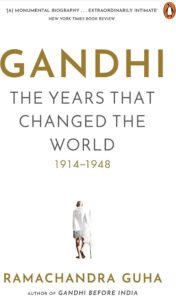
Pages: 890
Review by Anil Saxena
“Majboori nahin, majbooti ka naam hai Gandhi.”
— Prof. Purushottam Agrawal
I am told that if you want to understand the political history of modern India, you cannot do without reading the works of Gandhi, Nehru, and Ambedkar—and whatever is written or spoken about them. The recent biography of the Mahatma by Ramachandra Guha is a continuation of his earlier volume that covered Gandhi’s early years and time in South Africa.
Guha, in this monumental 890-page work, narrates in the preface how painstakingly he searched for new material on one of the most written-about, adored, debated, and curiously observed figures of the 20th century.
After Gandhi’s death, his secretary Pyarelal collected many boxes of correspondence and papers. Guarded possessively, they were never shared widely. Eventually, these were handed over to the Nehru Memorial Library and Museum (NMLM). From this treasure trove, Guha drew his material, producing what is truly a magisterial biography of Gandhi’s most crucial years.
The Gandhi Who Emerges
This book gives us not only a unique glimpse into Gandhi’s life but also into the roles of luminaries who interacted with him—as contemporaries, disciples, or adversaries.
When Gandhi arrived in India at the age of 45, he sought the blessings of his mentor Gopal Krishna Gokhale, and then traveled tirelessly across the country to understand its soul. From this journey emerged his vision of swaraj and Ram Rajya. His puny, emaciated frame, toothless grin, and frail legs became one of the most endearing and enduring images of the 20th century.
Passion and Multitasking
The singular trait of Gandhi’s personality was his passionate nature. He was passionate about meeting people, arguing, evolving his thoughts, fasting, spinning, and always being on the move. In this sense, he was India’s foremost multitasker.
Soon after his arrival, he started three journals simultaneously—Young India (English), Navjeevan (Gujarati), and Harijan—all of which he continued till his death. These were not just political platforms but also forums for advice, debate, and even personal guidance. Gandhi could answer queries on politics and spirituality with the same sincerity as he discussed brahmacharya, becoming something of an “agony uncle” for his readers.
Religion and Gandhi
Gandhi was a devout Hindu, drawing inspiration from the Gita, Puranas, and the lives of saints and avatars. Yet, he was unafraid to criticize Hindu dogmas.
His strongest stance was against untouchability:
“I do not want to be reborn. But if I am, I wish to be born an untouchable, so that I may share their sorrows, sufferings, and affronts.”
He sought to reform Hinduism so that Dalits received dignity and equality. But entrenched caste interests were too powerful, and Gandhi’s efforts often fell short.
Hindu-Muslim Amity
For Gandhi, no religion was superior. He saw them all as paths to the same truth. He admired Christ’s sacrifice and the Sermon on the Mount as much as the Gita. He knew early on that Hindu-Muslim unity was essential for India’s survival.
A Spartan Lifestyle
Gandhi led a deliberately austere life. He wore only a loincloth to identify with the poorest. He recycled scraps of paper, counted every matchstick, and despised waste. Truly, he was the “father of recycling” before being called the Father of the Nation.
Tolerance of Adversaries
Remarkably, Gandhi bore no rancor toward even his harshest critics. Churchill dismissed him as a “half-naked fakir,” yet Gandhi remained unfazed. At home, his biggest critics included Ambedkar and Jinnah, but Gandhi never responded with bitterness.
Argumentative and Witty Gandhi
Gandhi was argumentative, relentless in debate, and never gave up easily. Yet once a discussion ended, he was the first to forgive.
He also had a wonderful sense of humor and gift of repartee. His childlike smile and witty remarks disarmed even stiff British viceroys. Once, when carrying his own lunchbox to a viceroy’s palace, Gandhi quipped about simplicity, turning the occasion into a gentle lesson.
Admirers and Global Impact
Einstein, Romain Rolland, Charlie Chaplin, Bernard Shaw, Aldous Huxley, Ho Chi Minh, and others admired him deeply.
Einstein’s tribute remains immortal:
“Generations to come will scarce believe that such a one as this ever in flesh and blood walked upon this earth.”
Personal Complexities
Even Gandhi was not free from personal struggles. In his fifties, he experienced a fleeting romantic attachment, quickly averted by Rajaji’s intervention. His obsession with brahmacharya and sexual experiments caused embarrassment to his followers but did not deter him.
His relationship with his sons, particularly Harilal, was fraught. Critics argue Gandhi was authoritarian at home, even as he preached compassion to the world.
Principles of Swaraj
The planks of his movement included:
- Means as important as ends – “Sullied means can never lead to clean ends.”
- Truth as compass – his guiding light in politics.
- Non-violence with rationality – never rigid or fetishistic.
- Religious unity and Dalit equality – central to his moral universe.
- Village economy and khadi – symbols of self-reliance.
He preferred to delay independence rather than compromise on these principles.
Methods of Penance
Whenever Gandhi faltered or faced resistance, he fasted—sometimes unto death. Admirers saw this as moral force; critics called it blackmail. But fasting remained his most potent weapon.
Gandhi’s Contemporaries
- Tagore respected Gandhi but criticized his reliance on spinning and superstitious beliefs.
- Nehru was his chosen heir but often disagreed, especially on industrialization and socialism.
- Ambedkar was perhaps his severest critic, dismissing Gandhi’s efforts for Dalits as inadequate.
- Subhash Bose admired Gandhi despite differences, famously calling him the “Father of the Nation.”
Controversies and Questions
- Why Nehru over Patel? Gandhi chose Nehru as PM for his youth, egalitarianism, mass popularity, and international outlook.
- Bhagat Singh’s execution? Contrary to popular belief, Gandhi pleaded for clemency, and Nehru visited Singh in prison.
- Was Gandhi racist? Early writings show prejudice, but his later evolution proves otherwise. Gandhi himself admitted:
“I make no fetish of consistency. If I am true from moment to moment, I do not mind all the inconsistencies flung at me.”
Trivia
- First called Mahatma: by Pranjeelal Mehta, not Tagore.
- “Father of the Nation”: first used by Subhash Bose.
- Nobel Prize: nominated multiple times, never awarded.
Legacy
In today’s strife-torn, nuclear-armed, and divided world, Gandhi’s philosophy is more relevant than ever. His methods of satyagraha and non-violence inspire movements for justice globally, from Martin Luther King Jr. to Nelson Mandela.
As Guha shows, Gandhi’s simplicity, sagacity, and moral courage continue to enrich humanity, just as the teachings of Buddha and Christ have for centuries.
My Conclusion
This is Guha’s best work yet—a collector’s item. Richly researched, deeply human, and written with grace, Gandhi: The Years That Changed the World is essential reading for anyone seeking to understand not just Gandhi, but modern India itself. I recommend this book.
Rating: ⭐️⭐️⭐️⭐️½ (4.5/5)
Author Bio: Anil Saxena
 Anil Saxena is a retired Principal Chief Conservator of Forests and Head of Forest Force (HoFF), Maharashtra.
A lifelong nature lover and prolific reader, he brings depth, clarity, and insight to every book he reviews. As a Core Committee member of the Nagpur Book Club, he is known for his comprehensive reviews that make even complex subjects accessible and engaging.
Anil Saxena divides his time between Nagpur, Mumbai, and New York, enjoying the company of his children and grandchildren while continuing to explore the world of literature.