Book Review of ‘Fahrenheit 451’, by Ray Bradbury
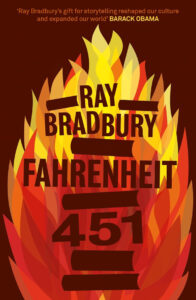
Pages: 212
Review by Anil Saxena
The Eternal Struggle Over Books
There has always been a struggle between lovers of books and those who hate them—so much so that some take enormous glee in burning them. History is replete with such incidents, yet books have never lost their power to invoke contrary emotions, both equally strong.
There are those who seek to control everything that makes human beings liberal, progressive, independent, and inquisitive. Such minds fear books because books compel people to question obscurantism, tyranny, and authoritarianism. The torching of books is equivalent to a regression into barbarism and the complete closing of the human mind.
Almost all countries—even the most civilized democracies—ban books if not burn them, like Nazi Germany. Governments of all hues may boast of lofty liberal constitutions, but it requires great sagacity to retain equanimity when faced with the barrage of criticism that books encourage. Books that awaken citizens to their rights and deserving freedoms remain a constant irritant to autocrats.
As Bradbury reminds us through Captain Beatty’s sharp words:
“A book is a loaded gun in the house next door. Burn it. Take the shot from the weapon.”
A World Without Books
Fahrenheit 451 is a dystopian science fiction novel written in 1953. In it, Bradbury depicts a country in an indeterminate time where books are considered anathema and are burned wherever found.
Conventionally, firemen are known for quenching fires, but in this novel they become agents of destruction—burning books with mechanical hounds (eight-legged robotic creatures), kerosene, and giant flamethrowers. They burn houses, books, and even people—a chilling symbol of extreme censorship and control of dissent.
The society described has lost all its critical faculties. Like zombies, people just listened and obeyed. Entertainment meant consuming recycled, hackneyed shows, laced with trashy and mindless advertisements. Like the chained prisoners in Plato’s allegory of the cave, citizens had no access to books to regenerate their minds or glimpse the proverbial sunlight. They lived without grudge, curiosity, or questioning.
Bradbury’s words sting:
“You don’t have to burn books to destroy a culture. Just get people to stop reading them.”
Montag’s Awakening
The protagonist, Guy Montag, is a married fireman. He and his team are experts in ruthlessly burning books—until he meets Clarisse, a young girl who changes his life forever. She makes him realize the beauty of Mother Earth, the freshness of air, the aroma of soil, and, above all, restores his curiosity about the world.
Clarisse urges him to look for deeper meaning in life, to question societal norms, and to break away from mindless trash. In his awakened state, Montag frantically searches for books, collects them secretly, and seeks like-minded individuals to keep the spirit of literature alive.
As Montag himself reflects:
“There must be something in books, things we can’t imagine, to make a woman stay in a burning house; there must be something there. You don’t stay for nothing.”
Allies in Rebellion
Montag finds Dr. Faber, a retired professor also intent on saving books from obliteration. Together they attempt—through not entirely foolproof methods—to restore books to society. Their efforts, however, are eventually thwarted.
Captain Beatty, Montag’s shrewd superior, senses his change. With wit and brilliance, Beatty argues against the greatness of books. He likens them to a tree with much foliage but little fruit. His contrarian arguments are masterpieces of rhetoric. Yet when persuasion fails, Beatty orders Montag’s house burned along with his rescued books. Montag, in desperation, kills Beatty and flees, hunted by mechanical hounds, helicopters, and soldiers.
The Exiled Book Lovers
While fleeing, Montag meets a group of people sitting by a fireside in a remote forest. They are book lovers, but also practical realists. They remind Montag that books have always had enemies—burned and destroyed since the dawn of civilization. Yet, they tell him, books cannot be destroyed forever.
The group preserves books by memorizing them. Each person crams a chapter, verse, or entire book into memory. With thousands of such volunteers, the heritage of literature—Greek, Latin, English, French, and beyond—survives within living minds.
One of them tells Montag:
“We’re nothing more than dust jackets for books, of no significance otherwise,”
This realization—that memory can safeguard literature from annihilation—offers a fragile but hopeful path forward.
Dystopian Company: Orwell and Huxley
This book was written in 1953, while George Orwell wrote 1984 in 1948 and Aldous Huxley wrote Brave New World in 1931. All three novels depict futuristic societies ruled by authoritarian control.
In 1984, Big Brother watches every move of subdued citizens. In Brave New World, Huxley depicts a society where attempts to engineer a perfect world end in soulless conformity. Together, they convey a warning: people must be free to make their own choices and follow their passions.
All three works are classics, prescient in portraying a future that mirrors reality more than we wish to admit.
Parallels to Today
We live in a world where censorship of creative works—cinema, theater, stand-up comedy, cartoons, and books—has become inescapable. People are increasingly thin-skinned, and governments grow more hostile toward free expression. Courts overflow with complaints seeking bans on one book, film, or performance after another.
Stand-up comedians and cartoonists face their worst times. Ironically, as politics becomes more comical, cancel culture has become ubiquitous. Pegasus spyware used to track political opponents is chillingly reminiscent of 1984. The flood of trash, deepfakes, and manipulated content on WhatsApp and YouTube today recalls the nightmare of Brave New World.
The scenarios in these novels differ in intensity, but their spirit remains alive in our present-day reality.
Compelling and Powerful
I read this cult classic in two sittings. Though a sci-fi novel, its appeal may not be universal. However, for readers accustomed to futuristic depictions of dystopian life, it will be deeply engaging. If nothing else, the plot itself is compelling, and I admired it most for its powerful theme.
Rating: ★★★½
Author Bio: Anil Saxena
 Anil Saxena is a retired Principal Chief Conservator of Forests and Head of Forest Force (HoFF), Maharashtra.
A lifelong nature lover and prolific reader, he brings depth, clarity, and insight to every book he reviews. As a Core Committee member of the Nagpur Book Club, he is known for his comprehensive reviews that make even complex subjects accessible and engaging.
Anil Saxena divides his time between Nagpur, Mumbai, and New York, enjoying the company of his children and grandchildren while continuing to explore the world of literature.