प्रबोधनकर ठाकरे लिखित ‘देवळांचा धर्म आणि धर्माची देवळे’ या पुस्तकाची समीक्षा | Devalancha Dharma aani Dharmachi Devale, by Prabodhankar Thackeray – Book Review in English
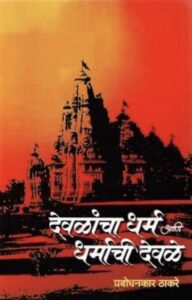 Marathi | 24 pages
Review by Rohit Tokhi
My Tryst with Marathi
When a dear friend gifted me Devalancha Dharma aani Dharmachi Devale, I accepted it with gratitude — and a wave of nostalgia. Marathi was a language I had once known intimately, the language of my school essays and everyday speech, but over time, it had quietly receded from my world. Opening the book felt like revisiting an old home — comforting, yet layered with the patina of years gone by.
The first few pages were unexpectedly humbling. Words that once rolled off my tongue now appeared strange and distant. I paused, guessed, searched my memory for their meanings, sometimes even smiled at my own forgetfulness.
But as I read on, something remarkable happened — the rhythm of the language returned. The words began to sing again. I started to hear the cadences of Marathi prose, its earthy logic, its lyrical intensity. Soon, I wasn’t just reading — I was listening to Prabodhankar himself, speaking across time. What began as a struggle with forgotten vocabulary turned into a profound personal reconnection — with the language, its power, and the reformist fire of one of its greatest voices.
Prabodhankar Thackeray – The Social Reformer
Prabodhankar Thakre (1885–1973), born Keshav Sitaram Thakre, was a pioneering Marathi writer, social reformer, and rationalist thinker — and the father of Bal Thackeray, founder of the Shiv Sena. A fearless critic of superstition, caste orthodoxy, and blind ritualism, Prabodhankar used his pen and platform to awaken social consciousness in early 20th-century Maharashtra. His writings, including Devalancha Dharma aani Dharmachi Devale, continue to challenge and inspire readers to question the purpose and practice of religion in a changing society.
The Heart of the Book: Questioning Religion, Power, and Morality
At its core, Devalancha Dharma aani Dharmachi Devale is a fearless and uncompromising examination of organized religion — particularly the way temples and religious institutions have often become entwined with social hierarchy, hypocrisy, and exploitation.
Prabodhankar does not attack faith itself; rather, he distinguishes sharply between “Devalancha Dharma” (the religion of temples — ritualistic, institutional, power-driven) and “Dharmachi Devale” (the temples of religion — the moral, spiritual, humanistic essence of true faith). His critique is not nihilistic but reformist — a call to rediscover the ethical foundations of dharma buried beneath ritual and orthodoxy.
He writes, in one of his most piercing reflections:
“देवळांचा धर्म — तो केवळ सोपस्कारांचा खेळ नाही; पण धर्माची देवळे उभी करावी, ती हृदयाने यावीत असे मला वाटते.”
“The religion of temples is not a mere play of rituals; I believe the temples of dharma should rise within the heart.”
Throughout the book, Thakre blends biting satire with moral clarity. He points to the contradictions of a society that builds grand temples while ignoring human suffering. He questions the sanctity of priestly privilege, challenges inherited beliefs, and dares to imagine a spirituality rooted in equality rather than hierarchy.
Strengths and Occasional Challenges
Strengths
-
Moral Courage and Vision
Thakre’s greatest strength lies in his unwavering moral vision. He writes not as an academic but as a conscience-keeper, asking why religion so often loses its humanity. His tone is fiery, but his goal is liberation — from ignorance, exploitation, and fear.
-
Cultural Authenticity
The book breathes Marathi culture — its idioms, humour, and cadence. Thakre critiques from within the tradition, not outside it. His arguments are steeped in lived experience, which makes them ring with authenticity.
-
A Call to Thought, Not Blind Rebellion
What impressed me most was his balance. He does not demand that readers abandon faith; he invites them to understand it. His message is not atheistic but reformist — that true worship begins with moral awareness, not ritual conformity.
-
Timeless Relevance
Though written decades ago, the book feels startlingly contemporary. Its questions about commercialization of religion, social inequality, and moral emptiness remain painfully resonant today.
Challenges
For modern readers, especially those unfamiliar with the socio-religious context of early 20th-century Maharashtra, a few references might feel dated. The Marathi itself is richly idiomatic and occasionally archaic, which can slow the pace. Yet, that is part of its charm — every unfamiliar word is a doorway to rediscovery.
My Emotional Journey While Reading
Reading Devalancha Dharma aani Dharmachi Devale felt less like studying a book and more like engaging in a moral dialogue. There were passages that stung — reflections that forced me to confront uncomfortable truths about how easily we mistake custom for conscience.
And yet, there was also hope — a belief that reform, sincerity, and compassion can still guide faith. Thakre’s voice, firm but humane, echoed with the conviction that spiritual progress is meaningless without social justice.
By the end, I found myself humbled. The book not only sharpened my awareness of the world outside but also turned the mirror inward. It reminded me that reform begins not in protests or sermons, but in self-scrutiny.
What Remains With Me
Days after finishing the book, its questions still echo in my mind. What do I worship when I pray? Do my rituals reflect understanding, or habit? Where, in my life, do I mistake the structure for the spirit?
Prabodhankar’s greatest gift is that he does not leave us comfortable. He disturbs, provokes, and yet ultimately uplifts. His call is not to abandon temples, but to build new ones — within ourselves.
A Book That Honors the Heart
Devalancha Dharma aani Dharmachi Devale is more than a critique of religion; it is a work of deep moral introspection. Through sharp wit and unwavering honesty, Prabodhankar Thakre urges us to see beyond stone and ceremony, and to rediscover the living essence of dharma — compassion, justice, and truth.
For me, the book became not only a rediscovery of Marathi but also a reaffirmation of faith — not faith in ritual, but in reason, empathy, and human goodness. It reminded me that the truest temples are not built of stone, but of conscience.
For Whom (and Why) I Recommend It
- For readers of Marathi — this book is a cultural and intellectual landmark.
- For those interested in faith and reform — it shows how questioning can coexist with belief.
- For anyone who has drifted from their mother tongue Marathi — it is a beautiful way to rekindle that bond through meaning and purpose.
Even if you are rusty in Marathi, persevere — the language rewards effort with insight.
About the Author: Rohit Tokhi
 Rohit Tokhi is a Tech Entrepreneur, Web Developer, and co-founder of the Nagpur Book Club, as well as the Founder of the Nagpur Film Society. A lifelong reader and cinema enthusiast, he is equally passionate about sports administration and social work, having organized several community initiatives, including blood donation camps.
An avid bibliophile, Rohit often reads several books at a time and organizes monthly book meets that bring together hundreds of fellow readers. Through his expertise in digital marketing, he is dedicated to recognizing and giving exposure to talent in art, books, and culture.
Beyond his professional and social pursuits, he enjoys vegetarian cooking, exploring world cuisines, traveling, photography, and is an avid admirer of Vintage and Classic cars, Formula 1, and the art of motoring.