Book Review of ‘Culture – A New World History’, by Martin Puchner
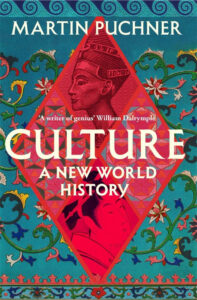
Pages: 476 | Buy Book
Book Review by Anil Saxena
I listened to the audiobook version of Culture: A New World History by Martin Puchner and liked it a lot.
The author deals with the issues of culture, and without defining it rigidly, he uses 17 chapters to convey its essence and peculiarities—how culture transmits from one group of people to another, from one nation to another, from the ancient to the modern. Strangely enough, this transmission often occurs between the most unlikely strands of people who are otherwise separated by space and time.
The Nature of Culture
Some cardinal principles about culture stand out from this book:
- Culture is never pure. No culture can avoid blending—it is syncretic in nature and thrives in diversity.
- It is not a pond, but a river. Culture flows continuously.
- To me, it is like a fragrance— a fragrance that wafts and is impossible to curb.
- It can also be compared to water— so light that it takes the shape of the receptacle it is poured into and gets transmuted easily.
Take Buddhism for instance. Though its source is one, the Buddhism practiced in India differs from what is practiced in China, and what is followed in Japan is different from both. When culture is transmitted to an alien place and takes root, it evolves and prospers according to the overall proclivity, taste, and genius of its milieu.
Setbacks to Cultural Transmission
Culture suffers greatly when its transmission is disrupted. Natural calamities, loss of manuscripts due to decay or improper preservation, and the vulnerability of fibrous materials on which ancient texts were written—all contribute to its setbacks. Human factors like ignorance, prejudice, barbarism, and savagery also disrupt the cultural flow.
Yet, a unique feature of culture is its resilience. Once the obstructions are removed, culture begins to flow again.
Cultural Connections Across Time and Space
In his 17 chapters, Puchner presents countless fascinating instances where culture flows uninhibitedly from one people to another, enriching both.
The Bust of Nefertiti and Monotheism
In one chapter, he explores the bust of Nefertiti, drawing a connection between her religious movement and Judaism’s monotheism.
Feroz Shah Tughlaq and the Pillar of Ashoka
Another gripping chapter recounts how Feroz Shah Tughlaq (1368 CE) discovered a huge Ashokan pillar in the Himalayan foothills and transported it with great difficulty—using a carriage with 400 wheels pulled by 200 men—to Delhi, erecting it near the Jama Masjid.
Tughlaq wished to decipher the script, but it took another 600 years before James Prinsep, an English Indologist and Greek scholar, cracked the code in 1830. The deciphering of Ashoka’s edicts on rocks and stupas stunned the world. It revealed Ashoka as a Buddhist and one of the most righteous kings of his time. Interestingly, Vedic India never used stone masonry, but the presence of stone pillars and arches shows the influence of Greek and Persian cultures. The script, now known as Brahmi, was found to resemble Greek.
The Spread of Buddhism: A Cultural Epic
One fascinating chapter describes how Buddhism spread to China and then to Japan. The Chinese monk Hiuen Tsang reached India in 678 CE after a 16-year journey filled with hardship. Along with predecessors like Kumarajiva and Fa-Hien, he carried Buddhist manuscripts, scrolls, and artifacts back to China.
Even more inspiring is the tale of a Japanese monk named Anin, who clandestinely crossed the sea to China. He remained hidden in a monastery for 7 years before managing to carry precious manuscripts and the Lotus Sutra back to Japan.
From Japan, Buddhism spread to other nations in the Far East. Though India was the source of Buddhism, each nation adopted and practiced it in a manner suited to its own temperament.
Surprising Finds: Goddess Lakshmi in Pompeii
In another chapter, archaeologists discovered a 9-foot ivory idol of Goddess Lakshmi in the ash of Pompeii. Not only this, 19th-century archaeologists found clear evidence of Greek influence on Roman art and culture.
Despite being militarily vanquished by the Romans, the Greeks influenced Roman poetry, philosophy, and aesthetics. Virgil, the most famous Roman poet, modeled his Aeneid on Homer’s Odyssey.
In 79 CE, when the volcano erupted in Pompeii, Rome had flourishing trade with India. India exported spices, medicines, jewelry, and idols to Rome, while Rome offered only hard currency.
The Intellectual Melting Pot of Baghdad
During the reign of Caliph Al-Mamun (son of Harun Al-Rashid), Baghdad became one of the most intellectually stimulating places on earth. Situated on the Silk Route, it absorbed knowledge from all directions:
- From China – Paper
- From India – Astronomy, arithmetic, and the decimal system
- From Greece – Euclidean geometry and philosophy
The Caliph, fond of Aristotle, translated and preserved Greek philosophical works. Ironically, by then Byzantine rulers had turned pagan Greece toward Christianity, which often suppressed classical thought. Thus, an emergent Islamic culture gave fresh life to a dying one.
Christianity in Ethiopia: An Early Convert
Christianity became dominant in Rome around 378 CE, but it found an early follower in Ethiopia. In 400 CE, King Ezana of the Aksumite dynasty embraced Christianity. Ethiopia had strong ties with Jerusalem, going back to the legendary union of Queen Sheba and King Solomon. It is said their offspring carried the Ten Commandments to Ethiopia.
In the 20th century, Black Jamaicans and Black Panthers traced their roots to Ethiopian Christianity.
Aztec Civilization: A Tale of Destruction and Revival
The chapter on Aztecs reveals that their civilization was as ancient and advanced as the Egyptian, Sumerian, and Harappan ones. In the 15th century, the Aztecs had floating cities, gold artifacts, and a prosperous urban culture. The Spanish invaders burned, looted, and spread smallpox, nearly erasing this culture.
Yet, years later, an Aztec monk, while visiting the Pope’s Library, found stolen cultural assets. He gradually revived the remnants of his heritage and resurrected Aztec culture from the brink.
From Haitian Revolution to Japanese Waves
There’s more. Want to know how the Haitian independence in 1804 links to the French and American revolutions and the abolition of slavery? Read the book.
Curious about the connection between Japanese wave paintings of the 19th century and the Avant-Garde movement in the West? It’s here too.
George Eliot and Soyinka on Culture
The book also examines how literary giants interpreted culture.
George Eliot (author of Middlemarch) believed in understanding history through scientific evidence, philology, and archaeology. To her, the lives of common men and women were more significant than the rise and fall of empires.
Wole Soyinka, the Nigerian Nobel Laureate, fiercely opposed cultural hierarchies. Are Chinese porcelain better than African masks? Soyinka thought such debates were futile. Every culture, he argued, evolves from its unique local conditions.
“Only fools and bigots reject the cultural treasures of others.”
The Future of Culture: Seeds in the Youth
The last chapter asks: What does the future hold for culture? How can we preserve it against the odds of climate change, nuclear holocaust, war, and ignorance?
Digital storage may be unreliable due to changing formats and languages. Oral traditions have their limitations. The ultimate solution lies in cultivating the young.
“Like planting a seedling, if a seed of love for culture is sown in the young at an early stage, there is no need to fear its disappearance.”
Today’s generation, obsessed with STEM (Science, Technology, Engineering, Mathematics), must remember that too much technology and too little culture creates bigots, barren minds, and soulless nations.
“Culture is like salt—its quantity may be small, but its absence makes life worthless.”
Final Thoughts
This is not a pedantic book. It is engaging, persuasive, and easy to read. It’s a must-read for all—especially the young—to rescue themselves from intolerance and tribalism.
Author Bio: Anil Saxena
 Anil Saxena is a retired Principal Chief Conservator of Forests and Head of Forest Force (HoFF), Maharashtra.
A lifelong nature lover and prolific reader, he brings depth, clarity, and insight to every book he reviews. As a Core Committee member of the Nagpur Book Club, he is known for his comprehensive reviews that make even complex subjects accessible and engaging.
Anil Saxena divides his time between Nagpur, Mumbai, and New York, enjoying the company of his children and grandchildren while continuing to explore the world of literature.