Book Review of ‘A Chequered Brilliance’, by Jairam Ramesh
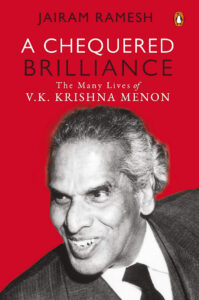
744 pages | Buy Book
Review by Anil Saxena
A Portrait of a Paradox: VK Krishna Menon
A Chequered Brilliance by Jairam Ramesh is a biography of one of India’s most controversial yet influential figures—VK Krishna Menon. A politician, diplomat, and freedom stalwart of a unique kind, Menon was a disciple, soul-mate, and, to a certain extent, an agent of Nehru. Yet, it was this very proximity to power and his penchant for courting controversy that brought Nehru much ill-repute, especially during the latter years of his tenure.
Research and Richness: Unearthing the Man
The author has undertaken meticulous research, delving into archives and correspondences—not just from Indian sources but also from all possible British publications and unpublished material—to bring to light the many dimensions of this colorful and complex man.
Early Influences and Revolutionary Spirit
VK Krishna Menon was a Keralite born in the last decade of the 19th century and was brilliant in whatever he did from the outset. Even while young, he was noticed by Annie Besant—founder of the Theosophical Society—and became her disciple. But like her other brilliant disciple, J. Krishnamurti, Menon also left her fold early to immerse himself in studies and, later, in becoming the voice of India’s freedom movement in Britain.
He made an impressive academic career in economics at the London School of Economics and also studied law. In England, he moved in elite circles of left-oriented liberal intellectuals like Harold Laski, Sir Stafford Cripps, Bertrand Russell, and many others. He founded the India League, which espoused the cause of India’s freedom, aiming to influence British opinion-makers and generate sympathy for the freedom struggle.
Menon and Nehru: A Historic Bond
As early as the 1930s, Menon came into active contact with Pandit Nehru. This started a lasting friendship that endured until Nehru’s death in 1964. He was impressed by Nehru’s intellect, vision, and liberal scholarship, while Nehru was equally enamored by Menon’s dazzling brilliance and potential. They corresponded regularly—hundreds of letters that speak volumes about their extraordinary relationship.
The Other Side of Brilliance
While Menon was erudite, meticulous, and intelligent enough to push all the right buttons in service of Nehru, he also became a liability. He was edgy, thin-skinned, emotionally insecure, and suffered from a constant persecution complex. His egotism and narcissism, his failure to appreciate camaraderie, and his knack for making enemies faster than friends created a toxic atmosphere for both his superiors and subordinates—barring a few exceptions.
“He was capable of becoming an emotional ruin in the midst of the best of his times. Hats off to Panditji and his patience in dealing with his emotional blackmails, which were frequent, with the aplomb of a perfect friend, philosopher, and guide—sometimes, even like an agony aunt.”
Friends, Enemies, and Fractured Loyalties
Menon could count among his friends the crème de la crème of British liberal society, including Lord and Lady Mountbatten. Yet, he was equally detested by almost all right-wing Congress stalwarts, barring Rajaji. In Britain, he was branded a communist and was shadowed by the conservative government. Even his socialist peers in India were not warm to him—many who started as friends eventually became foes, thanks to his mercurial personality. By the late 1950s, almost Nehru’s entire Cabinet distrusted and disliked him.
Diplomatic Brilliance: Achievements Abroad
Despite the chaos he sometimes invited, his achievements were enormous. Menon kept the flame of India’s freedom alive in Britain, forged a valuable rapport with the Mountbattens, and often conveyed Nehru’s views during the transition of power.
According to Jairam Ramesh, his role in the formation of the Constituent Assembly was as strong as that of Pandit Nehru.
As a diplomat, Menon argued India’s case on Kashmir single-handedly at several global forums. His legendary address at the UN is now part of folklore. He helped elevate India’s diplomatic status during the Korean crisis, sitting at the same table as the global superpowers in matters of peace.
Jeep Scandal and Public Humiliation
But the controversies were never far behind. While serving as High Commissioner to the UK, Menon led a spartan life, often subsisting only on tea and buns. Yet, he became embroiled in the infamous Jeep Scandal—a case that dogged him like the Bofors issue in later years. The Comptroller and Auditor General (CAG) commented stringently on the deal involving the purchase of second-hand jeeps for the Indian Army in the early 1950s. Parliament discussed it endlessly, and it became a potent weapon in the hands of his detractors.
The Disaster of the China War
The biggest setback in Menon’s career came as Defence Minister during India’s humiliating defeat to China in 1962. He began well in the role and initially got along with the top generals. But his personality, political maneuvering, and tendency to play favorites alienated the Army’s leadership.
“It would be apt to describe the Menon era in Defence as nothing short of a disaster.”
Gen. J.N. Chaudhry, Gen. Thimayya, and Gen. Thorat all had high-profile run-ins with Menon. One notable scandal involved Gen. Thimayya writing his resignation directly to Nehru and a scoop in The Statesman—penned under a pseudonym by Gen. Chaudhry—exposing the fissures within. This embarrassment was compounded by Menon’s continued missteps, culminating in India’s debacle against China. Nehru’s own political reputation suffered deeply as a result.
Jairam Ramesh rightly points out that Finance Minister Morarji Desai, who refused to fund defense modernization citing Gandhian principles, must also share the blame.
A Better Fit Elsewhere?
Ramesh opines that, given Menon’s keen perception of developmental economics, he may have been a better candidate for the Planning Commission than for Defence.
Lucid Style and Hidden Gems
The book is written in a lucid style and offers fascinating tidbits about the personalities of that era. Some gems include:
- Menon once drafted a letter about committing suicide—unsent but preserved.
- Pamela Mountbatten’s amusing description of Nehru’s Shirshasana (headstand) routine.
- The myth that Nehru sent a frigate to England for Edwina Mountbatten’s funeral—debunked by Ramesh.
- Nehru’s private frustrations, even contemplating resignation.
- Menon was once rumored to be Nehru’s successor—alongside unlikely names like Thimayya and Kaul.
- Menon’s role in acquiring the MiG-21s from Russia against American and British pressure.
A One-Man Diplomatic Army
Menon was a brilliant orator, deeply insightful in world affairs, and often acted as a one-man army demolishing India’s critics at the UN. His diplomatic stature and influence earned India much respect globally. However, his flaws were equally monumental.
“Krishna Menon’s achievements were gigantic, his failures monumental.”
Life After Nehru
After Nehru’s death, Menon couldn’t find a way back into Parliament and returned to practicing law. He spent his later years campaigning for global disarmament, against apartheid, and for Vietnam and Palestine.
He remained silent about his relationship with Nehru, which he considered too personal to be discussed publicly. While others—Kaul, Dalvi, and Mullik—published their versions of events, Menon never responded.
He remained a peacenik throughout, opposing the Pokhran nuclear test.
Biographer Jairam Ramesh’s Integrity
According to one author, a biographer’s job is not to assert, but to ascertain. Jairam Ramesh has remained loyal to that dictum till the end.
The Final Word: Menon and Nehru—An Inseparable Saga
Menon’s name, fame, achievements, and failures are inseparable from Nehru’s legacy. Much of his life was spent alongside Nehru, who, despite his failings, had immense regard for him.
“Nehru opened up to him like to no one else… They were intellectual partners and ideological soulmates in a way that Nehru was with nobody else… Krishna Menon’s achievements were gigantic, his failures monumental.”
Verdict
It is a fascinating chronicle of its time, a saga of a man who witnessed both the heights of diplomacy and the abyss of political isolation. From being a master of global diplomacy to becoming Mr. Nobody, VK Krishna Menon’s story is as tragic as it is brilliant.
Highly recommended
Author Bio: Anil Saxena
 Anil Saxena is a retired Principal Chief Conservator of Forests and Head of Forest Force (HoFF), Maharashtra.
A lifelong nature lover and prolific reader, he brings depth, clarity, and insight to every book he reviews. As a Core Committee member of the Nagpur Book Club, he is known for his comprehensive reviews that make even complex subjects accessible and engaging.
Anil Saxena divides his time between Nagpur, Mumbai, and New York, enjoying the company of his children and grandchildren while continuing to explore the world of literature.