Book Review of Rebecca Goldstien’s book, 36 Arguments for the Existence of God
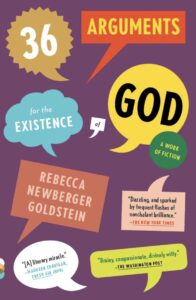
506 pages | English
Review by Anil Saxena
Why I picked up this book
I was inspired to read this book after reading Enlightenment Now by Steven Pinker. I have already written a review of Enlightenment Now, whose author is an inveterate optimist presenting a robust case for the future of humankind despite prevailing despondency. His arguments are logical, well-balanced, unemotional, and supported by sturdy empirical evidence. Ms. Goldstein, the author of the present book, is Pinker’s spouse, and he has strongly recommended this work.
Fiction Reopens an Ancient Debate
The book is a work of fiction, but as the title suggests, it reopens one of humanity’s most enduring debates: whether God exists. What is best for humankind; science, reason, enlightened education, and progress, or belief, faith, religion, spiritualism, and mysticism?
The book also examines the value of religion in human life and introduces a new term: “faithiest,” contrasted with “atheist” and “theist.” Here, the protagonist is a non-believer who refutes arguments supporting the existence of God, yet is simultaneously haunted by the spiritual yearning present among men and women. Somewhere, he acknowledges this deep thirst for meaning—one that mundane science has not yet fully answered. Thus, faitheism, as evolved in the book, emerges as an intellectual stance blending faith with atheism or agnosticism.
Goldstein writes with philosophical wit and irony, reminding us that
Arguments about God are never only about God – they are about us.
Cass Seltzer: An Atheist With a Soul
This fictional narrative is gripping, largely because of its strong and polemical characters who hold deeply contrasting yet passionately defended positions.
At the center stands Cass Seltzer, a psychologist of religion; an atheist, yet one with a soft corner for spiritualism and humanity’s need for it. He is essentially an “atheist with a soul.” He is not a diehard, logic-chopping atheist who dismisses the sincerest human quest for transcendence.
Cass is the author of the fictional bestseller The Varieties of Religious Illusions. While rational and opposed to ritualistic and miraculous claims of religion, he believes that the mystical longings of humanity deserve respect. Science and logic, though powerful, appear insufficient to answer the deeper existential anxieties of human beings.
As the narrative subtly suggests:
Reason explains much, but longing explains the rest.
In essence, Cass believes there remain aspects of both the inner and outer universe that lie beyond the current reach of science. They may someday be deciphered; but at present, the reasoning mind is still limited.
A Personal Reflection on Faith and Doubt
I relate deeply to this line of thinking. In my happier, carefree moments, I hover around atheism and agnosticism. But when I am emotionally or physically low – during illness, loss, or unexplained sadness – I find myself yearning for something to hold onto: some mercy, some benediction, some assurance.
Anthropologists, positivists, and psychoanalysts may offer explanations, but they still have a long way to go in truly comforting a person in distress who seeks emotional succor rather than theoretical clarity.
Identity, Background, and Academic Life
Cass is Waldenian, Jewish, and connected to a deeply traditional Hasidic sect – one that practices strict endogamy. His mother, however, may not be Jewish. He is a professor at Princeton University and receives an offer from Harvard University.
The Women Around Cass
Cass is surrounded by some of the most attractive and intellectually formidable women in the novel.
Roz Margolis
Roz Margolis, an anthropologist, is imbued with scientific curiosity and is fascinated by longevity research. Older than Cass, she admires and loves him deeply. A bohemian personality, she studies cultures across distant lands, exploring both their diversity and underlying unity. She possesses remarkable vivacity and a zest for life.
Lucinda Mandelbaum
Lucinda Mandelbaum is a rare blend of beauty and intellect – a goddess of game theory, an avowed atheist, and a brilliant logician capable of challenging the strongest analytical minds. She loves Cass but loves her career more. Too ambitious to compromise her intellectual independence, she refuses to play second fiddle – even to someone she loves.
When she senses that Cass’s rising fame may overshadow her own, she walks away from the relationship.
Professor Jonas Clapper: Mysticism Versus Reason
Perhaps the most controversial and polemical character in the book is Cass’s former mentor, Professor Jonas Clapper – a cantankerous Jewish scholar and a master of mystical verbosity.
He speaks in metaphors and parables, weaving interpretations from theology and mythology with theatrical flourish. A consummate windbag, he cloaks intellectual obscurity in dazzling rhetoric.
To him, mathematics and science are mundane compared to mystical imagination. He believes spiritual symbolism surpasses empirical reasoning. In his worldview, the imaginative mystic outranks even the greatest scientist.
He positions himself as a savior of souls bewildered by the theories of Charles Darwin.
Goldstein’s portrayal is clearly satirical. Clapper represents those absorbed in metaphysical abstraction while dismissing empirical knowledge. He quotes Martin Heidegger and Matthew Arnold with equal authority, and in one sweeping claim considers Carl Friedrich Gauss pedestrian compared to William Blake.
Readers familiar with The Magic Mountain by Thomas Mann will immediately recognize the resemblance to the Jesuit polemicist Naphta.
The Child Prodigy and the Promise of Reason
Another memorable thread involves a cherubic mathematical prodigy; the son of a leader from a conservative Waldenian sect. Cass and Roz recognize his brilliance and persuade his hesitant father to allow formal mathematical training.
Through their efforts, the young boy gains access to university education and the opportunity to fully develop his intellectual potential.
This subplot beautifully symbolizes the tension – and possible reconciliation – between tradition and modern knowledge.
The Intellectual Debate at the Heart of the Novel
The strongest element of the book lies in the debate between Cass, the atheist, and his confident and verbose antagonist who argues for God’s existence. Their philosophical duel—sharp, witty, and intellectually charged – forms the core dramatic engine of the narrative.
Who ultimately prevails is best discovered by reading the book rather than revealing it here.
As Goldstein cleverly reminds readers:
Arguments rarely end belief – but they often refine it.
A Gallery of Characters and an Unresolved Question
I liked the book not only for its wide range of fabulous characters – both eccentric and humane – its pithy dialogues, and its engagement with one of the most debated themes in human history, but also because the central question remains unresolved and perhaps always will.
That ambiguity is precisely what gives the novel its philosophical depth.
The Appendix: A Treasure for Philosophical Readers
The book concludes with an extraordinary appendix where the author outlines all 36 arguments for the existence of God – from ontological and cosmological to teleological frameworks – while also exposing their logical limitations and contradictions.
This appendix is a true intellectual gem and extremely useful for readers interested in philosophical debate on either side of the question.
My Final Thoughts
If questions of faith, tradition, skepticism, and the search for values that define human existence intrigue or disturb you, this book is well worth reading.
I certainly enjoyed it.
Author Bio: Anil Saxena
 Anil Saxena is a retired Principal Chief Conservator of Forests and Head of Forest Force (HoFF), Maharashtra.
A lifelong nature lover and prolific reader, he brings depth, clarity, and insight to every book he reviews. As a Core Committee member of the Nagpur Book Club, he is known for his comprehensive reviews that make even complex subjects accessible and engaging.
Anil Saxena divides his time between Nagpur, Mumbai, and New York, enjoying the company of his children and grandchildren while continuing to explore the world of literature.